
Privileged access management (PAM) is a cybersecurity discipline that secures, monitors, and controls the credentials and sessions of identities with elevated permissions — the accounts that can change infrastructure, access sensitive data, or reconfigure security controls. Where general identity and access management (IAM) governs who can log in, PAM governs what the most powerful identities can do once they're in. Three things matter most: PAM's core controls center on vaulting, session monitoring, and just-in-time access; its primary operational goal is reducing blast radius so a single compromised credential cannot cascade into a full environment takeover; and the first concrete action for any team is a complete inventory of every privileged identity, human and non-human, across the environment.
Key Takeaways
A PAM program that starts with complete discovery, enforces JIT across all Tier 0 accounts, and integrates session logs into a SIEM delivers measurable blast-radius reduction within 90 days of pilot launch.
| Point | Details |
|---|---|
| Discovery comes first | Scan all systems before enforcing policy — most environments surface more privileged accounts than expected. |
| JIT replaces standing privileges | Time-limited, task-specific elevation shrinks the window an attacker can exploit a stolen credential. |
| Non-human identities are high priority | Service accounts and API keys often hold persistent admin rights and must be vaulted and rotated on the same schedule as human accounts. |
| Compliance output is built in | Session recordings and privilege logs satisfy HIPAA, CMMC, PCI DSS, and SOC 2 audit requirements when configured correctly. |
| Securetechie manages PAM for SMBs | Securetechie operates discovery, vaulting, rotation, and 24/7 session monitoring for Southern California businesses as a fully managed service. |
Table of Contents
- Why privileged access management is urgent right now
- What core PAM capabilities should you expect?
- How does a PAM system actually work?
- Which identities actually need PAM controls?
- How to implement PAM: a practical lifecycle
- Common PAM implementation challenges and how to address them
- How to evaluate a PAM approach for your organization
- The part of PAM advice most teams get wrong
- Securetechie brings enterprise-grade PAM to Southern California SMBs
- Sources
Why privileged access management is urgent right now
Credential theft targeting privileged accounts is the most direct path to catastrophic breach. An attacker who compromises a domain admin account can move laterally across the entire network, escalate to additional systems, and reach domain controller level within hours. PAM interrupts that chain at multiple points: vaulting removes standing credentials from reach, session brokering isolates the connection, and JIT controls shrink the window of exposure to the duration of a single task.
Compliance pressure adds urgency. HIPAA requires audit trails for access to protected health information. PCI DSS mandates strict privileged-user controls and session logging. CMMC Level 2 and above require demonstrable least-privilege enforcement. GDPR expects organizations to show who accessed personal data and when. PAM produces the immutable, timestamped session records that satisfy all of these requirements. Cyber insurers now expect granular privileged-user visibility and audit trails as a baseline underwriting condition, meaning organizations without PAM controls face higher premiums or coverage exclusions.
The SMB gap is significant. Research from IT Security Guru found that fewer than half of small and midsize businesses use formal PAM controls, leaving the majority exposed to disproportionate identity risk despite being frequent targets. That gap is exactly where attackers focus.
What core PAM capabilities should you expect?
A mature PAM program delivers eight functional controls. Understanding what each one does, and which ones are non-negotiable for smaller organizations, helps teams prioritize budget and implementation effort.
- Discovery and inventory: Automatically scans Active Directory, cloud consoles, and endpoints to surface every privileged account, including service accounts and API keys that teams often overlook.
- Vaulting and secret management: Stores credentials in an encrypted vault so administrators never handle raw passwords directly. Covers password rotation and secure storage for both human and machine identities.
- Automated rotation: Rotates passwords and secrets on a defined schedule or after each use, eliminating long-lived credentials that attackers can exploit after a breach.
- Session brokering and recording: Proxies privileged connections through a controlled jump host, records the full session, and makes recordings searchable for forensic review.
- JIT and ephemeral credentials: Grants time-limited, task-specific privileges that expire automatically. JIT access patterns include broker-and-remove, ephemeral accounts, and temporary elevation, each aligning with Zero Trust by treating every access request as a distinct transaction.
- MFA for privileged sessions: Requires a second factor at the point of privilege elevation, not just at login, so stolen passwords alone cannot unlock admin access. See how MFA integrates with privileged sessions in practice.
- Policy engine with RBAC/ABAC: Evaluates access requests against role-based and attribute-based rules, enforcing least privilege without manual approval for every routine task.
- Analytics and alerting: Flags anomalous privileged activity, such as off-hours logins, unusual command sequences, or access to systems outside a user's normal scope.
How does a PAM system actually work?
PAM combines people, processes, and technology through four core architectural components: the vault, the broker, the policy engine, and connectors to target systems. Understanding how these interact makes it easier to map a PAM deployment to your existing environment.
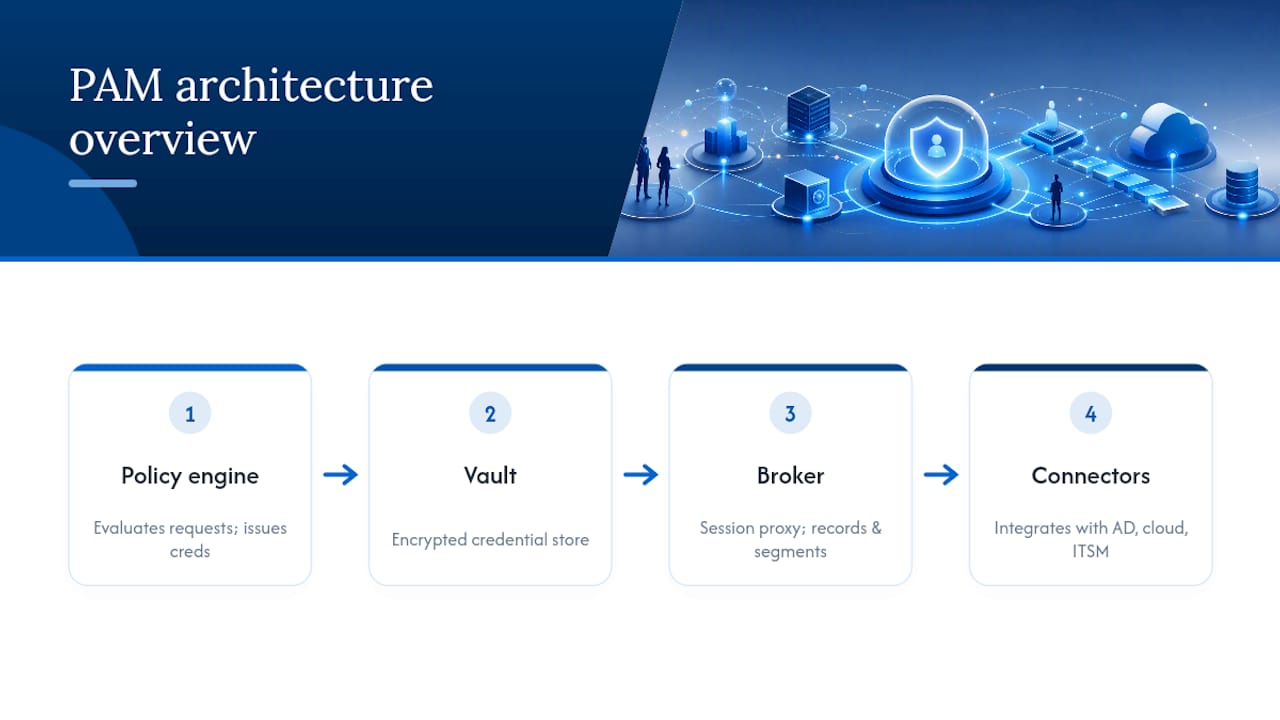
The vault is the encrypted credential store. It holds passwords, SSH keys, API tokens, and certificates. No administrator retrieves credentials directly from the vault; instead, they request a session, and the vault injects credentials into the broker on their behalf.
The broker (sometimes called a jump host or session proxy) sits between the administrator and the target system. It establishes the privileged connection, records the session, and terminates access when the session ends or the JIT window expires. The broker also enforces network segmentation, so administrators never have direct network access to production systems.

The policy engine evaluates every access request in real time. It checks the requester's role, the target system's classification, the time of day, the device posture, and any active approval workflows before granting or denying elevation. This is where Zero Trust principles are operationalized: no standing trust, every request verified.
Connectors integrate the PAM platform with Active Directory, cloud consoles (AWS IAM, Azure AD, GCP), CI/CD pipelines, and ITSM tools like ServiceNow. They translate PAM policy decisions into the native access controls of each target system.
A typical JIT session flows like this: an administrator submits an access request through the PAM portal, specifying the target system and the task. The policy engine verifies the request against role and approval rules, then provisions a time-limited credential or temporary group membership. The broker opens the session, records it, and monitors for anomalous commands. When the task is complete, or when the time window expires, the credential is revoked and the session is terminated. The recording is stored in the audit repository, indexed and searchable.
Pro Tip: Configure your policy engine to require a ticket number from your ITSM system for any privileged session on production systems. This creates an automatic link between every privileged action and an approved change record, which dramatically simplifies compliance audits.
Which identities actually need PAM controls?
The answer is broader than most teams initially expect. PAM controls apply to any identity that can change system configuration, access sensitive data, or affect the security posture of the environment.
Human privileged accounts:
- Domain administrators and enterprise admins in Active Directory
- Local administrator accounts on servers and workstations
- SaaS super-admins (Microsoft 365 Global Admin, Salesforce System Administrator, Google Workspace Super Admin)
- Database administrators with direct SQL access to production databases
- Network engineers with console access to firewalls and switches
Non-human privileged identities:
- Service accounts running scheduled tasks, backup jobs, or application services
- API keys used by third-party integrations or internal applications
- CI/CD pipeline credentials (GitHub Actions secrets, Jenkins service users, Terraform state access)
- Cloud IAM roles with broad permissions attached to EC2 instances or Lambda functions
- IoT and OT device credentials with network or system access
Shared and emergency accounts:
- Break-glass accounts for emergency access when normal authentication fails
- Shared admin accounts used by multiple team members without individual attribution
- Cloud root accounts (AWS root, Azure subscription owner) that should almost never be used for routine tasks
In a typical SMB environment, a 50-person professional services firm might have 15 named IT admin accounts, 40 or more service accounts running background processes, a handful of cloud IAM roles, and several SaaS super-admin seats. Discovery almost always surfaces more privileged identities than the team expected.
How to implement PAM: a practical lifecycle
A sound PAM program follows a structured lifecycle: discover first, then classify and enforce, then automate and monitor. Skipping discovery and jumping straight to enforcement is the most common reason PAM projects stall.
- Discover all privileged identities. Run automated scans across Active Directory, cloud IAM, SaaS admin consoles, and endpoints. Document every account, its owner, its permissions, and whether it is actively used. Expect to find accounts that nobody on the team knew existed.
- Classify and prioritize. Tier accounts by risk: domain admins and cloud root accounts are Tier 0; server local admins and DBA accounts are Tier 1; application service accounts are Tier 2. Start enforcement at Tier 0.
- Pilot on the highest-risk targets. Deploy vaulting and session brokering for Tier 0 accounts first. This delivers immediate blast-radius reduction with a manageable scope and builds team confidence before broader rollout.
- Enforce least privilege and JIT. Remove standing admin rights. Replace them with JIT elevation tied to approved requests. For cloud environments, apply API key rotation and ephemeral role assumption rather than persistent IAM user credentials.
- Automate rotation and monitoring. Configure automated password rotation on a schedule appropriate to each account tier. Connect session recordings and privilege events to your SIEM for correlation with other security telemetry.
- Integrate with SSO and MFA. PAM should sit downstream of your identity provider. Single sign-on handles authentication; PAM handles authorization and session control for privileged actions. MFA at the point of privilege elevation is non-negotiable.
- Roll out to remaining tiers and review regularly. Expand coverage to Tier 1 and Tier 2 accounts. Schedule quarterly access reviews to remove stale accounts, adjust permissions, and validate that JIT policies reflect current job functions.
For most SMBs, a phased rollout from discovery through Tier 0 enforcement takes 60–90 days. Full coverage across all tiers typically requires 6–12 months, depending on environment complexity and the number of legacy systems involved.
Pro Tip: Treat non-human identities as a separate workstream. Service accounts and API keys often have no clear owner, which makes remediation politically easier — there is no person to push back. Tackle them early to reduce your attack surface quickly.
Common PAM implementation challenges and how to address them
Most PAM projects encounter predictable obstacles. Knowing them in advance lets you plan mitigations before they become blockers.
- Legacy applications that don't support modern auth: Some older applications hard-code credentials or cannot accept injected passwords from a vault. Mitigation: use session isolation (the broker connects on behalf of the user without exposing the credential) and document exceptions with compensating controls such as enhanced logging and network segmentation.
- Credential sprawl across SaaS platforms: Admin accounts in dozens of SaaS tools are often managed outside any central directory. Mitigation: prioritize SaaS discovery in Phase 1, use your identity provider's SCIM provisioning to centralize lifecycle management, and vault SaaS admin credentials the same way you vault server credentials.
- Non-human identity ownership gaps: Service accounts frequently have no assigned owner, making it unclear who should approve rotation or JIT requests. Mitigation: assign ownership during discovery, even if the owner is a team rather than an individual, and enforce ownership as a required field in your PAM platform.
- Scaling session recording storage: Full session recordings generate significant data volume. Mitigation: apply tiered recording policies — record all Tier 0 sessions in full, use metadata-only logging for lower-risk sessions, and set retention periods aligned to your compliance requirements.
- Cultural resistance from administrators: Admins accustomed to standing privileges often view JIT as friction. Mitigation: involve the admin team in policy design, keep JIT approval workflows fast (under two minutes for pre-approved request types), and demonstrate that the controls protect them as much as the organization.
Pro Tip: Watch for "shadow" admin accounts created outside your provisioning process — local admin accounts added directly on servers, or SaaS admin seats granted without an IT ticket. These are the accounts attackers find first. A monthly automated scan that compares discovered accounts against your authoritative list catches them before they become a liability.
How to evaluate a PAM approach for your organization
Selecting the right PAM model requires matching deployment architecture, integration depth, and operational capacity to your environment. The evaluation framework below applies whether you are assessing a platform, a managed service, or a hybrid approach.
Decision axes to evaluate:
- Deployment model: Cloud-native PAM is fastest to deploy and scales without infrastructure investment. On-premises suits environments with strict data-residency requirements. Hybrid covers organizations with both cloud workloads and legacy on-prem systems.
- Integration depth: Confirm native connectors for your Active Directory version, cloud providers (AWS, Azure, GCP), and any SaaS platforms where you have super-admin accounts. CI/CD integration matters if your developers use pipeline credentials.
- Non-human identity support: Verify that the solution vaults API keys, rotates service account passwords, and supports dynamic secrets for DevOps workflows, not just human admin sessions.
- Compliance reporting output: Confirm that session recordings, access logs, and privilege-event data can be exported in formats your auditors accept for HIPAA, CMMC, SOC 2, or PCI DSS reviews. Securetechie's compliance audit services can help map PAM output to specific regulatory requirements.
- Managed vs. self-operated: SMBs without a dedicated security team often benefit from a managed PAM service, where a provider operates the vault, monitors sessions, and handles rotation, rather than purchasing a platform and staffing it internally.
KPIs to measure PAM effectiveness:
- Reduction in standing privileged accounts (target: zero standing Tier 0 privileges within 90 days of pilot)
- Mean time to provision a JIT session (target: under two minutes for pre-approved request types)
- Percentage of privileged accounts covered by vaulting (target: 100% of Tier 0 and Tier 1 within six months)
- Audit completeness: percentage of privileged sessions with a full recording or metadata log
- Number of new privileged accounts discovered in monthly scans (a declining trend indicates maturing governance)
Pro Tip: Ask any PAM provider or managed service how they handle emergency (break-glass) access. The answer reveals how mature their operational model is. A well-designed program has a documented, audited break-glass procedure — not just a shared spreadsheet with emergency passwords.
The part of PAM advice most teams get wrong
Most PAM guidance focuses on the platform: which vault to buy, which session proxy to deploy, which vendor's JIT module to license. That framing misses the actual problem.
The organizations that fail at PAM are not the ones that chose the wrong tool. They are the ones that started enforcement before finishing discovery, or that vaulted human admin accounts while leaving 80 service accounts with persistent domain-admin rights sitting untouched in Active Directory. The tool is not the program. The program is the discipline of knowing every privileged identity in your environment, assigning ownership to each one, and enforcing a consistent policy across all of them.
Zero Standing Privileges is the right operational target. Every identity, human or machine, should have no entitlements by default and receive ephemeral privileges only for the duration of a specific, approved task. That model is harder to reach than most teams expect, but it is the only one that actually reduces blast radius in a meaningful way. JIT is not a feature to turn on — it is a governance posture that requires process, ownership, and ongoing review to sustain.
For SMBs specifically, the managed-service model is often more realistic than self-operating a PAM platform. The operational overhead of running a vault, managing connectors, reviewing session recordings, and handling rotation failures is substantial. A managed provider that already has the tooling, the processes, and the 24/7 monitoring capacity can deliver the same security outcome at a fraction of the internal staffing cost.
Securetechie brings enterprise-grade PAM to Southern California SMBs
Small and midsize businesses in Southern California face the same privileged-account risks as enterprise organizations, but rarely have the internal team to build and operate a PAM program from scratch. Securetechie's managed cybersecurity services include a structured PAM engagement: discovery and inventory of all privileged identities across your environment, a prioritized pilot on your highest-risk accounts, and full managed operations covering vaulting, rotation, session monitoring, and compliance reporting.
The team integrates PAM controls with your existing Active Directory, cloud consoles, and SIEM, and aligns session audit output to HIPAA, CMMC, SOC 2, and other frameworks your organization must satisfy. With 24/7 monitoring and a local Southern California team, Securetechie handles the operational complexity so your staff can focus on the work that requires their attention. To start with a privileged-identity discovery assessment, contact Securetechie through the managed IT services page.