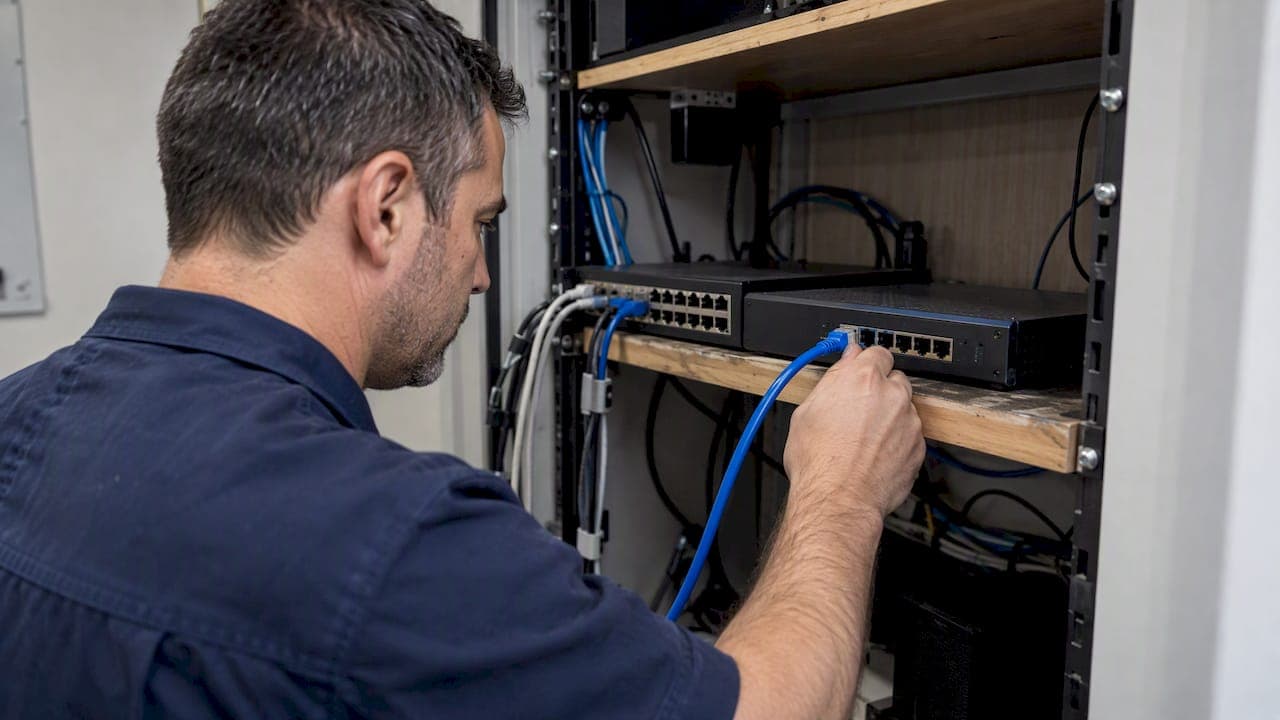
A next-generation firewall (NGFW) builds on traditional packet filtering with deep packet inspection, intrusion prevention, application and identity awareness, TLS inspection, and threat-prevention services such as sandboxing. These capabilities matter most when the firewall operates as a visibility platform woven into a zero-trust or SASE architecture rather than as an isolated box at the network edge.
TL;DR:
- TLS inspection matters because over 95% of web traffic is encrypted; exempt banking, healthcare, apps using certificate pinning, and latency sensitive services.
- Pilot TLS decryption with one department or network segment, then measure latency, throughput, and false positives before expanding inspection across the organization.
- Compare rated throughput with IPS and TLS decryption enabled against your own traffic, and verify centralized logging plus SIEM and EDR integration.
- Traditional firewalls remain useful for core segmentation, simple perimeter rules, and high throughput internal routing; reserve deeper NGFW inspection for higher risk traffic.
- Policies tied to identity follow people across networks, while device posture checks and SIEM logs inform access decisions and investigations.
Table of Contents
- Core NGFW Features Explained
- How NGFWs Differ From Traditional Firewalls
- Encrypted Traffic Inspection: Necessity, Trade-Offs, and Configuration
- Threat Prevention Services: IPS, Sandboxing, and Reputation Blocking
- Identity, Application Awareness, and Contextual Policy Enforcement
- Deployment Models and Integration With SASE and SD-WAN
- How to Evaluate NGFW Features: A Practical Checklist
- What We've Learned Cleaning Up Firewall Deployments
- NGFWs Are Visibility Platforms, Not Silver Bullets
- Getting Hands-On Help With NGFW Selection and Operation
- FAQ
- Sources
Core NGFW Features Explained
Traditional firewalls decide what to allow based on ports, protocols, and IP addresses. An NGFW adds several layers of inspection on top of that foundation, and each layer solves a different problem.
Deep packet inspection (DPI) looks inside the payload of network traffic rather than just the header, which lets the firewall identify the actual application generating a flow, even when that application tries to disguise itself on a common port. This is the mechanism that makes everything else on this list possible, because you cannot enforce a policy on traffic you cannot identify.
Application awareness and control extends DPI into policy. Instead of writing a rule for "port 443," an NGFW administrator can write a rule for "Salesforce" or "Dropbox" and allow or block that specific application regardless of which port or IP address it uses that day. TechTarget's definition of NGFWs frames this as one of the core additions that separates an NGFW from a traditional packet-filtering device, alongside integrated intrusion prevention and identity awareness.
Integrated intrusion prevention (IPS) inspects traffic for known exploit signatures and suspicious behavior patterns, then blocks the session automatically rather than just logging it. Because the IPS engine sits inline with the DPI engine, it can act on application-layer context that a bolted-on IPS appliance would miss.
TLS and SSL inspection decrypts encrypted sessions long enough to apply the above inspections, then re-encrypts the traffic before it continues to its destination. This step has become close to mandatory: NSS Labs-style research indicates that over 95% of web traffic now travels encrypted, which means a firewall that cannot inspect inside TLS is effectively blind to most of what crosses it.
URL filtering, content inspection, and data loss prevention (DLP) work together to block access to malicious or inappropriate sites and to stop sensitive data such as account numbers or health records from leaving the network in the first place. These controls depend on the TLS inspection layer being active, since most of the web traffic they need to evaluate is encrypted.
Sandboxing, sometimes called detonation, sends unknown or suspicious files to an isolated environment where they can run safely while the firewall watches for malicious behavior before deciding whether to deliver the file to the end user.
Threat intelligence feeds keep every one of these features current. Vendors push updated indicators of compromise, malicious domains, and attack signatures to the firewall automatically, so protection against a newly discovered threat does not wait for a manual policy change.
The features work as a set, not as a checklist:
- DPI identifies what is actually in the traffic, regardless of port.
- Application control turns that identification into enforceable policy.
- IPS blocks known exploits and abnormal session behavior inline.
- TLS inspection opens up encrypted sessions so the other layers can see inside them.
- URL filtering and DLP stop malicious destinations and data exfiltration.
- Sandboxing catches files that no signature has seen before.
How NGFWs Differ From Traditional Firewalls
The clearest way to understand the difference is by inspection layer. A traditional, stateful firewall operates mostly at the transport layer, tracking connections by IP address, port, and protocol. An NGFW adds application-layer inspection, which means it understands the application itself, not just the transport details carrying it.
That shift changes what a policy can say. A traditional firewall rule reads like "allow inbound traffic on port 443 from any address." An NGFW rule can read like "allow the finance team to use the approved banking application, block all other traffic claiming to use port 443 that is not actually TLS, and log unusually large file transfer attempts." NIST SP 800-41 describes this kind of granularity as part of the broader trade-off organizations face between simpler packet-filtering architectures and more capable but more complex application-aware gateways.
Prevention is the other major difference. On a traditional firewall, intrusion prevention, antivirus scanning, and content filtering are typically separate appliances or add-on modules that each require their own management console and their own update cycle. An NGFW integrates these services into a single inspection pipeline, which reduces the number of places a threat can slip through the cracks between systems.
Practical distinctions worth tracking when you compare the two:
- Inspection depth: port and protocol matching versus full application-layer visibility.
- Policy language: IP and port rules versus application, user, and content-based rules.
- Prevention services: separate bolt-on appliances versus a single integrated pipeline.
- Operational load: fewer consoles to manage, but more computing power needed to run deep inspection at line rate.
None of this makes a traditional firewall useless. Segmentation at the network core, simple perimeter rules, and high-throughput internal routing often still rely on simpler, faster devices, with NGFW capabilities concentrated at the points where traffic needs the deepest scrutiny.
Encrypted Traffic Inspection: Necessity, Trade-Offs, and Configuration
Over 95% of web traffic is now encrypted, according to NSS Labs-style testing, which means a firewall that skips TLS inspection is reviewing a small fraction of what actually passes through it. That single fact is why TLS inspection has moved from an optional feature to a baseline requirement for any firewall claiming next-generation status.
The trade-off is real, though. A firewall that breaks Microsoft 365 or a banking portal every morning will get its inspection turned off by week's end, which erases the security benefit entirely.
The fix is not to avoid TLS inspection, it is to configure it deliberately. Practitioner guidance from Zscaler recommends building a defined exemption list rather than inspecting everything by default: bypass decryption for privacy-sensitive categories like banking and healthcare, for applications that use certificate pinning (which breaks under inspection regardless of configuration quality), and for latency-sensitive traffic such as certain optimized Microsoft 365 categories. Session reuse and conditional decryption rules, applied selectively rather than globally, reduce both the performance hit and the false-positive rate. Our guidance on web content filtering covers similar exemption logic for URL categories that tend to break business applications when filtered too aggressively.

Pro Tip: Pilot TLS decryption on a single department or VLAN first, measure latency, throughput, and false-positive rates over a pilot period, and only expand the exemption list and inspection scope once those numbers look acceptable.
Testing before a full rollout matters more here than with almost any other firewall feature, since the cost of getting it wrong is either a security gap or a flood of help desk tickets.
Threat Prevention Services: IPS, Sandboxing, and Reputation Blocking
Modern attacks rarely announce themselves with a known signature, which is why NGFW threat-prevention services combine several detection methods rather than relying on any single one.
Intrusion prevention remains the first line of defense, using both signature matching for known exploits and behavioral analysis to flag sessions that look abnormal even without a matching signature. This catches a large share of commodity attacks and known malware delivery attempts before they reach an endpoint.
Sandboxing handles what signatures miss. When the firewall encounters a file or URL it has never seen, it can send that object to a cloud-based detonation environment, run it in isolation, and observe what it actually does before deciding whether to deliver it. This cloud-assisted approach is necessary because local hardware rarely has the capacity to run full behavioral analysis on every unknown file in real time.
Reputation and threat intelligence feeds close the loop by distributing what gets discovered. Once a sandbox or a security researcher identifies a new malicious domain or file hash, that indicator propagates to firewalls everywhere running the same intelligence feed, often within minutes.
Vendor documentation on modern threat-prevention architecture describes a layered approach that pairs cloud-assisted inline analysis with local machine-learning models, explaining that both are necessary because cloud analysis catches sophisticated, slow-moving threats while local models catch fast-moving exploits that cannot wait for a round trip to the cloud.
The combination looks like this in practice:
- Signature-based IPS blocks known exploits and malware delivery instantly.
- Behavioral IPS flags sessions that act abnormally even without a known signature.
- Sandboxing detonates unknown files in isolation before they reach a user.
- Local machine learning catches fast-moving threats without waiting on cloud analysis.
- Threat intelligence feeds push newly discovered indicators to every connected firewall.
Identity, Application Awareness, and Contextual Policy Enforcement
An IP address tells you almost nothing useful once employees work from laptops, home networks, and shared office space. User and group-based policies solve that problem by tying firewall rules to identity rather than to a device's network location, so the same person gets the same policy whether they connect from the office or from a coffee shop.
Context adds another layer on top of identity. Device posture checks, meaning whether a laptop has current patches and an active endpoint agent, can feed into the firewall's decision about what that device is allowed to reach. CISA-aligned guidance describes this telemetry exchange between firewalls and endpoint detection tools as central to zero-trust architecture, since it lets the network make conditional access decisions rather than static ones.
Application-aware policy also supports prioritization, not just blocking. A firewall that recognizes a video conferencing application can give it bandwidth priority over a bulk file sync running in the background, without needing a separate QoS appliance.
This context pays off during incident response, too. When a firewall logs activity by user and application rather than just by IP address, investigators can reconstruct what a specific account did across the network far faster, which matters for containing lateral movement once an attacker gets a foothold.
- User and group policies replace static IP rules with identity-based enforcement.
- Device posture checks feed into access decisions alongside user identity.
- Application-aware QoS prioritizes business-critical traffic automatically.
- Identity-based logging speeds up investigation during an active incident.
Deployment Models and Integration With SASE and SD-WAN
NGFW capabilities ship in several forms: physical appliances for data centers and larger offices, virtualized instances for private and public cloud workloads, and cloud-native firewall-as-a-service offerings that remove the hardware entirely. Most organizations end up running a mix, with appliances at larger sites and cloud-delivered firewalls protecting remote users and branch locations that do not justify dedicated hardware.
CISA's guidance on modernizing agency networks frames NGFWs as policy enforcement points within a SASE architecture, where firewall capabilities combine with SD-WAN routing, secure web gateways, cloud access security brokers, and zero-trust network access to form a single fabric rather than a collection of disconnected point products. In that model, the firewall is not the only control, it is one enforcement layer among several that share policy and telemetry, as detailed in discussions of next-generation firewall features for distributed teams.
SD-WAN routing decisions determine which traffic actually passes through NGFW inspection in the first place. Not every flow needs the same scrutiny, so organizations typically route high-risk traffic, such as general internet access, through full inspection while allowing trusted site-to-site traffic over more direct paths.
The choice between network-based and host-based enforcement depends on the use case: network-based NGFW inspection covers everything on a given segment regardless of device, while host-based controls follow a specific device wherever it connects. Our network segmentation plan walks through how to decide which segments need firewall-level inspection versus lighter controls.
- On-prem appliances fit data centers and larger sites with heavy traffic volume.
- Virtualized instances protect workloads running in private or public cloud.
- Cloud-delivered firewalls cover remote users and branches without dedicated hardware.
- SD-WAN routing determines which flows get full inspection versus a direct path.
How to Evaluate NGFW Features: A Practical Checklist
Vendor data sheets rarely reflect how a firewall performs once IPS, TLS decryption, and application control are all running at once against real traffic. A structured evaluation catches the gap between marketing numbers and operational reality.
- Confirm security efficacy under load. Verify IPS signature coverage, the actual scope of DPI, and how the device handles TLS decryption, not just whether it supports these features on paper.
- Test rated throughput with security features enabled. Independent enterprise firewall testing weighs results heavily toward encrypted traffic performance, since that reflects real-world conditions far better than throughput measured with inspection turned off.
- Check operational requirements. Confirm the platform supports centralized management, detailed logging, and automated policy updates, and that it integrates cleanly with your SIEM and EDR tools.
- Run a staged pilot. Start in a lab, move to a live pilot with a limited group, and track false-positive rates and latency before expanding.
- Review update cadence and support SLAs. Ask how quickly threat intelligence updates propagate and what response time the vendor commits to for critical issues.
Pro Tip: Request throughput numbers with IPS and TLS decryption both enabled, not the maximum throughput figure from the data sheet, since that number almost never reflects production conditions.
A firewall that passes this checklist under your own traffic mix tells you far more than any published benchmark.
What We've Learned Cleaning Up Firewall Deployments
Across firewall cleanup and policy remediation work, one pattern shows up again and again: NGFW features get enabled at install and then left untouched for years, which means the IPS signatures, application rules, and inspection exemptions in place no longer match how the business actually operates. Our firewall cleanup case study documents this kind of policy drift and what it took to bring rules back in line with current traffic patterns.
Two habits make the biggest difference going forward. First, pilot TLS inspection with a defined exemption list and measure false positives before expanding it network-wide, rather than flipping it on for everyone at once. Second, feed NGFW logs directly into a SIEM so an unusual pattern at the firewall gets correlated with endpoint activity instead of sitting in a log file nobody reviews. Our guide to SIEM detection and response covers how to tune that pipeline so real threats surface instead of getting buried in alert noise.
NGFWs Are Visibility Platforms, Not Silver Bullets
The industry habit of treating an NGFW purchase as the finish line for network security misses the point of the technology. An NGFW earns its value by generating visibility, telling you what applications are running, who is using them, and what is hiding inside encrypted sessions, and that visibility only matters if it feeds into the rest of a layered defense. Buy the box, enable every feature at once, and skip the measurement step, and you will likely end up either blind to real risk or drowning in false positives. Test TLS inspection deliberately, route the telemetry into detection tools that can act on it, and treat the firewall as one enforcement point among several rather than the entire defense.
— Alex
Getting Hands-On Help With NGFW Selection and Operation
Choosing and tuning next-generation firewall features takes ongoing attention, not a one-time install, and that is where a managed security partner earns its keep. We run Network Security Solutions for small and mid-size businesses across Southern California, with the same proactive, catch-it-before-it-breaks philosophy we apply across every engagement.
Here's what that looks like in practice:
- Network Security Solutions for firewall selection, deployment, and ongoing policy management.
- Cybersecurity Solutions covering endpoint detection, incident response, and risk assessment alongside firewall operations.
- Compliance & Security Audits for organizations that need firewall configurations to satisfy HIPAA, GDPR, SOC 2, or CMMC requirements.
Our team monitors IT systems around the clock, so TLS inspection exemptions, IPS tuning, and policy drift get caught and corrected before they turn into an outage or a breach. If you want a straight read on whether your current firewall setup matches what your business actually needs, reach out to discuss a network security assessment.
FAQ
What is the difference between a next gen firewall and a standard firewall?
A standard firewall filters traffic based on IP address, port, and protocol, operating mostly at layer 4 of the network stack. A next-generation firewall adds application-layer inspection, integrated intrusion prevention, identity-aware policies, and TLS decryption, which lets it see and control what is actually happening inside the traffic rather than just where it is going.
What should I check before choosing a next-generation firewall?
Confirm the firewall's rated throughput holds up with IPS and TLS decryption both enabled, since independent testing weighs results toward encrypted traffic for this exact reason. Also verify centralized management, logging, and SIEM or EDR integration, since those operational features determine how well the firewall fits into your existing security stack.
What are the top next generation firewalls available today?
Vendor rankings shift from year to year and depend heavily on the specific environment being protected, so there is no single definitive list that holds steady across every use case. A more reliable approach is to test the specific features your environment needs, such as TLS inspection accuracy and throughput under load, rather than relying on a generic top-five list.
Why is encrypted traffic inspection necessary in an NGFW?
Most web traffic today is encrypted, and research indicates over 95% of it travels over TLS, which means a firewall that cannot decrypt and inspect that traffic is effectively blind to most threats crossing the network. TLS inspection has to be configured carefully, though, since poor configuration can introduce high false-positive rates and break legitimate applications.
How do NGFWs support compliance with regulations like HIPAA and GDPR?
NGFWs support compliance by enforcing access controls, logging activity in detail, and preventing sensitive data from leaving the network through DLP and content inspection, all of which regulators expect as part of a documented security program. The firewall alone does not satisfy a framework like HIPAA or GDPR, since those require broader administrative and technical controls, but it forms a core piece of the technical safeguard layer auditors look for.
Sources
- Nsslabs
- The Journey to Zero Trust - Using SASE in a Modern TIC 3.0 Solution
- NIST SP 800-41, Revision 1, Guidelines on Firewalls and Firewall Policy