
Network segmentation limits how far an attacker can move once they get inside your network, and it shrinks the blast radius of any single compromised device. The fastest path to real protection: inventory every asset, isolate your most critical systems first, apply least-privilege access between zones, and turn on monitoring before you write a single enforcement rule. Everything below walks through how to prioritize, build, and validate that plan.
TL;DR:
- Prioritize inventory and classification of all assets to ensure correct zoning based on data sensitivity and business criticality.
- Protect high-value assets such as payment systems, patient records, and domain controllers before extending segmentation to general office network traffic.
- Use phased implementation: start with monitoring mode, validate policies with stakeholders, then gradually enforce rules across zones.
- Incorporate continuous monitoring of east-west traffic, and verify segmentation effectiveness through regular testing and logging of cross-zone activities.
- Be cautious of over-segmentation that burdens rule maintenance or under-segmentation that exposes critical systems, balancing granularity with manageable complexity.
Table of Contents
- What Is Network Segmentation and How Does It Support Zero Trust?
- What Are the Top Network Segmentation Best Practices?
- Which Segmentation Techniques and Enforcement Models Should You Use?
- How Do You Roll Out Network Segmentation Step by Step?
- What Tools Enforce and Automate Segmentation at Scale?
- How Do You Test and Validate That Segmentation Actually Works?
- What Segmentation Mistakes Should You Avoid?
- What's a Practical 30/60/90-Day Segmentation Action Plan?
- How Did Guest Wi-Fi Isolation Play Out in a Real Deployment?
- Does Network Segmentation Slow Down Network Performance?
- Why Governance and Testing Matter More Than Chasing New Tools
- How Secure Techies Can Help You Implement Segmentation
- Sources
What Is Network Segmentation and How Does It Support Zero Trust?
Network segmentation divides a network into smaller, controlled zones so that a breach in one area cannot freely reach another. Each zone enforces its own access rules, meaning a compromised workstation in the marketing department shouldn't have a direct path to your finance servers or your Cardholder Data Environment.
This is why segmentation sits at the center of most Zero Trust architectures rather than beside them. NIST frames network segmentation and microsegmentation as core Zero Trust controls, recommending phased rollout with monitoring before you flip enforcement on. The logic tracks with how real intrusions unfold: attackers rarely achieve their objective on the first machine they compromise. They pivot, escalate privileges, and hunt for the next hop. MITRE ATT&CK's mitigations for segmentation target exactly that pivot point, using filtering, authentication checkpoints, and application-layer controls to choke off lateral movement and slow exfiltration attempts long enough for your team to notice and respond.
What Are the Top Network Segmentation Best Practices?
Segmentation projects fail more often from sequencing mistakes than from bad technology choices. Work through these in order, and you avoid the two most common traps: boiling the ocean on day one, or protecting the wrong assets first.
- Inventory and classify every asset. You cannot segment what you haven't mapped. Catalog servers, endpoints, IoT devices, and cloud workloads, then tag each by data sensitivity and business criticality.
- Define zones around least privilege, not org charts. Group assets by what they need to talk to, not by department. A finance server and a finance laptop often belong in different zones.
- Protect critical assets first. Payment systems, patient records, and domain controllers get isolated before you touch general office traffic.
- Default to deny, then allowlist what's needed. OWASP's segmentation guidance recommends explicit allowlist policies over blocklists, since blocklists only stop threats you already know about.
- Monitor east-west traffic continuously. Most breach detection tools watch traffic entering and leaving the network. Segmentation demands visibility into traffic moving between internal zones too.
- Control and document third-party access separately. Vendors, contractors, and managed service tools need their own scoped zones with logged, time-limited access.
- Match granularity to your team's capacity to manage it. More zones mean more rules to maintain. Overreach here creates the exact policy chaos segmentation is supposed to prevent.
Which Segmentation Techniques and Enforcement Models Should You Use?
No single technique covers every zone in a modern network. The right approach depends on how static the environment is and how much operational overhead your team can absorb.
- Macrosegmentation (VLANs, subnets, VRFs) works well for broad, relatively static divisions, like separating guest traffic from production systems, but it doesn't stop lateral movement within a large VLAN.
- Internal segmentation firewalls enforce policy at zone boundaries with deep packet inspection, giving you far more granular control than VLAN separation alone.
- Microsegmentation using host agents, software-defined networking, or container networking interfaces (CNI) lets you write rules per workload rather than per network. It's precise, but it adds real operational complexity: CrowdStrike notes that microsegmentation's finer control comes with a genuine visibility and automation burden if you want it to scale.
- Identity-based segmentation ties access to who or what is authenticating, not just where traffic originates. Since most breaches now involve stolen credentials, identity controls catch what pure network rules miss, and pairing the two closes a real gap (see our Zero Trust primer).
- Cloud-native controls (security groups, VPCs, transit gateways) extend the same zoning logic into hosted infrastructure.
How Do You Roll Out Network Segmentation Step by Step?
A phased rollout beats a big-bang cutover almost every time, because it lets you catch broken business workflows before they become outages.
- Map data flows and dependencies. Use flow collectors or network mapping tools to see what actually talks to what. Assumptions about traffic patterns are wrong more often than teams expect.
- Classify assets and assign sensitivity labels. This turns your inventory into something a policy engine can act on.
- Design zone-to-zone allowlist policies. Document every exception with a reason and an owner, not just a rule number.
- Pilot in monitoring mode first. Run the policy in log-only mode, validate it against business owners who know the workflows, and fix the false positives before enforcement.
- Enforce, then govern. Flip enforcement on for the pilot zone, assign a policy owner, and put change control and exception tracking in place before expanding to the next zone.
SentinelOne's implementation guidance backs this monitoring-first sequence specifically because it reduces business disruption and produces more accurate rules than jumping straight to enforcement.
What Tools Enforce and Automate Segmentation at Scale?
Enforcement only holds up if visibility and automation keep pace with how fast your environment actually changes.
- Enforcement points include internal firewalls, host-based controls on endpoints, and cloud security groups at the infrastructure layer.
- Visibility tooling covers flow logs, network detection and response (NDR) platforms, SIEM integration, and distributed tracing for containerized workloads.
- Automation through tag-based policies and infrastructure-as-code keeps rules aligned with reality as workloads move, scale, or get decommissioned, rather than relying on someone remembering to update a firewall rule.
- Identity and endpoint telemetry integration closes the bypass gap. A network rule means little if an attacker simply authenticates their way around it with stolen credentials.
Pro Tip: If your segmentation policies live only in a firewall UI and nowhere in version control, you don't have a segmentation strategy. You have a set of rules nobody can audit six months from now.
For teams building this out internally, a managed network security provider can shorten the gap between "we have a plan" and "we have working enforcement with logs to prove it."
How Do You Test and Validate That Segmentation Actually Works?
Segmentation you haven't tested is a hypothesis, not a control. Proving isolation requires the same rigor you'd apply to any other security claim.
- Monitor cross-segment traffic for anomalies, not just volume spikes.
- Log every connection attempt across zone boundaries, allowed or denied.
- Run regular and event-driven penetration tests aimed specifically at segment boundaries, not just the perimeter.
- Use automated policy validation tools to catch configuration drift before an audit does.
- Align your testing cadence with compliance obligations. PCI DSS guidance explicitly calls for penetration testing to confirm the Cardholder Data Environment stays isolated, and HIPAA-covered organizations face similar expectations around access boundary verification.
What Segmentation Mistakes Should You Avoid?
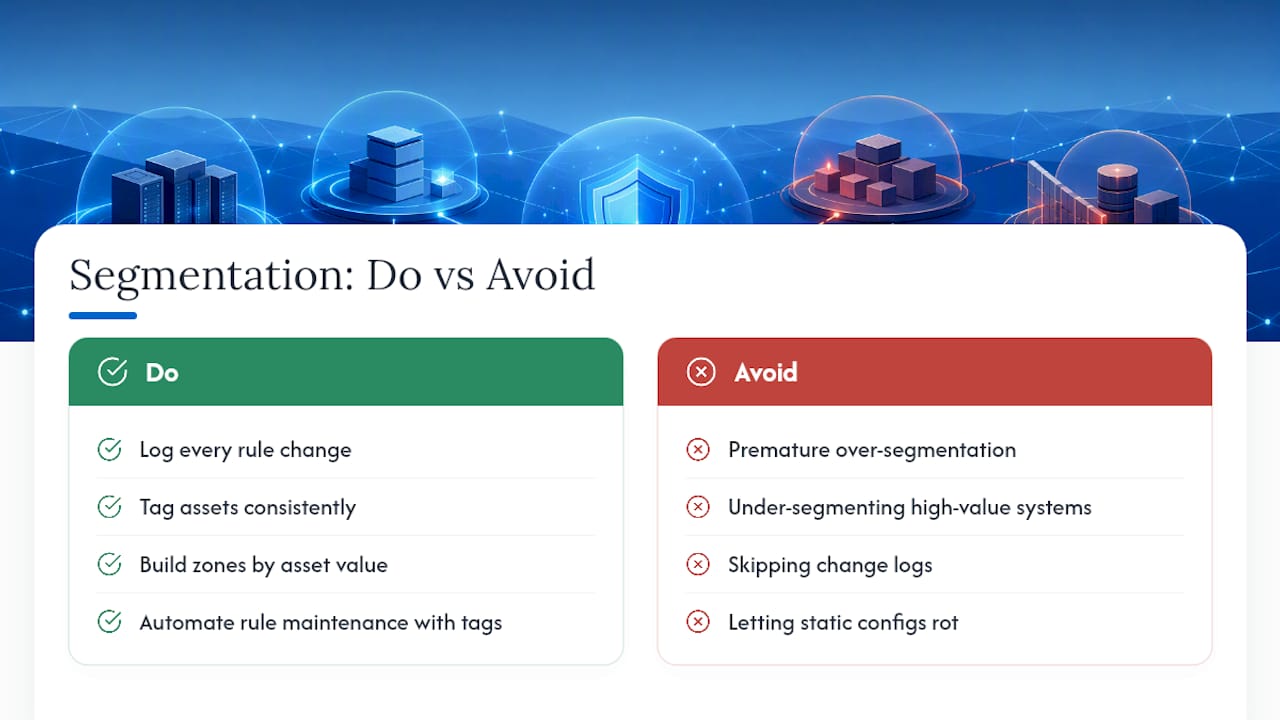
Most segmentation failures trace back to a handful of repeat offenders. Research from Carnegie Mellon's Software Engineering Institute points to policy drift and incomplete documentation as the root cause behind most rule sprawl that eventually undermines a segmentation program.
Fix it with a few concrete habits: require change logging for every rule modification, tag assets consistently so exceptions are traceable, and resist over-segmenting early. Build zones in stages, prioritized by asset value, rather than attempting total granularity on day one. On the flip side, under-segmentation leaves your highest-value systems exposed while you polish rules for low-risk zones. Isolate what matters most first, then automate rule maintenance with tag-based policies so static configurations don't rot as your environment changes.
What's a Practical 30/60/90-Day Segmentation Action Plan?
Here's a milestone structure that gets a segmentation program from concept to enforcement without stalling in planning meetings.
- Days 1 to 30: Complete the asset inventory, identify your highest-risk systems, and pick one pilot zone.
- Days 31 to 60: Run the pilot in monitoring mode, refine policies based on real traffic, and add logging across the zone boundary.
- Days 61 to 90: Move to enforcement, run a penetration test against the new boundary, and start planning the next zone.
| Immediate action | Why it matters |
|---|---|
| Restrict RDP access | Remote desktop protocol is one of the most common lateral-movement entry points |
| Isolate guest Wi-Fi | Prevents unmanaged devices from reaching internal systems |
| Segment backup infrastructure | Stops ransomware from encrypting backups alongside production data |
A related small business cybersecurity checklist covers adjacent priorities worth tackling alongside this plan.
How Did Guest Wi-Fi Isolation Play Out in a Real Deployment?
On one restaurant client's network, guest Wi-Fi shared a subnet with the point-of-sale system, a configuration that put payment data one weak password away from public exposure. Securetechie isolated the guest network into its own VLAN with a dedicated firewall zone, added flow logging, and blocked any path back to POS or back-office systems. The lesson held beyond that one site: guest and IoT traffic deserve isolation by default, not as an afterthought once something goes wrong.
Does Network Segmentation Slow Down Network Performance?
Segmentation adds processing overhead wherever traffic crosses a zone boundary, since every packet has to pass inspection instead of routing freely. Poorly designed zones can introduce measurable latency, particularly when internal segmentation firewalls perform deep packet inspection on high-volume east-west traffic between application tiers that talk constantly.
The fix isn't fewer zones. It's smarter placement of enforcement points. A few practices keep latency in check:
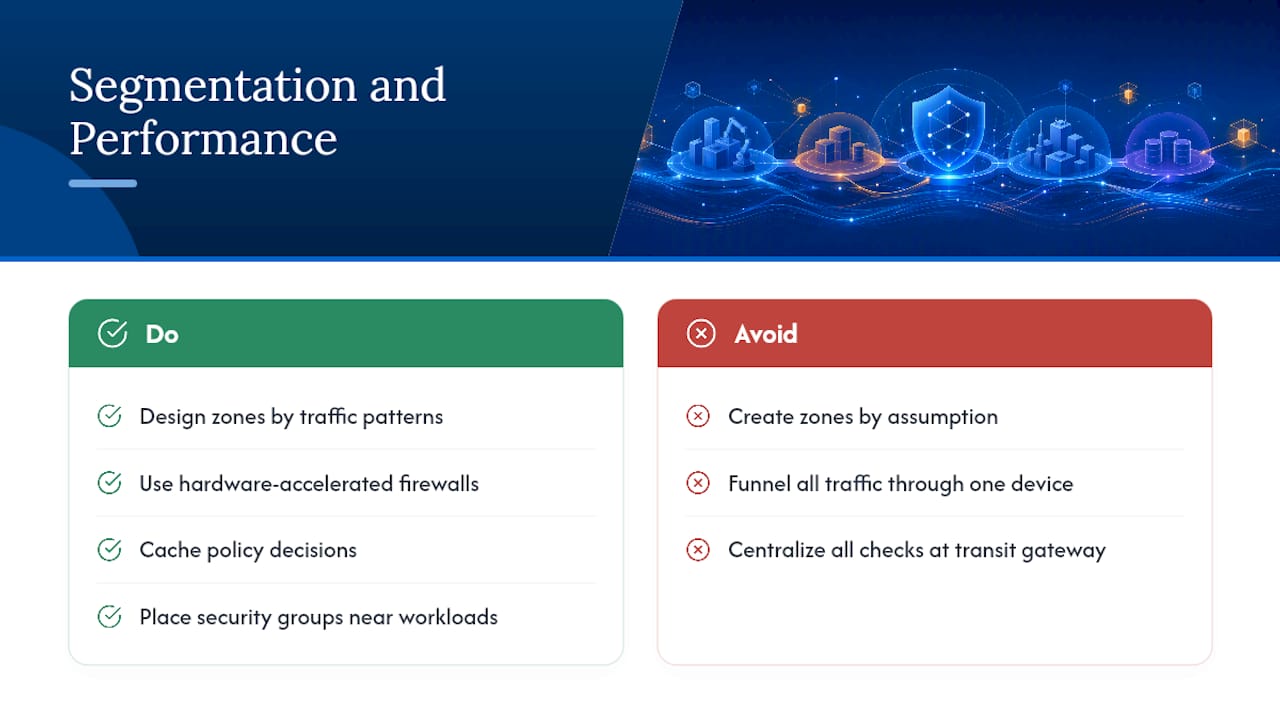
Design zone boundaries around actual traffic patterns, not assumed ones. If two systems exchange thousands of requests per second, that boundary needs hardware capable of handling that volume without becoming a bottleneck, or the two systems belong in the same zone with tighter host-based controls instead.
Use hardware-accelerated firewalls or dedicated inspection appliances at high-traffic boundaries rather than routing everything through a single choke point. Distributing enforcement across multiple internal firewalls, rather than funneling all inter-zone traffic through one device, prevents that device from becoming the network's slowest link.
Cache policy decisions where the enforcement model allows it, and keep microsegmentation rules as specific as possible so agents evaluate fewer conditions per packet. Cloud-native environments benefit from placing security groups close to the workload rather than centralizing every check at a transit gateway, which cuts down on round-trip inspection hops.
Monitor latency metrics at zone boundaries the same way you monitor security events. A performance regression after a policy change is a signal worth investigating with the same urgency as a failed login spike.
Why Governance and Testing Matter More Than Chasing New Tools
Every vendor pitch promises the platform that finally fixes segmentation. What actually moves the needle is boring: a documented policy registry, an owner for every zone, and a testing cadence nobody skips when things get busy.
Pro Tip: Before buying another tool, map two things: your data flows and who owns each zone's policy. Most stalled segmentation projects have plenty of tooling and no map.
Prioritize the mapping and pilot phase over procurement. Governance is what keeps a segmentation program working a year after the kickoff meeting, not the platform you chose in week one.
— Alex
How Secure Techies Can Help You Implement Segmentation
Building and maintaining segmentation in-house takes ongoing attention that most internal IT teams can't sustain alongside daily support tickets, which is exactly where a dedicated managed partner earns its keep. An effective approach to network segmentation for SMB environments starts with the same inventory and zoning work outlined above, then moves into policy design, deployment, and continuous monitoring so drift gets caught before it becomes an incident.
A typical engagement covers asset classification, zone-to-zone policy design, phased deployment starting with monitoring mode, and ongoing log review tied to compliance frameworks like HIPAA and SOC 2. Southern California businesses working through managed infrastructure services or looking to harden existing environments through cybersecurity solutions can start with a network assessment to identify where isolation gaps currently exist. Reach out to Securetechie for a segmentation assessment and get a prioritized plan instead of a guessing game.
Sources
The standards behind this guide carry real regulatory and operational weight: NIST's Zero Trust glossary frames phased rollout guidance, OWASP's cheat sheet defines allowlist architecture, MITRE ATT&CK details lateral-movement mitigations, and PCI DSS scoping guidance sets the bar for testing isolation around regulated data.
- Network Segmentation Cheat Sheet — OWASP
- NIST cybersecurity glossary / Zero Trust context
- MITRE ATT&CK mitigations — network segmentation
- PCI DSS guidance: Scoping and segmentation
- Network Segmentation Architecture & Implementation Guide — SentinelOne