
MTTA measures the average time between an alert firing and a human acknowledging it. MTTR measures the average time between an incident starting and service being restored. When acknowledgments lag, the fix is MTTA; when the delay happens after someone is already on the case, the fix is MTTR. MTTA nests inside MTTR as one of its earliest phases, so a team can hit its MTTA target and still miss its MTTR target if diagnosis or rollback is slow.
TL;DR:
- Teams should prioritize reducing MTTA when alert acknowledgments are delayed due to paging issues or muted notifications, as this affects response speed.
- Improving MTTR requires investing in diagnostic tooling, comprehensive runbooks, and automation to shorten resolution and verification phases.
- Accurate measurement of both metrics depends on collecting at least four timestamps per incident and clearly defining what "resolved" means in runbooks.
- Reporting median and p90 alongside mean helps identify critical tail delays affecting incident response effectiveness.
- Organizational structure impacts MTTA and MTTR; smaller, integrated teams tend to resolve incidents faster due to fewer handoff delays.
Table of Contents
- MTTR vs MTTA at a Glance
- Defining MTTA and MTTR Without the Ambiguity
- Where MTTA and MTTR Sit in the Incident Timeline
- When to Prioritize MTTA vs MTTR
- How to Measure MTTR and MTTA Without Lying to Yourself
- Practical Ways to Cut MTTA and MTTR
- How Team Structure Changes MTTA and MTTR
- Setting Realistic SLAs for MTTA and MTTR
- Tools for Tracking MTTA and MTTR
- What Actually Deserves Attention This Quarter
- How Secure Techies Helps Lower MTTA and MTTR
- Sources
- FAQ
MTTR vs MTTA at a Glance
The two metrics sound similar, but measure completely different parts of an incident. MTTA tracks responsiveness. MTTR tracks operational effectiveness once someone is already engaged. Confusing the two is the fastest way to misdiagnose why incidents drag on.
MTTA answers a narrow question: how long does it take a human to notice and confirm an alert? Its clock starts when monitoring fires an alert and stops the moment someone acknowledges it in a paging tool. MTTR answers a broader question: how long does the entire incident, from start to full service restoration, actually take? Its clock typically starts at incident detection (sometimes at first customer impact) and stops when the service is verified as healthy again.
| Attribute | MTTA (Mean Time to Acknowledge) | MTTR (Mean Time to Restore/Repair) |
|---|---|---|
| What it measures | Alert-to-acknowledgment delay | Incident start to full restoration |
| Formula | Total acknowledgment time ÷ number of incidents | Total resolution time ÷ number of incidents |
| Typical scale | Seconds to minutes | Minutes to hours |
| Primary levers | Paging reliability, escalation policy, alert noise | Runbooks, rollback tooling, alert context, diagnostics |
| Usual owner | On-call engineer, NOC, alerting platform admin | Incident commander, SRE, platform engineering team |
Both numbers are averages, and averages hide the tail. A team with a strong mean MTTA can still have a handful of incidents that sit unacknowledged for twenty minutes because someone's phone was on silent. That tail matters more than the headline number, which is why later sections cover median and p90 reporting instead of trusting the mean alone.
Defining MTTA and MTTR Without the Ambiguity
Vague definitions are the number one reason MTTR numbers get argued over in postmortems. Before calculating anything, a team needs to agree on exactly what starts and stops each clock.
MTTA is simple by comparison: the clock starts when an alert fires from a monitoring system and stops when a human acknowledges it, usually inside a paging or on-call tool. Because both timestamps typically live inside the same platform, MTTA is one of the cleanest signals of on-call health a team can measure.
MTTR is where confusion creeps in, because the letter "R" gets used for four different things:
- Mean Time to Repair — the time spent physically or technically fixing the broken component.
- Mean Time to Recover — the time until service functionality returns, even if the underlying cause isn't fully fixed yet.
- Mean Time to Resolve — the time until the incident is fully closed out, including root cause documentation.
- Mean Time to Respond — sometimes used interchangeably with MTTA, which is exactly the kind of overlap that causes dashboard confusion.
Pick one definition, write it into the runbook, and never let it drift. MTTR realistically spans detection, acknowledgment, triage, diagnosis, mitigation, and verification, and different teams influence different phases of that span.
Formula for MTTA: Total acknowledgment time across all incidents ÷ number of incidents
Formula for MTTR: Total resolution time across all incidents ÷ number of incidents
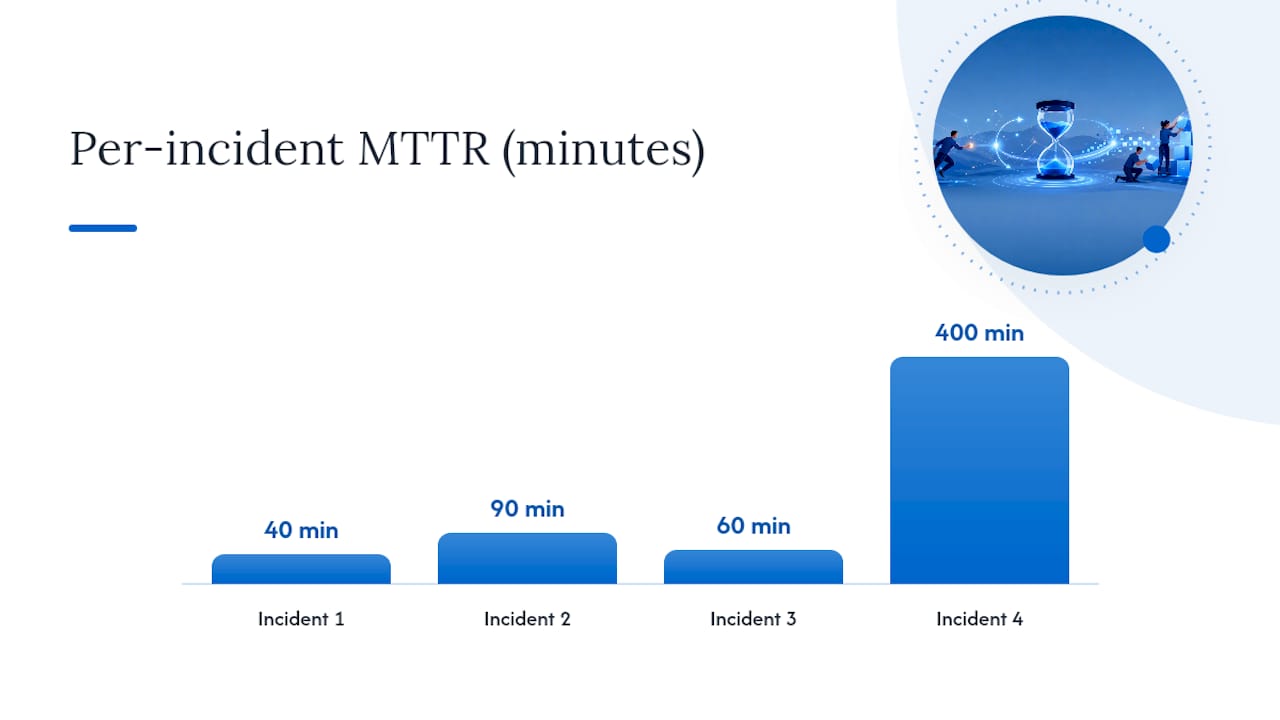
Worked example: if four incidents in a month take 2, 5, 3, and 50 minutes to acknowledge, MTTA is 60 ÷ 4 = 15 minutes. That single 50-minute outlier just tripled the "average" experience, which is exactly why relying on the mean alone is risky. If those same four incidents take 40, 90, 60, and 400 minutes to fully restore, MTTR is 590 ÷ 4 = 147.5 minutes, again skewed hard by one bad night.
Where MTTA and MTTR Sit in the Incident Timeline
MTTA and MTTR aren't competing metrics. They're sequential segments of the same timeline, and treating MTTR as one undifferentiated block is how teams lose the ability to diagnose where time actually goes. Decomposing the incident lifecycle into distinct stages turns a vague "things are slow" complaint into a specific, fixable bottleneck.
A full incident typically breaks into six stages:
- Detection — from first symptom to the monitoring system generating an alert. This interval is MTTD (Mean Time to Detect).
- Notification — from alert generation to the alert reaching a human's device.
- Acknowledgment — from notification received to a human confirming they're on it. This is MTTA.
- Diagnosis — from acknowledgment to understanding the root cause.
- Mitigation/Remediation — from diagnosis to the fix or rollback being applied.
- Verification — from the fix being applied to confirming the service is actually healthy.
MTTR, in most common usage, spans everything from detection through verification. That means MTTA is a subset of MTTR, not a separate measurement running in parallel.
Pro Tip: If your incident tooling only logs two timestamps, alert fired and incident closed, you're blind to which stage is actually broken. Add acknowledgment, diagnosis-start, and mitigation-applied timestamps and the picture changes instantly.
Each stage tends to have a different owner. Monitoring and alerting platforms drive detection and notification. On-call engineers own acknowledgment. SRE or platform teams typically own diagnosis and mitigation. QA or the incident commander usually signs off on verification. When an organization can't explain why MTTR crept up last quarter, it's almost always because nobody instrumented the handoff points between these owners.
When to Prioritize MTTA vs MTTR
The prioritization rule is straightforward once the timeline is instrumented: if incidents sit unacknowledged for long stretches, fix MTTA first, because that delay costs pure response time with no diagnostic value attached. If acknowledgment happens fast but resolution still drags, the bottleneck is downstream, and MTTA improvements won't move the needle at all.
- MTTA is the bottleneck when alerts sit unread, escalation policies are missing a tier, or paging fatigue has engineers muting notifications.
- MTTR is the bottleneck when the team acknowledges quickly but then spends 40 minutes hunting through logs to find the root cause.
- Both are the bottleneck when neither number has a documented target, which is more common than most teams admit.
Maturity benchmarking is useful for setting realistic targets rather than aspirational ones. Industry guidance frames MTTR improvement in stages, from baseline performance up to elite response times, and notes that containment speed often correlates with incident cost more strongly than detection speed alone. That's a useful reframe for security-flavored incidents specifically: catching a breach fast matters less than containing it fast once it's caught.
Statistic to watch: reporting median and p90 alongside the mean matters because incident-duration data is right-skewed — a handful of long-tail incidents will otherwise drag the average upward and mask what a typical incident actually looks like for the team.
Set targets in tiers rather than a single number, using realistic performance thresholds defined by your current monitoring data, and trigger reviews when the mean drifts significantly above typical values.
How to Measure MTTR and MTTA Without Lying to Yourself
The single most common way teams corrupt these metrics is by quietly changing what "resolved" means. If last quarter's MTTR looked bad, and this quarter someone redefines resolution to mean "workaround applied" instead of "root cause fixed," the number improves on paper while nothing operationally changes. That's not a metrics improvement. That's a metrics fraud, even when nobody intends it that way.
Four practices keep MTTA and MTTR trustworthy over time:
- Write the clock definitions into the runbook, not into someone's head, so "acknowledged" and "resolved" mean the same thing every time, for every team.
- Collect a minimum of four timestamps per incident: alert fired, alert acknowledged, mitigation applied, service verified. The SITM standard from FIRST recommends this level of granularity specifically so organizations can compare incident timing consistently.
- Report mean, median, and p90 together, every time, in every dashboard. A mean without a p90 hides exactly the incidents leadership most needs to see.
- Automate timestamp capture wherever the tooling allows it. Manual timestamp entry is where clock definitions quietly drift, because a tired on-call engineer rounds "acknowledged at 2:47" to "around 2:45" without thinking twice.
Pro Tip: Build a monthly report that shows MTTA and MTTR as three numbers each, mean, median, and p90, side by side. The gap between median and p90 tells you more about your reliability than either mean does on its own.
Practical Ways to Cut MTTA and MTTR
Improving MTTA and improving MTTR require almost entirely different work, and that split is the most useful thing to internalize about this pair of metrics. MTTA gains tend to come from fixing the paging and escalation layer, while MTTR gains usually require deeper investment in tooling and process.
Quick wins for MTTA:
- Test paging reliability regularly. A pager that silently fails to deliver is worse than no pager, because it creates false confidence.
- Tighten escalation policies so an unacknowledged alert automatically bumps to a secondary on-call person within a fixed window, not an open-ended wait.
- Cut alert noise aggressively. Engineers who get paged fifteen times a night for non-actionable alerts start ignoring pages on instinct, and that habit is hard to undo.
Longer-term investments for MTTR:
- Build runbooks for the incident types that recur most often, so responders aren't improvising diagnostic steps under pressure.
- Invest in rollback capability so mitigation doesn't depend on a perfect root-cause diagnosis before service can be restored.
- Correlate traces and logs automatically so responders aren't manually stitching together three different dashboards mid-incident. When diagnosis time dominates MTTR, richer alert context is usually the fix, not more headcount.
- Reduce alert fatigue at the source using practices covered in alert fatigue and detection tuning, which directly feeds both MTTA and diagnosis speed.
For AI-driven or automated systems specifically, incident response needs its own playbook rather than a patched version of the human-response process, a point BowTie explores in depth when discussing how automation changes what "acknowledgment" even means.
A managed IT provider becomes worth considering once an internal team has exhausted the cheap fixes, alert tuning, escalation policy, basic runbooks, and MTTR still isn't moving because nobody has the bandwidth to build deeper observability.
How Team Structure Changes MTTA and MTTR
Organizational shape affects these metrics as much as tooling does, and comparing MTTR numbers across teams with different structures is often comparing apples to oranges. A single-team startup where the same five engineers write the code, get paged, and fix the bug will usually show fast MTTA and fast MTTR, simply because there's no handoff friction. Nobody has to page a stranger.
Larger organizations with siloed teams, network on one team, application on another, security on a third, tend to see MTTA stay reasonable (the first responder acknowledges quickly) while MTTR balloons, because that first responder often isn't the person who can actually fix the problem. The clock keeps running while the incident gets routed to the right specialist.
Centralized incident command structures, where a dedicated incident commander coordinates across teams, tend to compress MTTR even in large organizations, because the commander's job is specifically to cut through routing delay. Distributed "whoever's on call handles it" models can produce inconsistent MTTR depending entirely on which engineer picked up that night. Teams without a clear ownership map for each incident type will always see wider variance between their median and p90, because the outcome depends on who happened to be awake.

Setting Realistic SLAs for MTTA and MTTR
SLAs built on hope instead of historical data collapse under real incident load and erode trust in the metrics program overall. The starting point should always be current median and p90 performance, not an aspirational number pulled from a benchmark report.
A workable approach sets targets in layers: an internal-facing operational target (what the team aims for day to day), and a customer-facing SLA (a looser, contractually safer number with margin built in). If median MTTA currently sits at four minutes, setting an internal target of three minutes is reasonable. Promising customers a two-minute SLA on top of that is setting up a breach the first time a bad night happens.
Thresholds should also differ by incident severity. A Sev1 outage affecting all customers deserves a tighter MTTA and MTTR target than a Sev3 cosmetic bug. Blending all severities into one SLA number obscures whether the team is actually fast where it matters most.
Revisit SLAs quarterly using the same median and p90 data used to build them originally. A target set once and never revisited either becomes trivially easy to hit, which teaches the team nothing, or stays permanently out of reach, which teaches the team to stop caring about the number at all.
Tools for Tracking MTTA and MTTR
Most modern incident management and paging platforms calculate MTTA and MTTR automatically once timestamps are flowing correctly, but the underlying instrumentation matters more than which platform sits on top of it. A tool can only report what it's given, and plenty of teams discover their MTTR dashboard has been quietly wrong for months because someone changed a status field's meaning without telling the platform.
The baseline requirement is a system that can capture at least four distinct timestamps per incident, alert fired, acknowledged, mitigation applied, verified, and expose mean, median, and p90 without extra configuration. Observability platforms that correlate logs, traces, and alerts in one place tend to shrink diagnosis time specifically, which is usually the single largest chunk of MTTR once acknowledgment is fast. Free diagnostic and reliability tools, like the ones in Secure Techies' tools library, can also help teams spot infrastructure weak points before they turn into the kind of incident that needs timing at all.
Whatever platform a team chooses, the real test isn't the dashboard, it's whether the underlying clock definitions were written down and enforced before the tool started calculating anything.
What Actually Deserves Attention This Quarter
If a team has to pick one change, it should be this: stop reporting a single MTTR number and start reporting it split into mitigation time and full resolution time, alongside the p90. Most teams already have the raw timestamps sitting in their paging tool. They just aren't pulling them apart.
The reason this matters more than most process changes is that a blended MTTR hides which half of the problem is actually broken. A team that mitigates fast but resolves slow needs better root-cause tooling. A team that mitigates slow needs better runbooks. Those are different investments, and a single averaged number will never tell you which one to make.
Start next week by adding one field to the incident postmortem template: mitigation-applied timestamp. That's it. Everything else, median tracking, p90 dashboards, SLA tiers, builds on having that one number available.
— Alex
How Secure Techies Helps Lower MTTA and MTTR
Cutting MTTA and MTTR usually comes down to two things: someone answering the alert fast, and someone competent already knowing what to do next. Managed IT providers build both into their managed services rather than leaving them to whoever happens to be awake. Its managed IT services run on 24/7 local monitoring, so alerts get seen and acknowledged around the clock instead of sitting in a queue until business hours.

Faster acknowledgment only helps if resolution keeps pace, which is where the managed help desk support and structured incident response come in, backed by documented runbooks instead of improvisation under pressure. For incidents involving data loss or system failure, backup and disaster recovery planning shortens the mitigation stage specifically, since rollback is already built rather than invented mid-incident. Businesses seeking to improve their MTTA and MTTR numbers, not just make them look better in reports, can request response-time assessments from managed IT providers to identify where their current timelines are losing time.
Sources
The Rootly glossary and Atlassian's incident metrics guide anchor the core definitions and timeline decomposition used throughout this article. The FIRST Security Incident Timing Metrics standard is the closest thing the industry has to a formal specification for which timestamps to capture, and it's worth reading directly for any team building its own instrumentation from scratch.
- MTTA vs MTTR: What's the Difference? · Rootly glossary
- MTBF, MTTR, MTTA, and MTTF - Incident Management · Atlassian
- Incident Response Metrics Worth Tracking (Beyond MTTR) · Pagerly
FAQ
What are the differences between MTTD, MTTA, and MTTR?
MTTD measures time to detect an issue, MTTA measures time to acknowledge it once detected, and MTTR measures time from the incident's start until service is fully restored, making MTTA a subset of the broader MTTR window.
What is MTTR, MTBF, and MTTF?
MTTR is the average time to restore service after a failure; MTBF (Mean Time Between Failures) measures how often failures occur for repairable systems; MTTF (Mean Time to Failure) measures average lifespan for systems that get replaced rather than repaired.
What are acceptable MTTR values?
Acceptable MTTR depends heavily on incident severity and system complexity, but industry benchmarking frames MTTR improvement in maturity tiers from baseline to elite performance rather than a single universal number, and teams should set targets from their own median and p90 data.
What does MTTA stand for?
MTTA stands for Mean Time to Acknowledge, the average time between an alert firing and a human confirming they're responding to it.