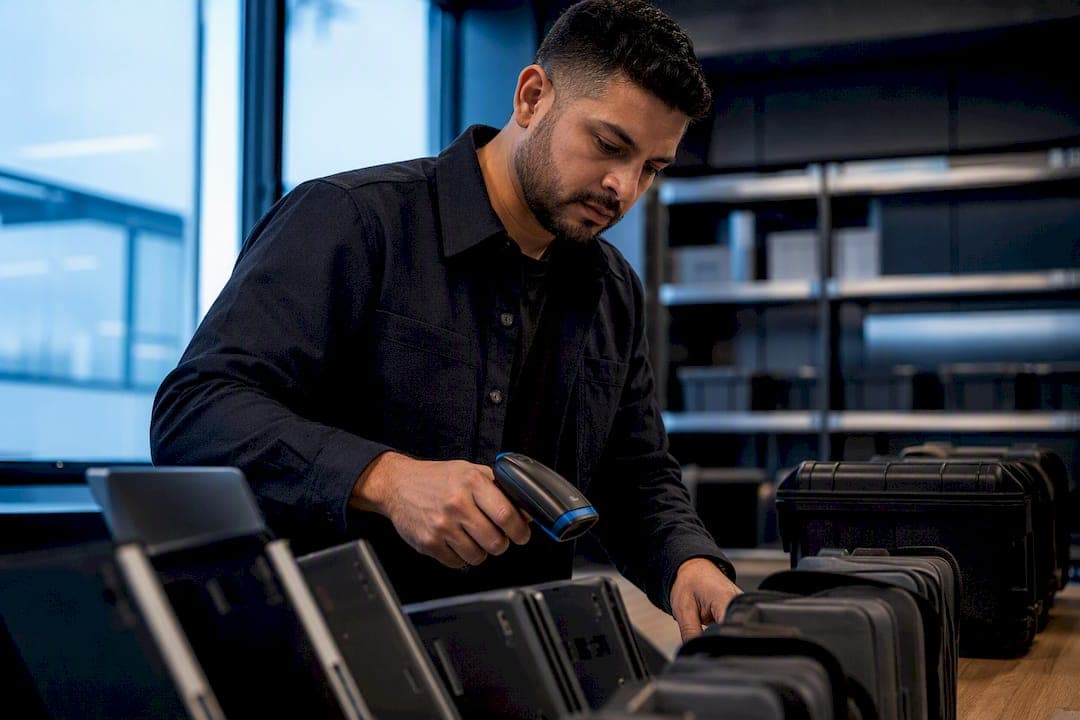
Device lifecycle management (DLM) is the end-to-end operational system that keeps company devices secure, available, and cost-effective from purchase to certified disposal. Its core outcomes are lower data risk, less duplicate spending on hardware, and fewer surprise outages. The next move for most organizations is simple: assign one owner, usually the IT manager, to reconcile inventory and tie device actions directly to HR events.
TL;DR:
- Tracking device recovery within 14 days of offboarding significantly reduces data exposure risk and improves overall program security.
- Automating HR-triggered recovery tasks and establishing clear recovery SLAs help close the offboarding gap and prevent device loss.
- Quarterly reconciliation of inventory ensures devices do not drift off the books due to repair, transfer, or misplacement.
- A hybrid or full-service DLM model is advisable for larger, multi-site organizations or those with limited internal logistics capacity.
- Building a simple, clear policy with assigned ownership, deadlines, and documented destruction procedures supports effective lifecycle management.
Table of Contents
- What Are the Stages of Device Lifecycle Management?
- How Is DLM Different From ITAM and MDM?
- What Business Benefits Does DLM Deliver?
- Where Does Device Lifecycle Management Break Down?
- Which Operating Model Fits Your Organization?
- How Do You Build a Working DLM Playbook?
- What Technology Stack Actually Supports DLM?
- What Metrics and Budget Should You Track?
- What Proof Points Show DLM Actually Works?
- What Are the First Three Moves to Make This Quarter?
- How Securetechie Supports Your Device Lifecycle Program
- Sources
What Are the Stages of Device Lifecycle Management?
Device lifecycle management runs through five distinct stages, and each one needs its own owner, records, and triggers. Skip a stage's paperwork and you get the inventory drift that turns audits into fire drills.
- Planning and procurement. IT defines standard configurations and approval thresholds before purchase, tying budget to actual headcount and refresh forecasts rather than guesswork.
- Provisioning and deployment. Zero-touch enrollment through an MDM/UEM platform pushes configuration profiles automatically, while asset tags and serial numbers get logged the moment a device leaves the box.
- Maintenance. Warranty status, patch compliance, and repair history get tracked continuously, with warranty expiry set as an automated trigger for replacement review.
- Reassignment and refresh. Devices moving between employees get wiped, reconfigured, and reissued under documented chain of custody, not handed off informally.
- Retrieval and decommissioning. HR offboarding events trigger recovery requests, remote wipes, and eventual certified destruction or resale.
The pattern that separates mature programs from chaotic ones is simple: every stage produces a record, and every record has a named owner. A device asset inventory built at deployment time, not reconstructed later, is what makes the later stages fast instead of frantic.
How Is DLM Different From ITAM and MDM?
Confusion between these three terms causes more policy gaps than any single technical failure. Each one governs a different layer of the device's existence.
- ITAM (IT asset management) tracks financial ownership, depreciation, license counts, and compliance reporting. It answers "what do we own and what did it cost."
- MDM/UEM (mobile device management or unified endpoint management) governs configuration, security policy, and compliance status while a device is in active use. It answers "is this device configured and secure right now."
- DLM coordinates the physical logistics and policy decisions that connect the two: procurement, shipping, retrieval, sanitization, and disposal. It answers "where is this device physically, and who is responsible for moving it to its next state."
A device can be fully MDM-compliant and still be a lifecycle failure if it sits with an inactive employee, unrecovered, for months. Unenrollment and physical chain of custody are separate controls, and both need enforcement. Sync data fields like assigned user, location, and warranty status across all three systems, and assign clear cross-team SLAs so nobody assumes "someone else" is tracking a device once it leaves the warehouse.
What Business Benefits Does DLM Deliver?
The financial case for structured DLM rests on four measurable levers, and executives respond better to numbers than to abstractions.
- Security and compliance. Automated retrieval and wipe closes the offboarding window, the single riskiest gap in most fleets, and produces the audit trail regulators expect.
- Cost control. License reclamation on reassigned devices, a right-sized spare pool, and longer device life through condition-based refresh all reduce spend without new purchases.
- Uptime and experience. Standardized provisioning and a maintained spare pool mean a broken laptop gets replaced in hours, not days.
Recovery speed matters more than most budgets reflect. Devices recovered within 14 days of an offboarding event carry dramatically less data exposure risk than those tracked past that window, according to operational lifecycle guidance. That single metric, tracked consistently, tells you more about program health than almost any other number in the fleet.
Where Does Device Lifecycle Management Break Down?
Most DLM failures aren't technical. They happen in the gaps between people, systems, and paperwork, and the offboarding window is the worst offender.
- Close the offboarding gap first. The stretch between an employee's last day and device recovery is where most data walks out the door. Tie every device action to the HR system directly rather than waiting for a manual ticket.
- Automate recovery on HR triggers. When HR marks someone as terminated or transferred, that event should fire a recovery task and a remote-wipe deadline automatically, not after a manager remembers to email IT.
- Set a hard recovery SLA. A reasonable target recovery deadline for corporate-owned equipment is often recommended; anything longer should trigger an escalation, not a shrug.
- Reconcile inventory on a fixed schedule. Quarterly physical or MDM-based reconciliation catches devices that drifted off the books, whether through repair loops, department transfers, or plain misplacement.
Pro Tip: Build your recovery workflow around the HR system, not the help desk queue. An offboarding checklist tied to HR events closes the gap faster than any policy memo ever will.
Which Operating Model Fits Your Organization?
Choosing how to run DLM depends less on company size and more on fleet complexity, geographic spread, and how much internal bandwidth IT actually has.
- In-house. Works when the fleet is small, single-location, and IT has dedicated headcount for logistics. Gives full control but demands consistent staffing to avoid the exact drift the program is meant to prevent.
- Software-first. A UEM platform plus an asset registry handles configuration and tracking well, but physical retrieval, sanitization, and disposal logistics still need a human process layered on top. Good fit for organizations with strong internal discipline but limited desire to manage vendor relationships.
- Full-service. A managed partner handles procurement, provisioning, retrieval, and disposal end to end. Best suited to multi-site organizations, regulated industries, or lean IT teams that would otherwise absorb logistics work nobody budgeted for.
- Hybrid. IT retains policy and security decisions while outsourcing the physical logistics, retrieval, and sanitization work. Common for K-12 districts and mid-size firms with growing device counts but no logistics staff.
A quick decision signal: if your team spends more time chasing devices than configuring them, that's a sign to shift toward hybrid or full-service. If compliance audits keep surfacing devices nobody can locate, the same signal applies.
How Do You Build a Working DLM Playbook?
A usable policy doesn't need to be long. It needs clear ownership and deadlines that people actually follow.
- Write the policy core. Define scope, mandatory inventory fields, refresh criteria, and disposal procedures, following the structure recommended in hardware asset management policy guides.
- Assign RACI by event. HR owns termination notifications, IT owns recovery and wipe execution, and finance owns disposal sign-off. Document who is Responsible, Accountable, Consulted, and Informed for each lifecycle event, mirroring the approach the IRS uses for its own hardware asset procedures.
- Set procurement rules. Standard configurations and dollar-based approval thresholds prevent one-off purchases that never make it into inventory.
- Run offboarding on a deadline. Recovery request within 24 hours of the HR event, wipe confirmed within the SLA window, verification logged in the asset inventory.
- Decommission with evidence. Wipe, unenroll from MDM, generate a certificate of destruction, then update the registry before the device physically leaves the building.
Pro Tip: Never skip the certificate of destruction, even for donated or resold equipment. It's the one document auditors ask for by name.
What Technology Stack Actually Supports DLM?
No single platform runs the whole lifecycle. DLM works when four tool categories talk to each other: enrollment platforms, asset registries, ticketing/logistics systems, and certified sanitization partners.
- HRIS to ticketing. A termination event in the HR system should auto-generate a recovery ticket, not wait for a manager to notice.
- Ticketing to MDM/UEM. The ticket triggers configuration lockdown and a scheduled remote wipe.
- MDM/UEM to asset registry. Enrollment status and device health sync back to the master inventory automatically.
- Registry to logistics. Physical pickup, shipping, and sanitization get scheduled once the digital side is confirmed clean.
Microsoft's own documentation frames Intune's role clearly: it covers enrollment, configuration profiles, protection policies, and remote wipe through retirement, but the physical recovery of the device and its certified destruction remain operational work outside the platform.
That gap between digital retirement and physical retrieval is exactly where most fleets lose track of hardware. An example Intune rollout for small business clients shows how enrollment automation pairs with manual retrieval workflows to close that gap in practice.
What Metrics and Budget Should You Track?
Track four numbers monthly: recovery rate within 14 days, average time-to-provision a new hire's device, percentage of retired devices with a certificate of destruction on file, and spare-pool ratio against active headcount.
- Budget drivers to plan for: replacement cadence based on device condition (not calendar age), logistics and shipping for remote retrieval, sanitization fees per device, and MDM/UEM licensing.
- Rollout milestones: 30 days for inventory reconciliation and policy sign-off, 90 days for HR-triggered automation live, 180 days for full recovery SLA compliance across all locations.
What Proof Points Show DLM Actually Works?
Theory is easy. Execution is where most DLM programs stall, which is why proof points matter more than policy language.
A Microsoft Intune rollout case study documents how zero-touch enrollment and configuration profiles reduced manual provisioning work for a growing client fleet, freeing internal staff from repetitive setup tasks. Pairing that kind of enrollment automation with compliance and security audit support gives regulated organizations, healthcare practices and financial firms especially, a defensible audit trail alongside faster device turnaround.
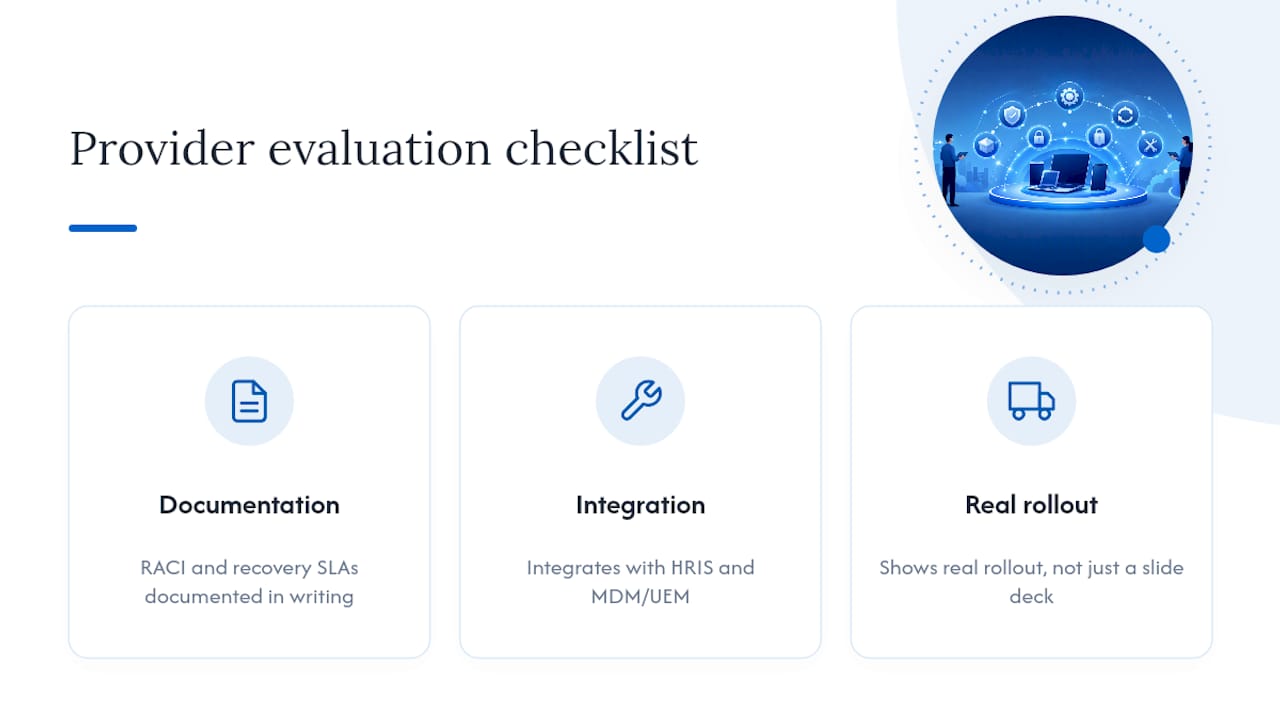
Judging a managed provider comes down to three questions: do they document RACI and recovery SLAs in writing, do they integrate with your existing HRIS and MDM/UEM rather than replacing them, and can they show a real rollout, not just a sales deck. An engagement that fails any of those three questions usually ends up recreating the same inventory drift it was hired to fix.
What Are the First Three Moves to Make This Quarter?
Reconcile your inventory before you write a single new policy line. You cannot govern what you cannot see, and most fleets discover ghost devices the moment they actually count.
Second, wire HR termination events directly into device recovery tasks. This one integration closes the largest risk window in the entire lifecycle, larger than any endpoint security control.
Third, set a 14-day recovery SLA and hold IT accountable to it in writing. These three moves cost little and return disproportionate risk reduction. Use the offboarding checklist and Intune case study above as your starting templates.
— Alex
How Securetechie Supports Your Device Lifecycle Program
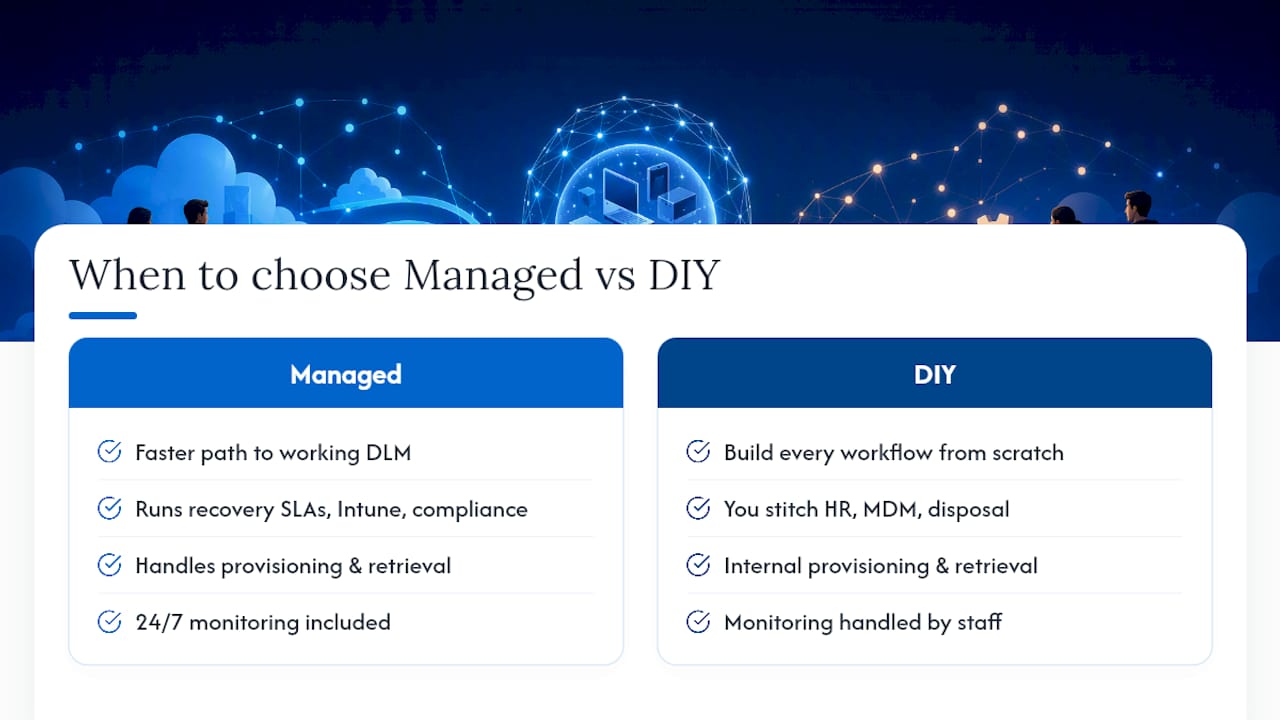
Securetechie gives IT managers a faster path to a working DLM program than building every workflow from scratch. Instead of stitching together HR triggers, MDM policies, and disposal logistics on your own, a managed partner runs the recovery SLAs, Intune rollout, and compliance documentation as one connected service.
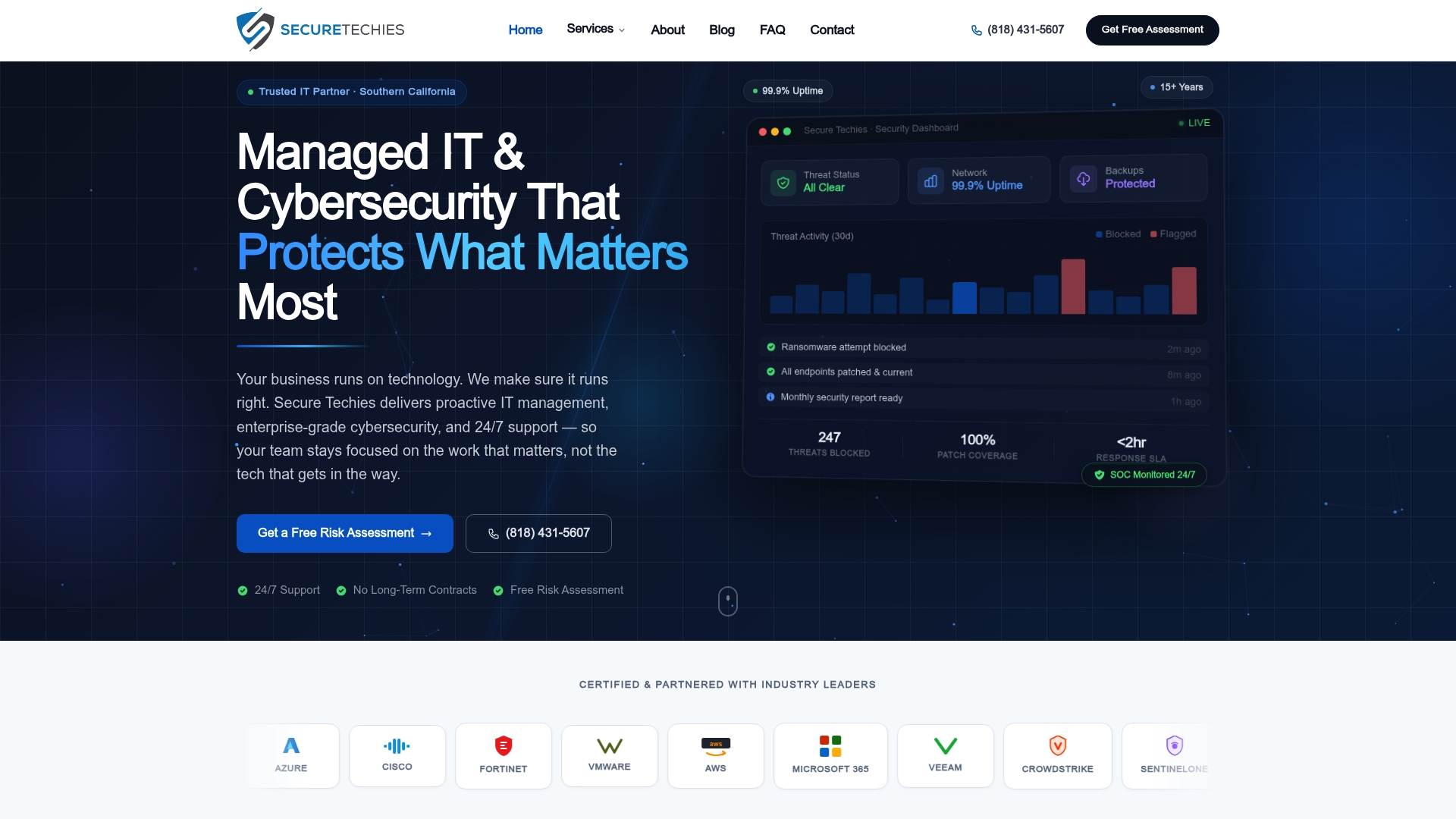
Southern California organizations, from professional services firms to healthcare practices, use Securetechie's managed infrastructure services to handle provisioning, retrieval, and 24/7 monitoring without adding headcount. Managed services make sense when your team is spending more time chasing devices than securing them, or when HIPAA, SOC 2, or CMMC compliance audits demand documentation your current process can't produce on short notice. A DIY approach still works for smaller, single-location fleets with dedicated IT staff.
If your device count has outgrown your current recovery process, request a fleet assessment through Securetechie's managed IT services page and get a concrete plan for closing your offboarding and retrieval gaps.
Sources
For readers who want the primary documents behind this playbook, three sources are worth bookmarking directly. The IRS hardware asset procedures offer a government-grade RACI and repository model. The InvGate hardware asset management policy guide breaks down the mandatory fields a working policy needs. Microsoft's Intune device lifecycle documentation explains enrollment-to-retirement workflows in technical detail, and organizations layering AI-driven compliance review into procurement can find useful context in ClawBase's overview of AI compliance assistance.
- IRS — 2.149.3 Asset Management Hardware Procedures
- Remoasset — Device lifecycle management guide
- InvGate — Hardware asset management policy guide