
GLBA compliance requirements break down into three pillars: the Financial Privacy Rule, the Safeguards Rule (16 C.F.R. Part 314), and the Pretexting provisions, and covered institutions must maintain a written information security program built around nine specific safeguards elements. If your organization handles nonpublic personal information from consumers, you need a designated Qualified Individual, a documented risk assessment, and evidence that your controls actually get tested.
Here's the fast version of what the Safeguards Rule requires in your written program:
- A Qualified Individual who owns the program
- A written risk assessment, refreshed periodically
- Access controls, encryption, and multi-factor authentication
- Ongoing monitoring or scheduled penetration testing
- Employee security training
- Service provider oversight
- A documented incident response plan
- Regular program updates based on testing and changes
- Annual reporting to the board or governing body
Pro Tip: Don't wait for a scoping exercise to tell you whether you're covered. If your organization extends credit, processes loan applications, or stores Social Security numbers for financial transactions, start your data inventory this week.
The FTC's final Safeguards Rule took effect with staggered compliance dates, and examiners are actively checking for documentation gaps. The rest of this guide maps each requirement to what an auditor expects to see.
Key Takeaways
GLBA compliance requirements center on a risk-based written information security program with nine Safeguards Rule elements, a designated Qualified Individual, and a breach reporting clock that starts once a notification event crosses the defined consumer threshold.
| Point | Details |
|---|---|
| Three pillars govern GLBA | Financial Privacy Rule, Safeguards Rule, and Pretexting provisions each carry distinct obligations. |
| Nine elements anchor the program | From risk assessment to board reporting, each element needs documented evidence, not just policy language. |
| Small entity exemption is partial | Institutions under 5,000 consumers skip some documentation, but core safeguards still apply. |
| Breach threshold is 500 consumers | Unauthorized access to unencrypted data at that scale triggers a 30-day FTC reporting window. |
| Securetechie fills technical gaps | Compliance audits, MFA deployment, and managed monitoring support Safeguards Rule implementation for Southern California organizations. |
Table of Contents
- Who Has to Meet GLBA Compliance Requirements?
- What Does the Financial Privacy Rule Require?
- What Are the Nine Safeguards Rule Requirements?
- What Counts as a Breach Under GLBA?
- Where Do Compliance Programs Usually Fail?
- How Do You Build a 30/60/90-Day Compliance Plan?
- Why GLBA Compliance Is a Program, Not a Checklist
- How Secure Techies Supports GLBA Safeguards Rule Compliance
- Frequently Asked Questions
- Sources
Who Has to Meet GLBA Compliance Requirements?
"Financial institution" under GLBA covers a lot more than banks. The definition includes mortgage brokers, auto dealers who arrange financing, tax preparation firms, payday lenders, career counselors at colleges who handle student financial aid, and even some retailers that issue store credit. If your business "engages in financial activities" as defined by the Bank Holding Company Act, you're likely in scope regardless of what industry you think you're in.
Two terms decide almost everything: a "customer" is someone with an ongoing relationship with your institution (not a one-time transaction), and "nonpublic personal information" (NPI) means anything from Social Security numbers and account balances to income data and payment history collected for a financial product or service.
Run these quick checks:
- Do you collect, store, or transmit NPI from individual customers?
- Do you extend credit, arrange financing, or provide financial advice?
- Do you receive customer financial data from a business partner?
Answer yes to any of these, and GLBA compliance requirements almost certainly apply to you. There's a partial exemption for institutions maintaining information on a relatively small number of consumers, which waives the written risk assessment documentation, incident response plan documentation, and annual board reporting requirements. It does not waive the core safeguards: you still need a Qualified Individual, access controls, and encryption.
Pro Tip: Small institutions often assume the exemption means "skip GLBA entirely." That misreading gets caught fast in an exam. Treat the exemption as a reduced paperwork burden, not a pass.
What Does the Financial Privacy Rule Require?
The Financial Privacy Rule governs how you tell customers what you do with their information and how they can say no to certain sharing. Your initial privacy notice, delivered when the customer relationship begins, must describe the categories of NPI you collect, the categories of third parties you share it with, and how customers can opt out of certain disclosures. Annual notices restate this, though you can skip the annual notice if your practices haven't changed and you meet specific conditions under the FDIC's guidance on the Privacy Rule.
Using the model privacy form gives you a safe harbor: follow its format and language exactly, and regulators presume you've met the content requirements. That's a meaningful shortcut if you're building notices from scratch.
Keep these records for audit readiness:
- A copy of every version of your privacy notice, dated
- Distribution logs showing when and how notices reached customers
- Documentation showing how opt-out requests were captured and honored
- Vendor contracts confirming third parties handle shared NPI under the same restrictions
Pro Tip: Cross-check your privacy notice language against what your vendor contracts actually permit. A notice promising limited sharing means nothing if your data processing agreement with a marketing vendor allows broader use.
What Are the Nine Safeguards Rule Requirements?
This is where most compliance programs live or die. The Safeguards Rule requires a written information security program "appropriate to your size and complexity," but the FTC has made the nine elements specific enough that vague policies won't survive an exam.
1. Designate a Qualified Individual. The rule requires one person accountable for the entire program, whether an employee or an outsourced provider. Examiners expect a signed designation memo and evidence this person has real authority, not just a title.
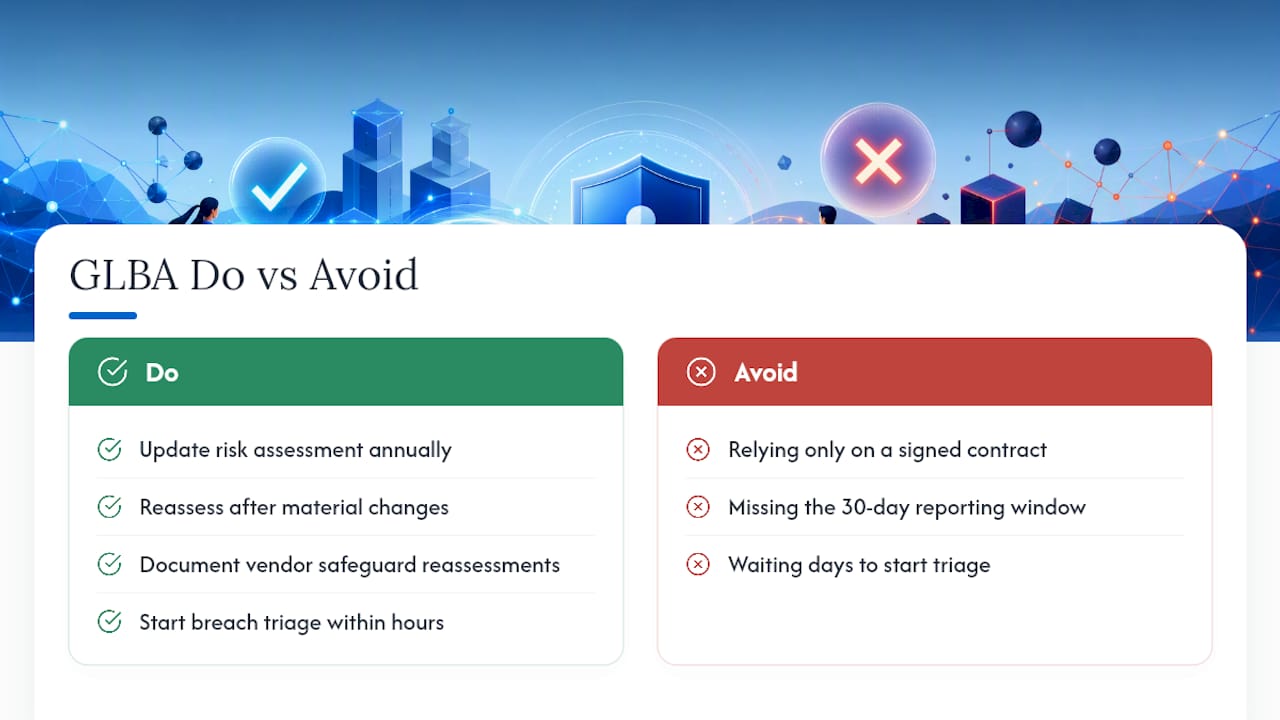
2. Conduct a written risk assessment. Document how you identify threats to customer information, evaluate the sufficiency of existing controls, and how often you reassess. Annual reassessment is standard practice; material changes to your systems should trigger an update regardless of schedule.
3. Design and implement safeguards. This covers access controls, encryption of customer information both in transit and at rest, and multi-factor authentication for anyone accessing systems containing NPI. The rule allows narrow exceptions to encryption where the Qualified Individual determines it's infeasible and approves an equivalent compensating control in writing.
4. Test and monitor. You have two paths here. Continuous monitoring satisfies the requirement on its own. Without it, you need annual penetration testing plus semiannual vulnerability scans. Either way, testing after a material system change isn't optional.
5. Train your workforce. Security awareness training needs to be role-specific and repeated, with attendance records that prove it happened.

6. Oversee service providers. Contracts must require providers to maintain safeguards, and you need periodic evidence, not just a signature on a data processing agreement, that they're actually doing so.
7. Keep the program current. Update your written program based on test results, risk assessment findings, incidents, and changes to your business or technology environment.
8. Maintain an incident response plan. This should define roles, communication protocols, and recovery steps, tested at least annually.
9. Report to the board. The Qualified Individual reports at least annually to the board or an equivalent governing body, covering risk assessment results, testing outcomes, service provider status, and security events.
Self-audit checklist:
- Can you produce a dated risk assessment from the last 12 months?
- Is MFA enforced on every system touching customer NPI?
- Do you have semiannual vulnerability scan reports or continuous monitoring logs?
- Can your Qualified Individual show board meeting minutes referencing their annual report?
- Do vendor contracts specify security obligations, backed by recent evidence of compliance?
What Counts as a Breach Under GLBA?
A "notification event" under the revised Safeguards Rule means unauthorized acquisition of unencrypted customer information affecting a significant number of consumers. The encryption-key caveat matters here: if the data was encrypted and the attacker didn't also get the encryption key, it typically doesn't count as "unencrypted" for reporting purposes.
Once you hit that threshold, the clock starts. You must report to the FTC as soon as possible and no later than 30 days after discovery, using the FTC's online reporting form.
First 72 hours after discovery, work through this sequence:
- Preserve logs, system images, and any forensic evidence before remediation destroys it.
- Determine whether affected data was encrypted and whether the key was compromised.
- Count affected consumers precisely; the threshold determines your reporting obligation.
- Engage legal counsel and your incident response team simultaneously, not sequentially.
State breach notification laws often run on different timelines than the FTC's 30-day window, so coordinate both tracks from day one. Law enforcement can request a delay in public disclosure during active investigations, but that request needs to be documented, not assumed.
Where Do Compliance Programs Usually Fail?
The Qualified Individual role is the single most common failure point examiners flag. Organizations frequently assign the title to a senior executive with no cybersecurity background and no real reporting authority, which defeats the purpose of the requirement.
Testing failures run a close second. A one-time penetration test from three years ago isn't a testing program; it's a historical artifact. The rule expects ongoing monitoring or a current testing cadence, plus retesting whenever you make material changes to systems or vendors.
Vendor oversight is where regulators dig hardest. A signed contract requiring "appropriate safeguards" from a service provider proves nothing on its own. Examiners want evidence of periodic reassessment, security questionnaires, or audit reports from the vendor, not just a clause in a master services agreement.
Pro Tip: If your Qualified Individual can't explain your last risk assessment findings without checking notes, that's a strong signal your program exists on paper more than in practice.
How Do You Build a 30/60/90-Day Compliance Plan?
Start with quick wins that close the biggest gaps fast, then move to the tasks that take longer to execute properly.
- Days 1 to 30: Complete a data inventory identifying every system that touches customer NPI. Formally designate your Qualified Individual. Deploy MFA across all access points to customer data.
- Days 31 to 60: Finish the written risk assessment. Review and update service provider contracts to include specific security obligations. Draft or revise your incident response plan.
- Days 61 to 90: Schedule and complete penetration testing or finalize your continuous monitoring setup. Deliver the first annual report to your board. Document employee training completion.
| Task | Owner | Evidence Artifact |
|---|---|---|
| Data inventory | IT / Qualified Individual | Documented system and data flow map |
| Risk assessment | Compliance officer | Signed, dated written risk assessment |
| MFA deployment | IT security | Configuration logs showing enforcement |
| Vendor contract review | Vendor manager / legal | Updated agreements with security clauses |
| Incident response plan | Qualified Individual / legal | Tested, documented response plan |
Why GLBA Compliance Is a Program, Not a Checklist
The Safeguards Rule is deliberately risk-based. It expects your program to evolve with every test result, every system change, and every incident, not to freeze into a static binder after your first audit. A five-person mortgage broker and a regional lender with thousands of employees will implement the same nine elements very differently, and that's by design.
Smaller institutions should prioritize the Qualified Individual designation and access controls first. Larger organizations need to focus more heavily on vendor oversight and testing cadence, since their attack surface and third-party exposure grow with scale.
How Secure Techies Supports GLBA Safeguards Rule Compliance
Closing the gaps in a GLBA compliance program usually comes down to technical execution: getting MFA deployed everywhere it's required, encrypting data that isn't yet encrypted, and proving your monitoring actually runs continuously instead of once a year.
Securetechie builds these controls for small and mid-size organizations across Southern California that don't have the internal bandwidth to run a full security program alongside daily operations. That includes compliance and security audits mapped directly to the nine Safeguards Rule elements, managed cybersecurity with continuous monitoring and incident response, and infrastructure work covering encryption and access control hardening. If your Qualified Individual needs a technical partner to close documentation gaps before your next exam, schedule a GLBA readiness assessment with Securetechie and get a clear picture of where your program stands today.
Frequently Asked Questions
Does GLBA apply to businesses outside traditional banking? Yes. Mortgage brokers, auto dealers offering financing, tax preparers, and even universities administering financial aid can qualify as financial institutions under GLBA compliance requirements.
What's the difference between the Safeguards Rule and the Financial Privacy Rule? The Safeguards Rule governs your technical and administrative security controls; the Financial Privacy Rule governs what you disclose to customers about data sharing and their opt-out rights.
How often does the risk assessment need updating? Annual reassessment is standard, but any material change to your systems, vendors, or business operations should trigger an immediate update regardless of your regular schedule.
Is a signed vendor contract enough to satisfy service provider oversight? No. Regulators expect periodic reassessment and documented evidence that vendors maintain the safeguards their contract requires, not just a signature on file.
What happens if we miss the 30-day breach reporting window? Missing the FTC's reporting deadline compounds regulatory exposure on top of the breach itself, which is why triage steps like evidence preservation and encryption verification need to start within hours of discovery, not days.
This article is general information, not a substitute for advice from a qualified financial advisor. Consult a qualified financial professional about your own circumstances before acting on anything here.
Sources
- FTC Safeguards Rule: What Your Business Needs to Know
- Gramm-Leach-Bliley Act (FDIC guidance / GLBA Privacy Rule explanation)
- Updates to the Gramm-Leach-Bliley Act Cybersecurity Requirements (Federal Student Aid announcement)