
Choose Vanta if your priority is the fastest path to audit readiness and your tech stack demands broad integration coverage. Choose Drata if your engineering team owns compliance and needs a customizable control engine with dedicated implementation support. That single distinction, who owns compliance internally, is the most reliable predictor of which platform will actually work for your organization.
Three facts sharpen that verdict quickly. Vanta connects to a broad set of integrations significantly more than Drata, runs automated tests more frequently than daily, and achieved FedRAMP Moderate Authorization in early 2026, currently the only platform in this category holding that credential. Drata, after acquiring SafeBase, bundles a native trust portal, scores 9.6/10 on G2 support quality versus Vanta's 9.0/10, and starts at a lower reported entry price. Both platforms support SOC 2, ISO 27001, HIPAA, GDPR, and PCI DSS. Where they diverge is on control customization depth, pricing behavior, and how much internal capacity your team needs to operate them effectively. For SMBs without a dedicated security engineer, outsourcing to a managed provider like Securetechie is often the more practical path.
Table of Contents
- Vanta vs Drata: side-by-side comparison
- How the practical differences affect your audit timeline
- What does pricing actually look like for an SMB?
- How to choose: a checklist for your vendor evaluation
- What these platforms don't cover, and when to outsource
- Key Takeaways
- The real cost of getting this decision wrong
- Securetechie handles compliance when your team can't
- Useful sources
Vanta vs Drata: side-by-side comparison
| Dimension | Vanta | Drata |
|---|---|---|
| Best for | Startups, FedRAMP-adjacent, broad integration needs | Engineering-led teams, multi-framework programs |
| Entry price (reported) | typically starts near $10,000/yr | typically starts near $7,500/yr |
| Monitoring cadence | Hourly | Daily |
| Automation rate | a majority of controls | a majority of controls |
| Auditor collaboration | In-platform | Audit Hub (dedicated environment) |
| Trust center | Add-on (increases TCO) | Native (SafeBase-integrated) |
| FedRAMP authorization | Yes (Moderate, April 2026) | Not available |
| Supported frameworks | — | 30+ |
| G2 support score | 9.0/10 | 9.6/10 |
| Custom framework creation | Limited | Yes (Enterprise tier) |
The primary decision signal: if compliance is owned by your engineering team and you need custom controls, Drata fits. If speed to first audit and integration breadth matter most, Vanta is the default.
How the practical differences affect your audit timeline
Integration breadth is the most immediate differentiator. Vanta offers the broadest integration coverage, including niche DevOps and HRIS tools, while Drata relies more on custom API integrations or manual uploads for uncovered tools. For a mid-size company with a heterogeneous stack, that difference translates directly into fewer exceptions and less compliance team overhead each week.

Monitoring cadence has a real operational impact. Vanta's more frequent automated testing detects misconfigurations within hours, whereas Drata's daily cadence may allow issues to remain undetected for nearly a day. For most SOC 2 Type II controls, that gap is manageable. For high-criticality controls like access management and encryption settings, faster detection genuinely reduces your exposure window.
Drata's Audit Hub is a standout feature for teams that have been through a painful audit. Auditors can request specific evidence tied directly to controls, and the platform pulls it automatically, cutting the email back-and-forth that typically consumes 20–30% of compliance team time during an audit window. Vanta handles auditor collaboration in-platform, which works well given its high auditor familiarity, but lacks the dedicated environment Audit Hub provides.
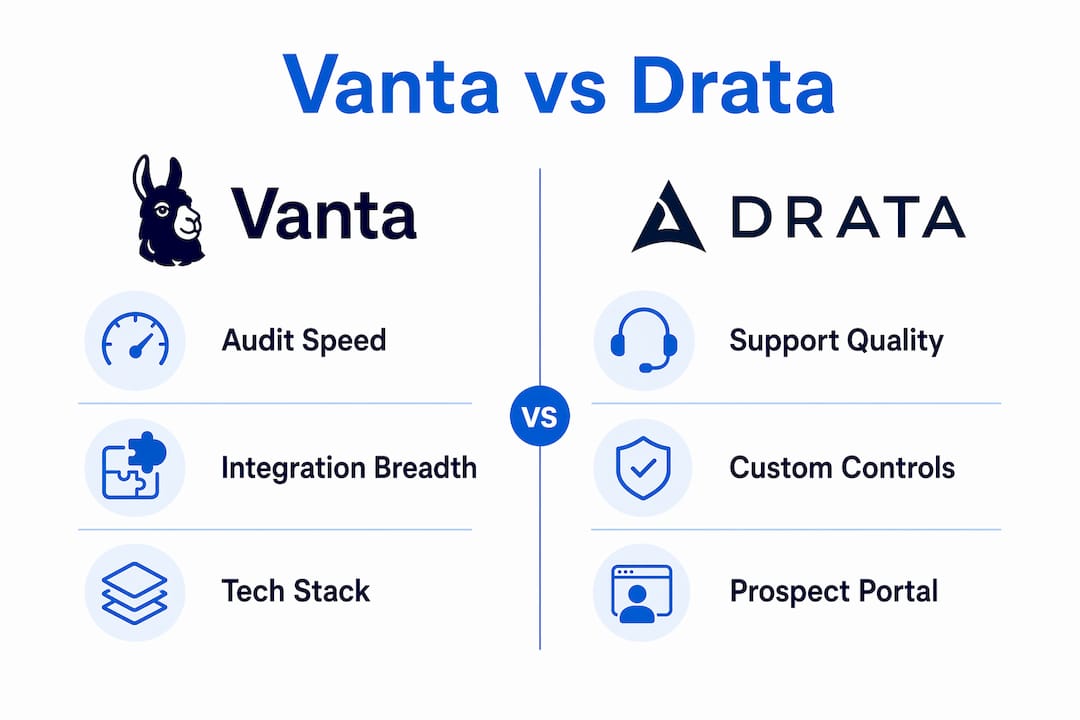
On trust-center capabilities, Drata's SafeBase acquisition gives it a native prospect-facing portal at no additional cost. Vanta's trust center is an add-on that increases total cost of ownership, a meaningful difference if sales enablement is part of your compliance program.
Pro Tip: Before signing with either vendor, ask them to run a live proof of concept using your three most critical integrations. If a connector fails or requires a CSV workaround during the demo, that manual burden will follow you through every audit cycle.
What does pricing actually look like for an SMB?
Neither vendor publishes fixed pricing. Reported buyer data indicate Vanta's entry price often starts near $10,000 per year, while Drata's typically starts near $7,500 per year. Mid-market deals for both scale with company size and selected frameworks, but Drata's initial and mid-market pricing commonly run lower according to buyer reports.
Per-framework add-on fees differ: Vanta charges a standard fee per additional framework, whereas Drata's add-on fees vary by complexity and can offer savings for companies managing multiple frameworks.
Common add-ons that inflate TCO on both platforms include:
- Trust center access (Vanta; bundled in Drata)
- AI agent features and questionnaire automation
- Premium or dedicated customer success manager support
- Additional compliance frameworks beyond the base subscription
Auditor fees are separate from platform costs and vary based on scope and auditor firm. Budget for both line items when modeling total cost of ownership.
Renewal behavior is a known risk on both platforms. Buyers report renewal increases of 30–50% on average. The practical mitigation: negotiate a multi-year deal with a capped renewal increase before signing the initial contract, and bundle all frameworks you anticipate needing in the first two years rather than adding them later at full add-on pricing.
How to choose: a checklist for your vendor evaluation
Work through these steps before your first vendor demo.
- Define who owns compliance. Is it your engineering team, a dedicated compliance officer, or an IT manager wearing multiple hats? Engineering ownership points to Drata; ops or speed-to-audit ownership points to Vanta.
- List your critical integrations. Pull your current stack: cloud providers, SSO, CI/CD tools, HRIS, ticketing. Check each vendor's native connector list before the demo.
- Estimate frameworks needed in the next two years. If you need three or more, Drata's per-framework pricing is likely lower. If FedRAMP is on the roadmap, Vanta is currently the only option.
- Set your audit timeline. Vanta typically gets startups to a first SOC 2 in 3–4 months. Drata's CSM-led model adds guided structure but may extend the initial setup phase.
- Define your budget band and support expectations. Drata's dedicated CSM model suits teams new to compliance. Vanta's self-service approach suits technical teams that prefer to move fast independently.
Ask these specific questions in each vendor demo:
- "Can you auto-collect evidence from [specific tool in our stack] without a CSV upload?"
- "Walk me through the auditor portal workflow from evidence request to delivery."
- "What controls are excluded from automated evidence collection, and how do we handle those?"
- "Show us a sample auditor-readiness report for a company at our stage."
- "What does your renewal pricing look like in year two and year three?"
Score each demo on: integration coverage for your actual stack, time-to-first-evidence dashboard, custom control flexibility, trust center access, and auditor report quality.
What these platforms don't cover, and when to outsource
Both Vanta and Drata are compliance orchestration platforms, not data-security tools. Neither was built to perform data loss prevention, data security posture management, or active threat detection. AI governance and data classification are typically bolt-on capabilities, not native functions. The hardest 20–30% of evidence collection, including admin screenshots, custom application evidence, and last-mile manual uploads, remains manual on both platforms regardless of subscription tier.
Clear signals that outsourcing is the better ROI decision:
- No in-house security engineer or dedicated compliance owner
- High volume of security questionnaires requiring fast, accurate responses
- Need for active remediation capability, not just monitoring and alerting
- Tight sales cycles requiring auditor-ready artifacts within weeks
- Compliance scope that includes DLP, DSPM, or endpoint detection alongside SOC 2
When evaluating managed providers, confirm they deliver evidence remediation (not just collection), DLP and DSPM integration, auditor coordination, and trust-center management. A provider that only monitors without remediating leaves the hardest work on your plate.
Key Takeaways
Vanta wins on integration breadth and audit speed; Drata wins on support quality, per-framework pricing, and engineering-owned control customization. Neither platform eliminates the need for active data-security tooling or a capable internal owner.
| Point | Details |
|---|---|
| Primary decision signal | Who owns compliance internally determines the right platform: engineering-led teams fit Drata, speed-to-audit teams fit Vanta. |
| Integration and monitoring gap | Vanta offers — integrations and hourly monitoring; Drata offers — with daily cadence. |
| Pricing and renewal risk | Both platforms raise renewal quotes by 30–50% on average; negotiate multi-year caps and bundle frameworks upfront. |
| Auditor and trust-center differences | Drata's Audit Hub and native trust center reduce audit friction; Vanta's trust center is a paid add-on. |
| Securetechie as managed alternative | SMBs without a security engineer can outsource SOC 2, evidence remediation, and DLP coverage to Securetechie. |
The real cost of getting this decision wrong
The Vanta vs Drata decision looks like a software selection. In practice, it is a staffing decision in disguise. Both platforms require an active internal owner to manage integrations, review failing controls, handle false positives, and coordinate with auditors. Buyers who treat either platform as a set-and-forget solution consistently report audit delays, missed evidence, and renewal sticker shock.
The procurement mistake Securetechie sees most often is teams signing a platform contract before confirming that their critical integrations work natively. A gap discovered after contract signing means either a manual workaround for every audit cycle or a mid-term platform switch. The recommended process: run a scoped proof of concept covering your top six integrations and one custom control before committing. Get multi-year pricing in writing, with a stated renewal cap, before the trial ends. That two-step sequence prevents the majority of compliance program failures seen in the first year of platform use.
Securetechie handles compliance when your team can't
For SMBs that lack an internal security engineer or compliance owner, running Vanta or Drata effectively is harder than the vendor demos suggest. Securetechie offers a practical alternative: managed compliance and audit support covering SOC 2, HIPAA, CMMC, and ISO 27001, paired with active cybersecurity services including endpoint detection, incident response, and DLP coverage.
This suits businesses that need auditor-ready evidence without dedicating internal headcount to it, teams that want to offload platform renewals and vendor negotiations, and organizations that need both compliance documentation and active data protection under one contract. During an initial scoping call, Securetechie will identify your framework requirements, map your current stack to evidence gaps, and outline a delivery plan with sample deliverables. Contact Securetechie to schedule that conversation.
Useful sources
Use these resources to validate vendor claims, prepare demo questions, and explore managed-service options.
Research sources used in this article:
- Vanta vs Drata 2026: Pricing, Features & Verdict — Ciphers Security analysis on compliance ownership as the primary decision signal
- Vanta vs Drata: How They Compare in 2026 — ComplianceRated buyer data on integrations, monitoring cadence, and renewal behavior
- Vanta vs Drata (2026): Full Comparison + a Third Option — Strac.io analysis on platform gaps in data security and AI governance
- Vanta vs Drata vs Secureframe 2026 — StackFYI buyer-reported pricing ranges and TCO modeling
Securetechie resources for next steps:
- SOC 2 compliance guidance — practical checklist for scoping frameworks and preparing audit questions
- Compliance and security audit services — managed SOC 2, HIPAA, and CMMC support
- Cybersecurity solutions — DLP, EDR, and incident response services that complement compliance automation
When using these links during vendor evaluation, cross-reference the vendor's claimed integration list against your actual stack, and use the SOC 2 checklist to build your demo scorecard before the first call.