
Disaster recovery testing proves, through documented evidence, that your organization can restore critical systems within the recovery time and recovery point objectives your business actually needs. The immediate plan: run or refresh a business impact analysis, choose test types that match your risk profile and maturity, then design each exercise to produce an evidence package, not just a pass/fail impression.
TL;DR:
- Most organizations should conduct annual technical restore tests and quarterly tabletop exercises to validate RTO and RPO effectively.
- Scenarios should be realistic, including ransomware, cloud outages, supplier failures, and human errors, tailored to the company’s risk profile.
- Test plans must include detailed runbooks, clear roles, communication channels, and pre-established rollback procedures to prevent operational disruptions.
- Artifact collection such as timestamps, backup IDs, logs, and screenshots is crucial for producing auditable, usable evidence and tracking improvements.
- Regular after-action reports with documented findings and corrective actions are essential to ensure continuous improvement of the disaster recovery program.
Table of Contents
- What Are the Main Types of Disaster Recovery Testing?
- How Do You Prepare a Disaster Recovery Test Plan?
- What Should a DR Test Plan and Safeguards Include?
- Who Does What During Test Execution?
- How Do You Measure Success in Disaster Recovery Testing?
- Which Scenarios Should You Test, and How Often?
- How Do You Turn Test Results Into Program Improvements?
- A Consultant's View on Where DR Testing Programs Actually Fail
- Let Securetechie Manage Your Disaster Recovery Testing Program
- Where to Find DR Testing Templates and Standards
- Sources
- FAQ
What Are the Main Types of Disaster Recovery Testing?
Most DR programs move through a testing ladder, starting low risk and building toward exercises that touch production. Each rung proves something different, and skipping straight to the hardest test without validating the earlier stages is how organizations get burned during a real outage.
- Tabletop exercises: Participants talk through a scenario, verifying decisions, roles, and communication paths without touching a single system.
- Walkthrough or functional tests: Teams check runbooks and sequencing step by step, confirming the plan makes sense before any system changes occur.
- Technical or restore tests: These validate actual backups, restore procedures, and configuration accuracy, usually in an isolated environment.
- Simulation, parallel, and full interruption tests: These prove end-to-end recovery, running production and recovery environments side by side or actually failing over, and are the only exercises that confirm real RTO and RPO performance.
A tabletop disaster recovery session is cheap and fast, but it only validates human judgment. Only a technical restore or a full interruption test proves your systems and data genuinely come back. Most mature disaster recovery testing plans blend all four levels across a calendar year rather than betting everything on one annual event.
How Do You Prepare a Disaster Recovery Test Plan?
A defensible dr test plan starts with a business impact analysis, not with a test date on the calendar. ISO/TS 22317 recommends a documented, adaptable BIA process that maps services to dependencies and assigns recovery priorities based on actual business impact, not assumption.
- Run or update the BIA. Inventory critical services, map upstream and downstream dependencies, and confirm RTO and RPO figures still reflect current operations, not numbers set three reorganizations ago.
- Set objectives and scope. Decide exactly what the test will prove, whether that's a single application restore or a full site failover, and write it down before recruiting participants.
- Define measurable acceptance criteria. Tie every criterion to RTO/RPO, such as "database restored and validated within 4 hours" rather than a vague "recovery successful."
- List participants and roles. Name who declares the test, who executes it, who observes, and who has authority to abort.
- Document assumptions and prerequisites. Note what has to be true going in, available bandwidth, current backup age, staff availability, so results aren't misread later.
- Establish communications channels. Pick a channel independent of the systems under test, since a chat tool hosted on the same infrastructure you're failing over is a bad backup plan.
NIST SP 800-34 frames contingency planning, including testing, as a living program tied directly to the BIA and updated as systems change, not a document you write once and file away.
What Should a DR Test Plan and Safeguards Include?
A complete disaster recovery strategy document reads less like a memo and more like an operations manual. Guidance aligned with ISO 22301 templates outlines the essential components a plan needs before execution day.
- Scenario definition and schedule, including exact start and end windows
- Roles and decision authority, with a named person able to call an abort
- Runbooks referenced step by step, not summarized from memory
- Evidence requirements, specifying what gets captured and by whom
- Abort conditions, written before the test, not improvised mid-exercise
Blast radius matters as much as scenario choice. Define precisely which systems, accounts, and data the test can touch, and keep that boundary tight for anything beyond a tabletop. Prepare rollback steps and snapshots before you start, isolate test credentials from production credentials, and use golden images so a technical restore test can't accidentally corrupt a live environment. A pre-test dry run, even a short one, catches missing prerequisites that would otherwise derail the real exercise.
Pro Tip: Run your rollback procedure once, deliberately, before the actual test date. An untested rollback plan is just a guess written down, and full interruption tests amplify that risk because they can cause a real outage if the rollback fails.
Who Does What During Test Execution?
Test day runs on assigned roles more than raw technical skill. A facilitator keeps the scenario moving and enforces scope. A timekeeper logs every phase transition with a synced clock. A scribe captures decisions and issues in real time rather than reconstructing them afterward. Observers watch for deviations from the runbook without intervening, and someone holds abort authority to end the test if it threatens production.
The sequence itself should be simple to follow:
- Declare the test start and timestamp it.
- Execute the restore, failover, or recovery steps according to the runbook.
- Validate that recovered services function as expected, not just that they're running.
- Gather artifacts throughout, not only at the end.
- Compare outcomes against the acceptance criteria set during planning and record a judgment.
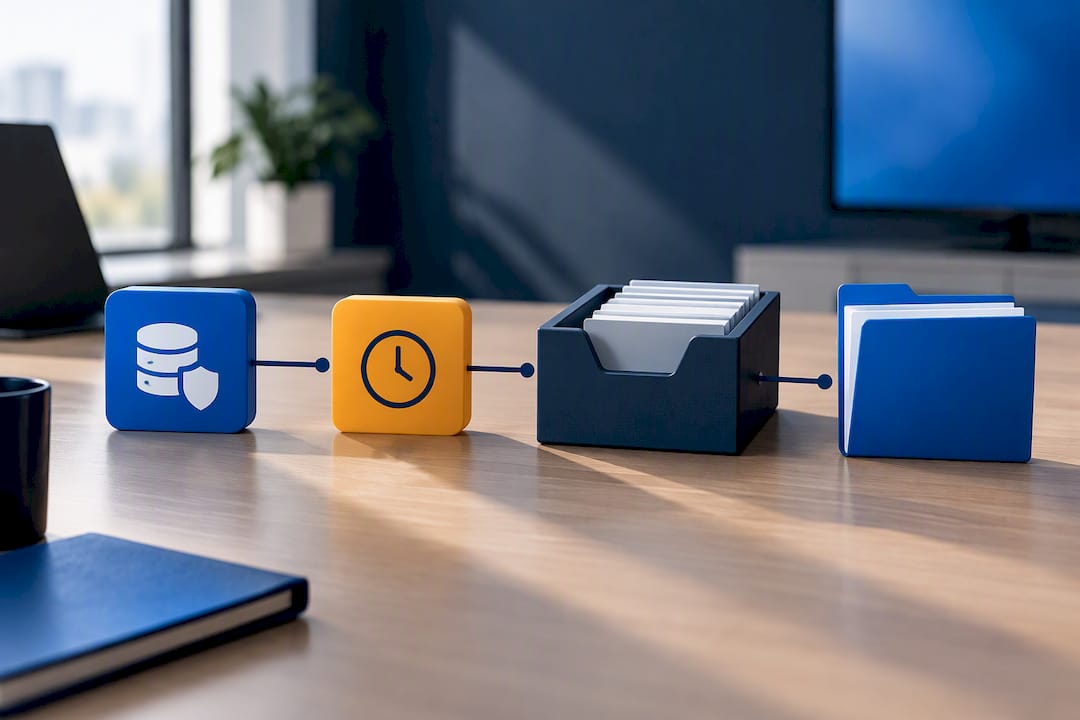
The artifacts matter more than any narrative summary. TechTarget's guidance on disaster recovery testing plans recommends capturing elapsed time from declaration to usable service, backup IDs used, system logs, screenshots of validated services, recovered data checks against RPO, and formal business-user signoff. Automated, time-synced logs beat someone's memory of what happened at 2:14 p.m. The most useful measurables are the ones a machine records automatically rather than the ones a tired participant tries to recall an hour later.
Skipping artifact collection is the single most common reason a technically successful test produces an unusable report. If nobody captured backup IDs or timestamps, you have a story, not evidence.
How Do You Measure Success in Disaster Recovery Testing?
Success in disaster recovery testing means proving RTO and RPO with numbers, not impressions. Timestamps from declaration to usable service prove your actual RTO. Recovered data points compared against your target RPO, say, "database current as of 11:42 a.m. against a 1 hour RPO," prove whether that objective was actually met or quietly missed.
- Verify data integrity by checking recovered records against known-good snapshots, not just confirming a file exists.
- Validate malware-free restorations using offline, encrypted backups and golden images, since CISA's StopRansomware guidance warns that attackers frequently target accessible backups directly.
- Confirm security controls, permissions, firewall rules, access policies, carried over correctly to the recovery environment.
- Build acceptance criteria around specific thresholds: "application responsive within 2 hours" or "zero data loss beyond the 15 minute RPO window."
When a test fails a criterion, that's not a wasted exercise. It's the input for a corrective action item with an owner and a deadline, which is the entire point of running the test in the first place.
Which Scenarios Should You Test, and How Often?
Realistic scenarios beat generic ones. Build test scenarios around ransomware and other adversarial events, cloud or regional outages, DNS and network failures, third-party or supplier loss, and plain human error, since that last category causes more incidents than most IT teams admit.
- Ransomware scenarios should specifically test restoration from offline, encrypted backups, proving recovery doesn't reintroduce malware.
- Cloud or region outage scenarios test failover to a secondary region or provider under realistic latency and bandwidth constraints.
- Supplier failure scenarios test what happens when a critical vendor, payment processor, hosting provider, SaaS platform, goes dark without notice.
- Human error scenarios test recovery from accidental deletion or misconfiguration, which happens far more often than a headline-grabbing attack.
Cadence should match risk and disruption cost. Run tabletop disaster recovery sessions quarterly or after any major organizational change. Run technical restore tests annually at minimum, or immediately after significant infrastructure changes. Reserve full interruption tests for organizations with mature safeguards, and run them sparingly given the operational risk. Regulatory frameworks tied to HIPAA, SOC 2, or CMMC often set explicit testing frequency requirements, so check contractual obligations before defaulting to an annual schedule out of habit.
How Do You Turn Test Results Into Program Improvements?
An after-action report is what separates a real disaster recovery testing plan from a box-checking exercise. NIST SP 800-84 recommends structuring test, training, and exercise programs so that every event feeds a documented evaluation, not just a verbal debrief in a hallway.
- The AAR should record objectives, what was tested, what passed, what failed, and every artifact gathered during execution.
- Every finding needs an owner, a deadline, and a retest trigger so corrective actions don't quietly disappear into next quarter's backlog.
- Keep runbooks, credentials, and vendor contacts stored offline and outage-resistant, since a runbook trapped inside the system you're trying to recover is useless.
- Version-control your golden images and use configuration drift detection so the environment you tested six months ago still matches what you'd actually be restoring today.
| Program element | What it captures | Why it matters |
|---|---|---|
| Evidence package | Timestamps, backup IDs, logs, screenshots | Makes results auditable and repeatable |
| Corrective action log | Owner, deadline, retest trigger | Prevents findings from stalling |
| Drift detection | Configuration changes since last test | Keeps recovery paths valid over time |
A Consultant's View on Where DR Testing Programs Actually Fail
The gap in most disaster recovery programs isn't ambition, it's evidence. Organizations run a technical restore, watch it work, and move on without capturing a single timestamp or backup ID. Six months later, nobody can prove the last test actually validated the current RTO. Securetechie builds every DR engagement around an assessment, a fresh BIA, a low-risk pilot test, and a managed testing cadence that produces an auditable record each time, because a test result you can't document to an auditor or an insurer is barely better than no test at all.
— Alex
Let Securetechie Manage Your Disaster Recovery Testing Program
Running a disaster recovery testing plan on top of daily IT operations usually means it gets postponed until an outage forces the issue. Securetechie's Backup & Disaster Recovery service handles the full cycle: an infrastructure assessment, a current BIA, a pilot technical restore, and ongoing managed testing on a schedule that fits your compliance obligations.
Clients get tested restores instead of assumptions, documented rollback safeguards instead of untested guesses, and an evidence package they can hand to an auditor without scrambling to reconstruct what happened during last quarter's test. That approach pairs naturally with Network Security Solutions for organizations building ransomware recovery into their DR program. Contact You can schedule a disaster recovery assessment to see where your current recovery plan would hold up, and where it wouldn't.
Where to Find DR Testing Templates and Standards
- NIST SP 800-84 for TT&E program structure
- CISA StopRansomware Guide for ransomware-specific test scenarios
- Info-Tech's DR Test Plan Template for a ready-made plan structure
- Business Crisis Response Planning guide for broader crisis communication planning
Sources
- NIST SP 800-84 Guide to Test, Training, and Exercise Programs
- NIST SP 800-34 Rev.1 Contingency Planning Guide for Federal Information Systems
- CISA StopRansomware Guide
- TechTarget: What to include in a disaster recovery testing plan
FAQ
What Is Disaster Recovery Testing?
Disaster recovery testing is the practice of validating, through structured exercises, that an organization can restore critical systems and data within its defined RTO and RPO. It ranges from tabletop discussions to full failover exercises, each proving a different level of readiness.
How Often Should You Run a DR Test?
Tabletop disaster recovery sessions work well quarterly or after major organizational changes, while technical restore tests should run at least annually or after significant infrastructure updates. Full interruption tests should happen sparingly, only once safeguards like rollback plans and blast radius controls are firmly in place.
What's the Difference Between a Tabletop Test and a Technical Test?
A tabletop test validates decisions, roles, and communication through discussion alone, without touching any system. A technical test actually executes a restore or failover, proving whether backups and infrastructure recover in practice, which is the only way to confirm real RTO and RPO performance.
What Should Go Into a DR Test Evidence Package?
An evidence package should include timestamps from declaration to usable service, backup IDs used during restoration, system logs, screenshots of validated services, and formal business-user signoff. This turns a test from a verbal impression into an auditable, repeatable record.
Can Securetechie Manage Our Disaster Recovery Testing?
Yes. Securetechie's Backup & Disaster Recovery service handles assessment, BIA updates, pilot testing, and ongoing managed test cycles with documented evidence packages for each exercise.