A secure construction site is built in layers and planned before the first delivery arrives. You assess what is worth stealing, limit and control access, light and monitor the site when nobody is there, and adjust all of it as the building fills with valuable materials. For contractors and developers in Southern California, the layer that covers nights, weekends and holidays is the one most often missing, and it is where our mobile CCTV trailers with 24/7 monitoring fit.
This guide walks through the plan in the order you would do it on a real project.
TL;DR
- Theft is the main loss on most sites. In a study of 15,274 reported incidents, tools appeared in 39.8% and heavy equipment in 12.1%.
- Recovery is rare, so prevention beats investigation: write a site-specific security plan before work begins.
- Control vehicle access first, then fencing, lighting and cameras. Each layer buys time for the next one to detect and respond.
- Raise security as values on site rise, and tell your insurer before you change anything that weakens protection.
- Unattended hours are the exposure. Video monitoring that runs around the clock covers them.
Table of Contents
- What actually gets stolen from construction sites
- Assess the site before you buy anything
- Perimeter: fencing, gates and vehicle control
- Lighting, signage and visibility
- Cameras and monitoring for the hours nobody is there
- Procedures that cut theft at the source
- Adjust security as the project changes
- Our perspective
- How Secure Techies can help
- FAQ
- Sources
What actually gets stolen from construction sites
Start with the numbers, because they set your priorities. An academic study of 15,274 construction-site theft incidents reported by participating agencies in 2015 found an average loss of $5,864.69 per incident. Tools showed up in 39.8% of incidents and heavy construction equipment in 12.1%. Recovery was below 7% for single-item thefts. The same paper puts annual direct losses to the U.S. industry at about $1 billion.

The lesson is that you rarely get your property back. Money spent before the theft is worth more than effort spent after it.
The typical targets, according to a loss-control guideline from the University of California's risk services, start with building materials, where theft and vandalism are two of the most frequent causes of loss. Insurer guidance adds the wider list of threats: theft of equipment, tools, fuel and materials, vandalism, arson, trespassers, breaches into partly finished areas, and even cyber-attacks on CCTV systems. That last item matters if your cameras connect to the internet: the cameras themselves need to be set up and secured like any other network device.
The same study notes that thieves typically do not attempt a jobsite theft unless they can take items and get away quickly. That one observation explains most of the controls below. You are not trying to build a vault. You are trying to make a quick grab impossible.
Assess the site before you buy anything
A plan based on the project in front of you beats a generic checklist. Insurance risk engineers recommend a site-specific, documented security plan before the project starts. It should include liaison with local police and fire departments, named supervisory responsibilities, a risk register and periodic review as boundaries and scope change.
A workable assessment covers these questions:
- Location. What is the local crime picture, and is the project welcomed by the neighborhood or seen as a target? Allianz's guidance says to weigh location, project type, equipment value and the local socio-economic profile. It also notes that threats can come from a project's own workforce, not only outsiders.
- Values at risk. List what is on site now and what will arrive in each phase: copper, tools, generators, fixtures, appliances, fuel, machines.
- Access points. Walk the perimeter. Note every gate, gap, easement and change in elevation, and where high-value items are stored.
- Hours. Public-sector guidance describes risk as a function of threats, vulnerabilities and consequences. It also stresses that the people who accept a risk own its consequences. Decide deliberately what you are willing to leave unprotected.
- Insurance. Read your builder's risk policy for security conditions before you set the budget, not after.
Write the result down, assign each control to a named person, and decide what happens when something fails: who gets the alert, who calls the police, who has the keys.
If your company also runs an office network, email and job-cost software, the same assessment habit applies there. Our Construction IT Services page covers jobsite IT and CCTV together.
Perimeter: fencing, gates and vehicle control
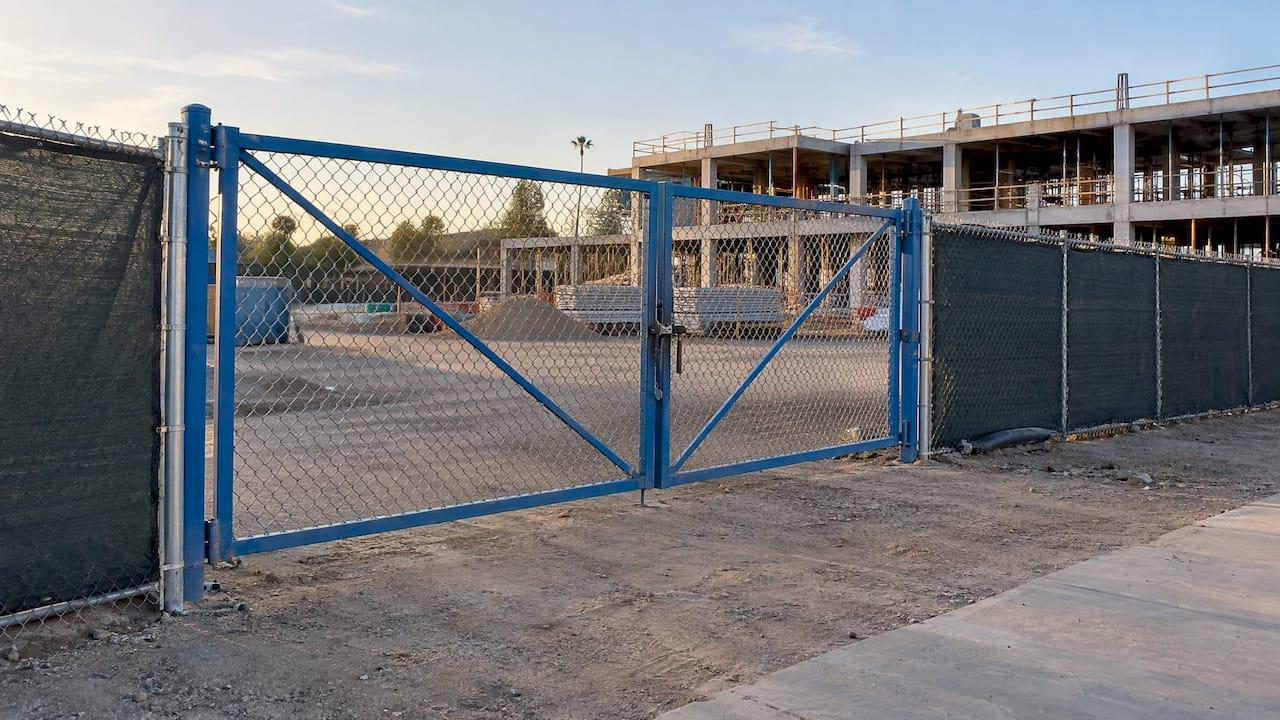
Fencing has two jobs. It stops unauthorized entry, and if someone does get in, it slows how much they can carry out. Chain-link fencing at least 6 feet high is the baseline in one insurance loss-prevention toolbox that cites NFPA 241, the fire-prevention standard for construction sites, unless your insurer's security agreement says otherwise. The same guidance puts a fence check into end-of-day closeout.
Practical rules that hold across the guidance:
- Control vehicles first. The UC risk guideline calls vehicle access control the most critical physical control, because stealing significant value means moving large loads quickly. Limit vehicle entrances, gate them, and ask local police about after-hours patrols.
- Fewer gates. Canton, Michigan's crime-prevention guide suggests one or two gates, and if you cannot enclose the whole site, at least enclose the trailers and material storage.
- Keep sightlines open. See-through fencing is preferred, and the UC guideline recommends removing gawk screens that block the view of the perimeter. A passerby who can see inside is a free witness.
- Harden the trailer. Better hardware on office trailer doors and windows, deadbolts, and cut-resistant padlocks on gates.
- Never leave a gap. The toolbox guidance warns against weakening a measure already in place, such as leaving a section unfenced at the end of the day.
Road and utility projects have their own traffic hazards inside and around the work zone. Those are covered in these road construction safety guidelines.
Lighting, signage and visibility
Bright lighting makes unauthorized access easier to see, which is why the UC guideline lists it as an effective deterrent. Motion-based lighting is preferred in the toolbox guidance over lights left on all evening, because a light that switches on draws attention.

One clarification saves confusion. OSHA's construction rules in 29 CFR 1926 cover worker safety, not theft. Their lighting minimums are about safe working conditions, not security. Security requirements usually come from your contract, your insurer and local fire codes. Check all three.
Post "No Trespassing" signs at access points and a 24-hour emergency phone number. Signage works best when the site visibly has cameras and monitoring behind it.
Cameras and monitoring for the hours nobody is there
According to a Los Angeles security installer's review of theft patterns, incidents cluster overnight, on weekends and around holidays. If your crew works 7 a.m. to 5 p.m., Monday through Friday, roughly 70% of the week is unattended (118 of 168 hours). Fencing slows a thief. Only something watching can start a response.
Two things separate useful video from decoration:
- Someone is watching. A recorder tells you what happened. Live monitoring tells you while it is happening, so a person can speak to the intruder, notify you and dispatch police.
- The camera survives the project. Sightlines change as walls go up. Plan to reposition cameras as the structure changes, and provide backup power for cameras and alarms, as insurer checklists such as Chubb's site security checklist advise.
This is where mobile CCTV trailers suit construction. They go where the risk is, they move when the site changes, and they do not depend on a building's wiring. We deploy them in Southern California with 24/7 monitoring. If you are weighing cameras against a staffed approach, our comparison of remote video monitoring vs. security guards lays out the difference, and our post on AI security cameras explains how analytics help catch activity early. For sites without grid power, see solar security camera trailers, and for fast setup, rapid deployment security trailers.
Some insurers require "active" security once certain conditions are met. A watchman clause generally means documented rounds at least hourly during non-working hours, and the toolbox guidance defines active security as either recorded patrols or a surveillance system. Read your endorsement so the system you choose satisfies it.
Procedures that cut theft at the source
Hardware is half the job. Habits do the rest, and they cost little. We collected more of these in 10 low-cost measures to stop construction site theft.
Time deliveries to use. Schedule lumber, appliances and fixtures to match actual progress so they do not sit on site. Insurer guidance suggests deliveries arrive the morning they are used rather than staged over a weekend.
Install high-risk items last. The U.S. Department of Justice's guidance on burglary at house construction sites advises installing expensive items as close to the end of construction as possible. A Charlotte police-district study found that delaying appliance installation until owners moved in reduced appliance theft with no sign of displacement to nearby districts.
Control who comes in. Only contract employees, named subcontractors and authorized personnel should be on site. The UC guideline notes that unapproved scavengers and recyclers raise theft risk. A loss-control bulletin from a mutual insurer recommends ID badges, sign-in, asking visitors their reason for being there, and requiring everyone to check out.
Track assets. Keep an inventory of tools and equipment, consider tagging and tracking high-value items, and immobilize machines, including hidden ignition disable switches, as Allianz's guidance suggests.
Lock up fuel. Fuel is a recurring target. For a deeper look at the problem, see this guide to diesel theft prevention.
A simple nightly closeout, done by the same person each evening, covers most of this:
- Remove keys from equipment and immobilize machines.
- Store copper, wire and fuel locked and out of sight.
- Lock gang boxes and trailers, and log tool inventory.
- Confirm the fence is intact and every gate is locked.
- Confirm lighting works and that the camera system is armed and monitored.
Adjust security as the project changes
A site on day one holds dirt and a few tools. A site in month eight holds finish materials, fixtures and appliances. The UC guideline says security should match the stage of the job and increase as values and finish materials increase.
Build that into your calendar:
- Groundwork and framing: perimeter, vehicle control, equipment immobilization, lighting.
- Enclosure and rough-in: add monitoring, secure building entrances as soon as the envelope allows, and lock up copper.
- Finishing: tightest controls on deliveries and access, and relocate cameras as sightlines change.
- Idle periods and holidays: raise coverage, since long idle stretches and weekends carry more risk.
Whenever you reduce a measure, such as removing a fence section for a crane, tell your insurer first. The toolbox guidance calls for notifying the insurance company two to three weeks or more before a change that reduces security effectiveness. Review the plan after every incident and every material site change.
Our perspective
Most theft we hear about on construction sites happens when nobody is looking. The fence was up and the gate was locked, but the site was empty for 14 hours.
That is why we treat jobsite security as a monitoring problem as much as a hardware problem. A camera that only records tells you what you lost. A camera that someone is watching around the clock gives you a chance to stop it. We combine 24/7 monitoring with mobile CCTV trailers that we can deploy where your site needs them, and move as the project changes.
Our approach to IT is proactive and preventative, and we apply the same thinking to physical sites: fix the exposure before it becomes an incident. Construction companies also carry client data, bid documents and payment systems, so the same team can look after your network security and backup alongside the trailers on your lots.
Alex
How Secure Techies can help
We are a managed IT provider serving small and mid-size businesses across Southern California, and our offering includes mobile CCTV trailer deployment for surveillance, 24/7 monitoring, network security and backup and disaster recovery. If you are planning a project in the Los Angeles area, start with our guide to construction site security in Los Angeles, then talk to our local team through Secure Techies.

FAQ
What is the first thing to secure on a construction site?
Vehicle access. The UC risk guideline calls it the most critical physical control because stealing significant value requires moving large loads quickly. Limit the number of vehicle entrances, gate them, and make sure the fence is checked at the end of every day.
Does OSHA require construction site security?
No. OSHA's construction standards in 29 CFR 1926 address worker safety, not theft. Security requirements typically come from your contract, your builder's risk insurer and local fire codes such as NFPA 241, so read those documents at the start of the project.
When are construction sites most at risk?
Overnight, on weekends and around holidays, when the site is unattended. Risk also rises during deliveries and as valuable finish materials arrive. Match your coverage to those windows, and increase it as values on site increase.
Should I secure a small residential job the same way as a large commercial one?
The principles are the same, but the scale differs. Security measures should be scaled to the size, location and duration of the project. A small site may need only a fenced storage area, a locked trailer, good lighting and one camera position, while a large project needs several coverage points and a documented plan.
Can I use the same IT provider for my office network and my jobsite cameras?
Yes. We provide managed IT, network security, backup and mobile CCTV trailer deployment, so camera systems, office networks and data protection can be handled by one local team.
Sources
- An Exploratory Look at Thefts from Construction Sites
- Theft and Vandalism, UC Office of the President risk services
- Contractor site security, Allianz Risk Consulting
- Chapter 15 Physical Security, Seattle Public Utilities
- Builder Developer Loss Prevention Toolbox
- Construction Site Crime Prevention, City of Canton, Michigan
- Best Practices Construction Site Security Checklist, Chubb
- Builders Risk Protective Safeguard Endorsements and Warranties, IRMI
- Burglary at Single-Family House Construction Sites, U.S. Department of Justice COPS
- Reducing Theft at Construction Sites, U.S. Department of Justice COPS
- Contractors' equipment theft and vandalism prevention, Grinnell Mutual