
A vulnerability management program is the continuous, governed cycle of finding, prioritizing, fixing, and verifying security weaknesses across your infrastructure before attackers exploit them. The primary outcome is fewer exploitable gaps through closed-loop remediation, not a longer list of findings. Your first move: scope your crown-jewel assets and assign a named program owner today.
- Identify the systems that would hurt most if breached (customer data, financial systems, patient records)
- Assign one accountable owner for the program, not a committee
- Set a target date for your first credentialed scan of those assets.
Key Takeaways
A vulnerability management program reduces exploitable risk by combining continuous scanning, risk-based prioritization using EPSS and CISA KEV data, and SLA-enforced remediation with verified closure.
| Point | Details |
|---|---|
| Program beats tool | A scanner produces data; a governed lifecycle with ownership and SLAs turns that data into closed risk. |
| Prioritize by exploitation | Combine CVSS with EPSS and CISA KEV status so real-world exploited flaws jump the queue. |
| Own every finding | Route findings through your CMDB automatically so nothing sits unassigned. |
| Verify before closing | Close tickets only after an automated rescan confirms the fix worked. |
| Securetechie runs this end to end | Securetechie delivers 24/7 monitoring, SLA-enforced remediation, and audit-ready evidence for regulated Southern California businesses. |
Table of Contents
- What Is a Vulnerability Management Program, Exactly?
- How Does the Vulnerability Management Lifecycle Actually Work?
- Who Owns Vulnerability Management, and What Are Realistic SLAs?
- How Should You Prioritize Vulnerabilities?
- Which Tools and Integrations Do You Actually Need?
- What Does a Working Remediation Workflow Look Like?
- What Metrics Show Your Program Is Actually Improving?
- How Do You Roll This Out in 90 to 180 Days?
- How Does a Managed Provider Execute This Checklist?
- Where to Go for Authoritative Standards and Feeds
- The Part Most Programs Get Backward
- Get a Program That Runs Itself, Not One You Manage by Spreadsheet
- Frequently Asked Questions
- Sources
What Is a Vulnerability Management Program, Exactly?
Confusing a scanner subscription with a vulnerability management program is the single most common mistake we see at Southern California businesses. A scanner produces data. A program turns that data into governed, SLA-driven action with an owner, a deadline, and proof of closure.
The pieces work together but aren't interchangeable:
- Vulnerability scanning: automated discovery of known weaknesses on hosts, apps, or cloud assets
- Vulnerability assessment: a point-in-time analysis that adds context and severity ranking to scan output
- Patch management: the operational process of deploying fixes, one input into remediation
- Penetration testing: manual, adversarial testing to find what scanners miss
Statistic Callout: The NVD grows by many new entries every month, which is exactly why IBM's guidance stresses prioritization over attempting to track every single item. NIST SP 800-40 and the OWASP Vulnerability Management Guide both frame this as a governed lifecycle, not a tool purchase.
How Does the Vulnerability Management Lifecycle Actually Work?
The vulnerability management lifecycle runs in five stages, and skipping the precondition step is why most programs stall before they start.
- Establish asset inventory. You cannot scan what you don't know exists. Build a discovery process before you buy or configure any scanning tool.
- Identify. Run credentialed scans wherever possible. Unauthenticated scans miss local privilege issues and misconfigurations that credentialed scans catch. Layer in software composition analysis (SCA) for open-source dependencies and cloud posture checks for misconfigured storage and identity settings.
- Evaluate and prioritize. Blend CVSS severity with EPSS exploitation probability, CISA KEV status, available exploit intelligence, network reachability, and blast radius if compromised.
- Remediate. Route the finding to an owner with a fix path: patch, configuration change, or compensating control.
- Verify and report. Close the ticket only after a rescan confirms the fix, then log the outcome for audit evidence.
Pro Tip: Treat "verify" as a separate stage from "remediate," not a rubber stamp. Teams that skip automated rescans routinely reopen the same finding within two quarters.
Who Owns Vulnerability Management, and What Are Realistic SLAs?
Governance is what separates a program from a spreadsheet nobody updates. You need three defined roles: a program owner who sets policy and reports upward, remediation owners embedded in each infrastructure or application team, and a steering committee that approves risk acceptance and reviews exceptions quarterly.
Your written policy should spell out:
- Scope: which assets, environments, and business units are covered
- SLA windows: separate clocks for triage versus full remediation
- Exception process: who can approve risk acceptance, and for how long
- Audit evidence: what gets logged for compliance review
Realistic SLA baselines from practitioners in the field: KEV-listed or actively exploited vulnerabilities get mitigated within 48 hours and fully remediated within 7 days, with longer windows for lower-severity internal findings. Every exception needs an expiration date. An "accepted risk" with no review date is how critical findings sit open for years.
How Should You Prioritize Vulnerabilities?
CVSS alone generates a flood of "critical" findings that will never be exploited, which is why relying on severity score alone burns out remediation teams fast. A workable risk-based queue blends multiple signals into one operational score.
- Start with CISA KEV status. Anything on that list jumps to the front regardless of CVSS score.
- Layer in EPSS to estimate real-world exploitation probability for everything else.
- Factor reachability: is the vulnerable component actually exposed, or buried behind three layers of network controls?
- Weigh blast radius: what does an attacker reach next if this asset is compromised?
Statistic Callout: Combining CVSS with exploit evidence, EPSS, and reachability into a single routing score is how practitioners avoid drowning remediation teams in false urgency. For findings you genuinely cannot patch (legacy systems, vendor dependencies), document a compensating control and a timeboxed exception rather than leaving the finding open indefinitely.
Which Tools and Integrations Do You Actually Need?
No single scanner covers everything. A functioning stack usually includes network and host scanners, web application DAST tools, SCA for open-source libraries, container image scanners, and cloud security posture management for misconfigurations.
The pattern that prevents chaos is scanner → orchestration → ITSM:
- Feed all scanner output into an orchestration layer that deduplicates overlapping findings across tools
- Tie that layer to your CMDB so every finding routes to a named owner automatically
- Push tickets into your existing ITSM platform (ServiceNow, Jira, or similar) with full context attached
- Trigger automated rescans on ticket closure so verification isn't a manual afterthought
The ShieldIQ guide to patch management for SMBs covers practical SLA and deployment considerations worth reading if patching is your biggest bottleneck.
What Does a Working Remediation Workflow Look Like?
Findings stall when there's no clear handoff between security and the team that actually fixes things. A six-stage workflow closes that gap:
- Detect the finding via scanner or SCA tool.
- Enrich it with asset criticality, EPSS score, and KEV status.
- Route it to the owner listed in your CMDB, automatically.
- Assign with a due date tied to your SLA policy.
- Fix through patch, config change, or compensating control.
- Verify and close with an automated rescan, not a self-reported checkbox.
Contextual ticket content matters more than most teams realize: a ticket that just says "CVE-2026-XXXXX, critical" gets deprioritized behind feature work every time. One that includes exploitability, business impact, and a suggested fix gets worked first.
Pro Tip: Build conditional escalation into your orchestration layer. If a critical, KEV-listed finding sits untouched for 24 hours, it should auto-escalate to the remediation owner's manager, no human triage required.
What Metrics Show Your Program Is Actually Improving?
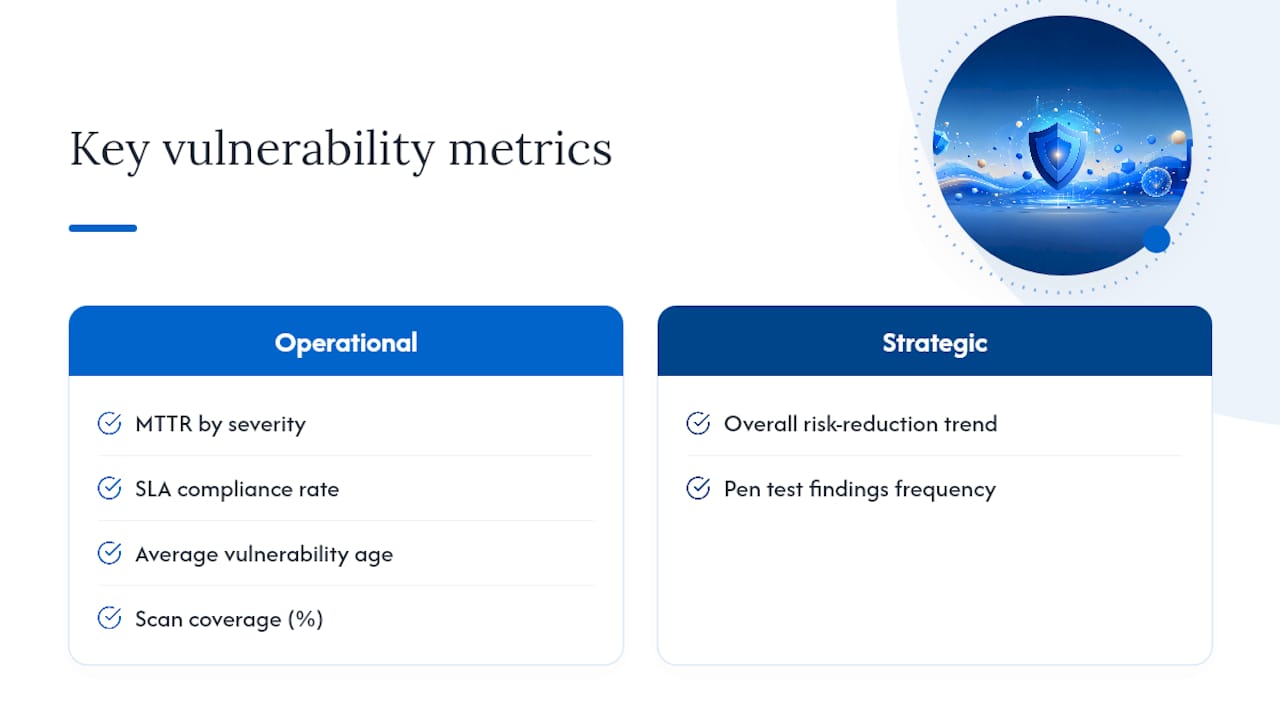
Track operational metrics weekly and strategic metrics quarterly. Operational metrics include mean time to remediate (MTTR) broken out by severity, SLA compliance rate, average vulnerability age, and scan coverage percentage across your asset inventory. Strategic metrics include your overall risk reduction trend and findings surfaced in periodic penetration tests.
Programs mature through multiple recognized levels of vulnerability management maturity, ranging from reactive scanning to automated remediation with measurable risk reduction. Many SMBs operate in the intermediate stages, and moving toward a prioritization-driven approach significantly improves risk management.
How Do You Roll This Out in 90 to 180 Days?
Start narrow. A phased rollout beats a big-bang program every time.
- Days 1 to 30: Scope crown-jewel assets, map ownership in your CMDB, and configure credentialed scans on your most critical hosts.
- Days 30 to 90: Define SLA windows, automate ticket creation into your ITSM tool, and run your first two triage cycles to establish a baseline MTTR.
- Days 90 to 180: Expand scan coverage, add SCA for dependency findings, and automate rescans for ticket closure.
Quick wins worth grabbing early: dependency version upgrades flagged by SCA tools, internet-facing asset hardening, and automated rescans that eliminate manual verification busywork.
Pro Tip: Watch for two traps that kill momentum: unowned findings sitting in a queue nobody checks, and duplicate tickets generated when two scanning tools flag the same issue without deduplication. Both are CMDB and orchestration problems, not scanning problems.
Coordinating remediation with your broader incident response plan also matters here. A vulnerability that gets actively exploited before remediation completes should trigger your incident process immediately, not sit in the normal ticket queue.
How Does a Managed Provider Execute This Checklist?
Securetechie runs this exact lifecycle for Southern California businesses that don't have a dedicated security team to own it internally. That means 24/7 monitoring against defined SLA windows, remediation coordination across your IT vendors, and audit-ready evidence for HIPAA, SOC 2, and CMMC compliance reviews.
When evaluating any managed provider against this checklist, ask three questions:
- Do they show verified rescan results, or just closed tickets?
- Can they produce audit evidence on demand, not after a scramble?
- Do they enforce SLA windows with escalation, or just report findings and move on?
Where to Go for Authoritative Standards and Feeds
- NIST SP 800-40: the federal standard for building and testing a patch and vulnerability management program.
- OWASP Vulnerability Management Guide: practical, repeatable cycle guidance for teams starting small.
- CISA KEV catalog: the definitive list of vulnerabilities under active exploitation.
- NVD: the authoritative source for CVE lookups and scoring metadata.
The Part Most Programs Get Backward
Most vulnerability management advice treats CVSS score as the finish line: patch everything critical, work down the list, call it done. That's backward, and it's why so many security teams burn out chasing findings nobody was ever going to exploit. The evidence points the other direction. CISA's own KEV catalog exists precisely because CVSS misses the signal that actually matters: is this thing being used against real targets right now?
The programs that hold up over time treat prioritization as an engineering problem, not a scoring exercise. They blend EPSS, KEV status, and reachability into one operational number and let that number drive the queue. They also treat ownership as the real bottleneck, not scanning. A finding with no assigned owner in the CMDB is a finding that will still be open in a year, regardless of its CVSS score.
If you take one thing from this guide, make it this: fix the ownership map before you buy another scanning tool. That's where the actual remediation velocity comes from.
Get a Program That Runs Itself, Not One You Manage by Spreadsheet
Southern California businesses running vulnerability management through a shared spreadsheet and quarterly scan reports usually find the gaps show up during an audit, not before. Securetechie built its managed cybersecurity service around the exact lifecycle covered here: continuous monitoring, SLA-enforced remediation coordination, and audit-ready evidence for HIPAA, SOC 2, and CMMC reviews, without needing to hire a dedicated security team.
If your organization handles patient data, financial records, or client information and needs a program that runs on defined SLAs rather than best effort, Securetechie's cybersecurity solutions team can scope your critical assets and show you exactly where your current coverage has gaps. Southern California businesses in Santa Monica, Sherman Oaks, and Burbank can request a review directly through Securetechie's team to see what a fully governed program looks like against your actual environment.
Frequently Asked Questions
What's the difference between vulnerability management and vulnerability assessment?
A vulnerability assessment is a point-in-time snapshot: scan, analyze, report. A vulnerability management program is the ongoing, governed cycle around it, with SLAs, ownership, and verification that turns each assessment's findings into tracked, closed work.
How often should you run vulnerability scans?
Internet-facing and critical assets warrant continuous or weekly scanning at minimum. Internal, lower-risk assets can run on a monthly cycle. The right cadence depends on your SLA policy and how quickly new CVEs affect your environment.
Do small businesses need a formal vulnerability management program?
Yes. Attackers don't check company size before scanning for exposed, unpatched systems. A lightweight program with clear ownership and basic SLAs beats no program at all, and it's far easier to build correctly from the start than to retrofit later.
What is EPSS and how is it different from CVSS?
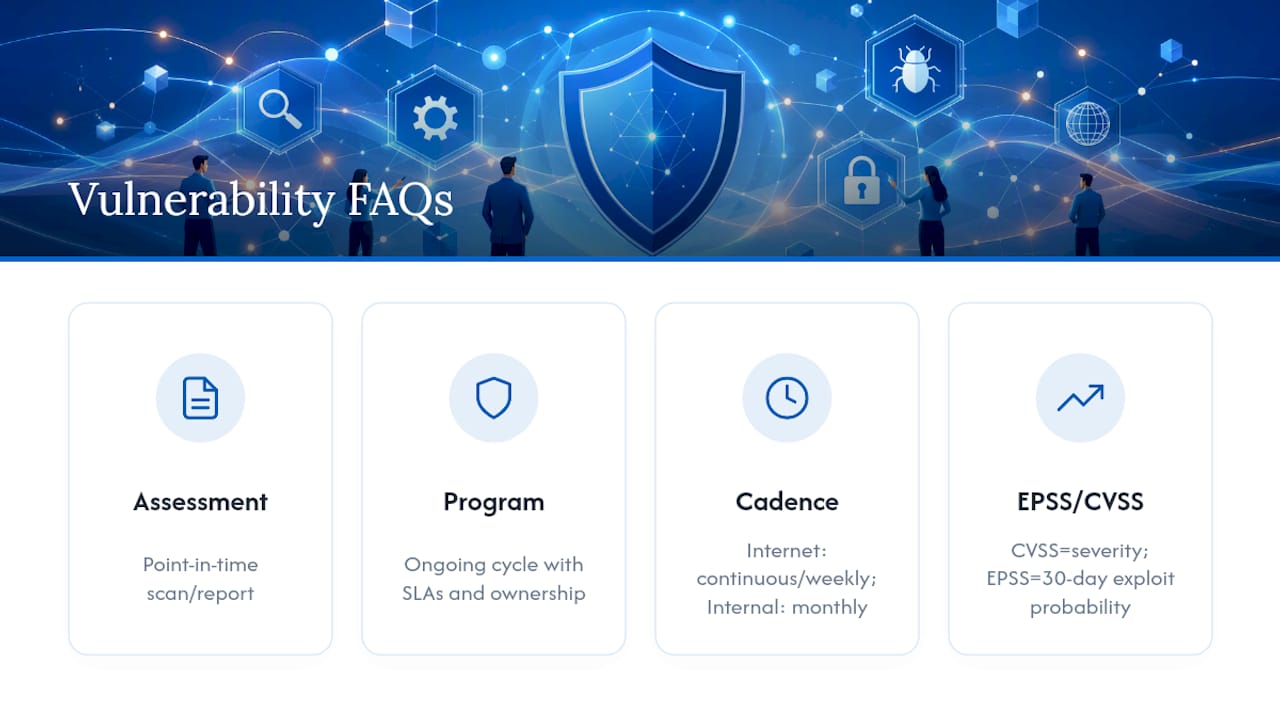
CVSS scores the potential severity of a vulnerability. EPSS estimates the probability it will actually be exploited in the next 30 days. Using both together, alongside CISA KEV data, produces a much sharper prioritization queue than CVSS alone.
Sources
- Creating a Patch and Vulnerability Management Program (NIST SP 800-40 Version 2)
- OWASP Vulnerability Management Guide (OVMG)
- CISA Known Exploited Vulnerabilities (KEV) catalog
- NVD (National Vulnerability Database)