
A vendor security questionnaire is a structured set of questions that turns vendor self-report into a defensible risk decision, but only when it is built correctly. The single best practice that separates effective programs from paperwork exercises is this: tier every vendor by risk before sending anything, and require evidence behind every "Yes" answer. Skip either step and the questionnaire becomes a compliance formality instead of a real control.
TL;DR:
- Tier vendors based on data sensitivity, integration scope, and business criticality before sending questionnaires, to ensure relevant and efficient assessments.
- Require vendors to provide evidence for all affirmative answers, such as policies, configuration screenshots, or certification reports, to verify claims.
- Use standardized templates like SIG, CAIQ, or NIST for different vendor profiles, customizing questions according to risk levels and regulatory requirements.
- Conduct regular reassessments aligned with vendor risk tiers, with critical vendors reviewed every 6 to 12 months, and ensure documentation justifies tier assignments.
- Implement a clear workflow with ownership at each stage—intake, scoring, evidence collection, and decision—to prevent questionnaires from becoming uncontrolled email threads.
Table of Contents
- What Does a Vendor Security Questionnaire Cover, and Why Does It Matter?
- What Are Good Vendor Security Questionnaire Questions?
- How Do You Tier Vendors to Scope the Right Questionnaire?
- What Is the Right Workflow for Sending and Scoring Questionnaires?
- How Should Vendors Respond to Security Questionnaires?
- What Are the Most Common Pitfalls in Vendor Questionnaires?
- Which Standard Templates Should You Use: SIG, CAIQ, VSA, or NIST?
- Secure Techies' Perspective: How We Run Vendor Assessments
- How Secure Techies Supports Vendor Security Questionnaires
- Sources
What Does a Vendor Security Questionnaire Cover, and Why Does It Matter?
A vendor security questionnaire is a risk-assessment tool that asks a supplier to describe its security posture across a defined set of domains before your organization signs a contract or grants system access. It matters because procurement decisions made without this step routinely expose companies to breaches that trace back to a third party with weaker controls than the buyer assumed.
Most well-built questionnaires assess:
- Governance and security policy maturity
- Access control and identity management
- Encryption for data at rest and in transit
- Vulnerability and patch management practices
- Incident response planning and breach notification timelines
- Data handling, retention, and disposal procedures
- Subprocessor and fourth-party oversight
- Business continuity and disaster recovery capability
- Regulatory compliance status (HIPAA, SOC 2, ISO 27001, GDPR)
These answers feed directly into procurement approval workflows, contract terms, and ongoing risk scoring. A vendor that fails on encryption or incident response might still be approved, but with compensating controls written into the contract terms and ongoing risk scoring.
The catch: a questionnaire captures a single moment in time, and it relies on the vendor telling the truth about itself. Gartner recommends pairing questionnaire responses with continuous monitoring or security ratings, since self-reported answers can go stale within months of submission.

What Are Good Vendor Security Questionnaire Questions?
Strong questions request evidence, not opinions. Here are representative examples across the categories that matter most:
- Access control: "Do you enforce multi-factor authentication for all administrative access to systems handling our data?" Request a screenshot of the MFA policy configuration.
- Encryption: "What encryption standard protects data at rest and in transit?" Ask for the specific algorithm (AES-256, TLS 1.2 or higher) rather than accepting "industry standard."
- Incident response: "Have you experienced a security incident in the last 24 months, and what was the notification timeline?" Request the IR plan itself, not a summary.
- Vulnerability management: "How frequently do you run vulnerability scans, and what is your patch SLA for critical findings?"
- Data handling: "Where is our data physically stored, and how is it destroyed at contract termination?"
- Subprocessors: "List all subprocessors with access to our data and their geographic location."
- Compliance: "Do you hold a current SOC 2 Type II report or ISO 27001 certification?" Ask for the report itself, or at minimum the audit period covered.
Phrase questions to force specificity. "Do you have a security program?" invites a checkbox. "What framework governs your security program, and when was it last audited?" invites proof.
How Do You Tier Vendors to Scope the Right Questionnaire?
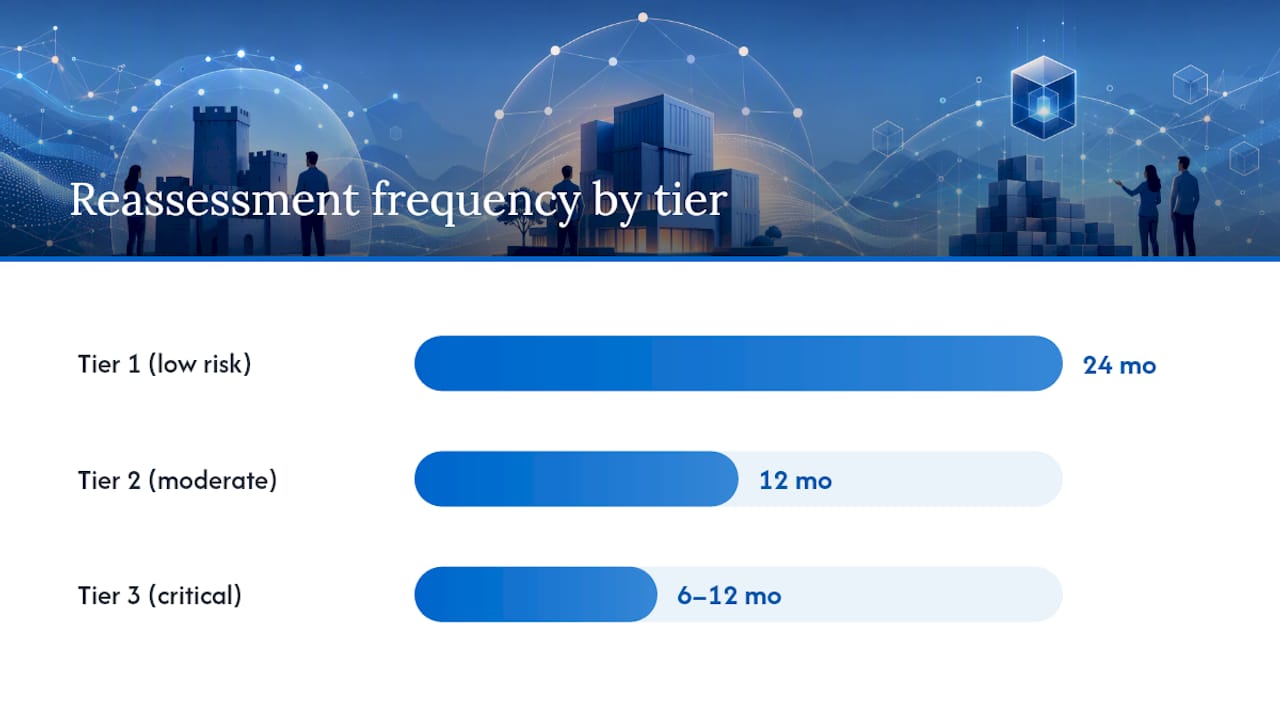
Sending a 150-question form to a vendor that only processes your marketing newsletter wastes everyone's time. Sending a 20-question form to a payroll processor holding employee Social Security numbers is negligent. Tiering solves both problems by scoring vendors on data sensitivity, integration depth, privileged access, and business criticality before you decide which questionnaire to send.
A practical field-tested model looks like this:
- Tier 1 (low risk): No sensitive data, no system integration. Send a lightweight questionnaire of 15 to 25 questions and reassess every 24 months.
- Tier 2 (moderate risk): Some sensitive data or limited integration. Send a scoped questionnaire of 60 to 120 questions, drawn from a standard template, and reassess annually.
- Tier 3 (critical risk): Regulated data, deep integration, or privileged system access. Send a full questionnaire exceeding 120 questions, often the full SIG or equivalent, and reassess every 6 to 12 months, according to one field guide's tiering model.
Lock the tier assignment before the questionnaire goes out, and document the scoring rationale (data type, access level, criticality) in the vendor file. Auditors ask why a vendor landed in a given tier, and "we felt like it" is not an answer that survives a SOC 2 audit.
What Is the Right Workflow for Sending and Scoring Questionnaires?
A questionnaire without a defined workflow turns into an email thread that nobody owns. Build the process around five stages with clear ownership at each handoff.
- Intake: Capture vendor name, contract value, data types accessed, integration scope, and business owner before anything else. Incomplete intake data is the most common reason tiering gets done wrong.
- Tiering: Score the vendor using the criteria above and assign the questionnaire template.
- Send and track: Set a response SLA, typically 10 to 15 business days for standard vendors, with evidence uploads due alongside answers, not after.
- Evidence collection and review: Score each response against the evidence provided, not the claim alone.
- Decision and sign-off: Risk owner approves, conditionally approves with compensating controls, or rejects. Record the decision and the evidence that supported it.
Pro Tip: Build the evidence upload requirement directly into your questionnaire portal so vendors can't submit a "Yes" answer without attaching the artifact. It cuts weeks off the back-and-forth chase for missing documentation.
How Should Vendors Respond to Security Questionnaires?
Vendors that answer honestly, with proof, move through review faster and build long-term trust with buyers. There are three legitimate response formats, and a credible vendor uses all three depending on the question.
- Yes, with evidence path: State the control exists and name the artifact (policy document, SOC 2 report, configuration screenshot) that proves it.
- No, with remediation plan: Admit the gap and provide a dated timeline for closing it, rather than leaving the box blank or fudging the answer.
- N/A, with justification: Explain why the control doesn't apply to this engagement, such as a control governing physical data centers when the vendor uses a cloud provider's infrastructure.
When a vendor lacks a certification like SOC 2 or ISO 27001, the workable middle ground is an interim evidence package: security policies, a penetration test summary, an incident response plan, and a documented certification timeline. One response guide warns that overclaiming "Yes" on a control that doesn't exist creates contractual exposure once a breach investigation surfaces the gap. Vendors that maintain a master answer library with pre-linked evidence, reviewed quarterly, consistently turn around questionnaires faster and with fewer inconsistencies across customers.
What Are the Most Common Pitfalls in Vendor Questionnaires?
Most questionnaire programs fail quietly, not dramatically. The forms go out, come back marked "Yes" across the board, and nobody checks further until a breach happens. Watch for these recurring failure patterns:
- One-size-fits-all forms sent to every vendor regardless of risk, which either overwhelms low-risk suppliers or under-scrutinizes critical ones.
- Unverified "Yes" claims accepted at face value with no supporting artifact attached.
- Stale evidence, such as a SOC 2 report from three audit cycles ago still sitting in the vendor file.
- Ignoring subprocessors, where the primary vendor is solid but a fourth party handling backups has no controls at all.
Verification does not require a full audit. Spot-check a sample of SOC 2 or ISO 27001 artifacts against the claims made, request a portal screenshot of an access control setting, or send a targeted follow-up question when an answer feels generic. Escalate to a deeper assessment or continuous monitoring when a Tier 3 vendor's evidence is thin, contradictory, or more than 12 months old.
Which Standard Templates Should You Use: SIG, CAIQ, VSA, or NIST?
Building a questionnaire from scratch wastes time that a standard template already solves. Each major framework fits a different vendor profile.
- SIG (Shared Assessments): The broadest and most customizable template, well suited for complex or non-cloud vendors across finance, healthcare, and manufacturing.
- CAIQ (Cloud Security Alliance): Maps directly to cloud control frameworks, which makes it the lower-friction choice for SaaS and cloud-native vendors, according to the Vendor Security Alliance.
- VSA (Vendor Security Alliance): Offers VSA-Full and VSA-Core versions, giving teams a scaled option depending on vendor tier.
- NIST SP 800-161r1: Provides supply chain risk management guidance that informs which control domains and evidence types belong in your questionnaire, particularly for vendors touching critical infrastructure or government-adjacent work, per NIST's own publication.
- FedRAMP: The relevant baseline when a vendor serves federal agencies or claims cloud authorization; FedRAMP artifacts are acceptable evidence for cloud-specific control claims.
For quick procurement decisions on low-risk vendors, a shorter baseline like the 20-question template from IsItPatched works, though it still flags the gap between what a vendor claims and what independent verification (open CVEs, CISA's Known Exploited Vulnerabilities list) actually shows. Customize a standard template when your industry has specific regulatory needs; use it unmodified when speed matters more than precision.
Secure Techies' Perspective: How We Run Vendor Assessments
We built our compliance audit practice around a simple rule: a questionnaire answer is a claim, not a fact, until evidence backs it. Our team scopes vendor risk first, pulls the right template, and cross-checks SOC 2, HIPAA, and CMMC artifacts against what a vendor actually submits, not just what they say. That approach comes out of running compliance work for Southern California healthcare practices, law firms, and financial services firms where a wrong answer on a subprocessor question has real regulatory consequences.
DIY questionnaire review works fine for a handful of low-tier vendors. Once you're managing dozens of vendors across multiple tiers with evidence expiring on different cycles, a managed partner keeps the process from quietly falling apart.
— Alex
How Secure Techies Supports Vendor Security Questionnaires
Securetechie's compliance and security audit team handles the parts of vendor assessment that eat the most internal time: scoping vendor tiers, reviewing SOC 2 and ISO evidence packages, and building out compliance and security audit programs that hold up under HIPAA, CMMC, or SOC 2 scrutiny.
Rather than leaving your team to chase down stale evidence or interpret a vendor's vague "Yes," Securetechie runs the evidence review as an impartial third party, flagging gaps before they become contract or breach exposure. That is a different position than a vendor marking its own homework. If your organization needs managed infrastructure and IT support alongside vendor risk review, a scoping call is the fastest way to see where your current questionnaire process has blind spots. Reach out to Securetechie to schedule that conversation and get a clear read on your third-party risk posture.