
Most U.S. small and mid-size businesses pay between $100 and $250 per user per month for managed IT services, according to On-Site Technology's 2026 pricing guide. That cost increases significantly when the service scope includes enterprise-grade endpoint detection and response (EDR), around-the-clock monitoring, and compliance requirements such as HIPAA or CMMC. The range is broad because "managed IT" is not a single product. It covers everything from basic remote monitoring to fully managed help desk, backup and disaster recovery, and regulatory audit support. The right budget depends on one variable above all others: whether your environment requires security and compliance coverage, or whether standard monitoring and support will do.
A practical starting rule: if your business operates in a regulated industry (healthcare, finance, legal) or handles sensitive client data, budget at the higher end of the range from day one. If you run a standard office environment with no compliance mandates, a mid-tier package in the $125–$175 per user per month range typically covers the core services most SMBs need.
Key factors that determine where your quote lands:
- Security scope: EDR, managed detection and response (MDR), and 24/7 security operations center (SOC) coverage add $30–$80 per user per month on top of base pricing.
- Coverage hours: Business-hours-only support costs less than 24/7 coverage, often by $20–$40 per user per month.
- Compliance requirements: HIPAA, SOC 2, CMMC, or GDPR compliance support typically pushes monthly rates toward the $200–$350 range.
- Device mix: Environments with servers, specialized hardware, or a high device-to-user ratio may be priced per device rather than per user.
Key Takeaways
Most U.S. SMBs should budget $100–$250 per user per month for standard managed IT, rising to $300–$400 for security-heavy or compliance-mandated environments, with onboarding fees adding $1,500–$6,000 in the first year.
| Point | Details |
|---|---|
| Baseline price range | Budget $100–$250/user/month for standard scope; $300–$400 for compliance-heavy environments. |
| Onboarding fees are separate | Expect $1,500–$6,000 one-time; require a written deliverable list before paying. |
| Low rates often omit security | A $100/user quote may exclude EDR, 24/7 monitoring, and backup — compare scope, not just price. |
| Normalize every quote | Use an inclusion checklist mapped to NIST's five core functions before comparing monthly totals. |
| Securetechie for Southern California | Securetechie builds scoped managed IT proposals covering infrastructure, security, and compliance for SMBs. |
Table of Contents
- What will managed IT pricing actually cost your team each month?
- Which managed IT pricing model fits your business?
- What does a managed IT monthly fee typically include?
- What factors push your quote toward the high end of the range?
- What should you know about onboarding fees and contract terms?
- How do you estimate your actual monthly bill?
- How do you compare MSP quotes without getting misled?
- Why headline per-user pricing is often misleading
- What actually matters when choosing an MSP
- Securetechie delivers managed IT with the security depth SMBs in Southern California actually need
- Sources
What will managed IT pricing actually cost your team each month?
The table below translates per-user rates into real monthly totals for three common SMB sizes. Low-tier assumptions include remote monitoring, basic help desk (business hours), and patch management. Mid-tier adds EDR, backup and disaster recovery, and extended support hours. High-tier includes 24/7 monitoring, full security stack, compliance support, and on-site visits.
| Company Size | Low Tier ($100/user) | Mid Tier ($175/user) | High Tier ($300/user) |
|---|---|---|---|
| 10 users | $750/mo | $1,250/mo | $2,500/mo |
| 25 users | $2,500/mo | $3,750/mo | $6,250/mo |
| 100 users | $10,000/mo | $12,500/mo | $18,750/mo |
These figures reflect per-user pricing only and exclude onboarding fees, hardware, and vendor software pass-throughs. Per-device pricing, which Relia Software's pricing guide documents as commonly running $25–$150 per device per month depending on device type and service scope, is an alternative model covered in the next section.
Regional variation matters. MSPs in major metro areas such as Los Angeles, New York, and San Francisco typically charge notably more than providers in smaller markets, reflecting higher labor and overhead costs. Urban providers also tend to offer faster on-site response times, which is a real operational advantage for businesses that cannot afford extended downtime. Most MSPs also enforce minimum seat counts to cover fixed monitoring and licensing overhead, often starting at a few users above actual headcount. A 7-person team quoted at $150 per user may effectively be billed at a 10-seat minimum, making the true per-user cost $107 at the minimum floor. Always confirm the minimum and calculate the effective rate against your actual headcount.
Which managed IT pricing model fits your business?
Channel Dive's analysis of the six common MSP pricing models shows that no single model dominates the market. MSPs choose structures based on their cost base, and buyers should choose based on their environment and risk tolerance.
Per-user pricing
Every employee covered under the contract pays a flat monthly rate regardless of how many devices they use. This model works well for businesses where employees use multiple devices (laptop, desktop, mobile) and need consistent support across all of them. Predictable billing makes budgeting straightforward.
- Typical range: $100–$250/user/month for standard scope; $200–$400/user/month for security-heavy environments
- Best for: Professional services firms, remote-first teams, businesses with a high device-to-user ratio
- Watch out for: Some contracts cap the number of devices per user; exceeding the cap triggers add-on charges
Per-device pricing
A flat rate applies to each managed device, regardless of who uses it. This model suits environments with shared workstations, kiosks, or a low user-to-device ratio.
- Typical range: $25–$75/device/month for workstations; $100–$150/device/month for servers
- Best for: Retail, manufacturing, or healthcare environments with shared terminals
- Watch out for: Costs scale quickly in device-heavy environments; a 50-device office can exceed per-user pricing at the same scope level
Tiered pricing
Providers offer two to four defined service bundles (often labeled Silver, Gold, Platinum or similar). Each tier adds services and raises the per-user or per-device rate. This is the most common structure SMBs encounter.
- Typical range: $75–$125 (entry), $150–$200 (mid), $225–$350 (premium) per user per month
- Best for: Businesses that want a clear scope without custom negotiation
- Watch out for: Tier boundaries may not align with your actual needs; you may pay for features you do not use at the next tier up
Monitoring-only pricing
The MSP monitors systems and alerts your internal team but does not provide active remediation or help desk support. This is the lowest-cost model and is often misrepresented as "managed IT."
- Typical range: $15–$40/device/month
- Best for: Businesses with an internal IT person who needs visibility tools
- Watch out for: This is not a replacement for full managed IT; it provides no help desk, no patching, and no active response
All-you-can-eat (value-based) pricing
A single flat monthly fee covers all IT support, regardless of ticket volume. MSPs price this based on their assessment of your environment's complexity and expected support demand.
- Typical range: $2,000–$10,000+/month for small to mid-size businesses, depending on scope and headcount
- Best for: High-volume support environments where unpredictable ticket counts would make per-incident billing expensive
- Watch out for: MSPs may under-scope the environment to keep the flat fee attractive; confirm the scope in writing
À la carte pricing
Individual services are priced and billed separately. A business might pay for monitoring, backup, and help desk as three distinct line items from the same provider.
- Typical range: Varies widely by service; monitoring $15–$40/device, backup $5–$20/device, help desk $50–$100/hour or $25–$60/user/month
- Best for: Businesses supplementing an internal IT team with specific outsourced functions
- Watch out for: Total cost can exceed a bundled tier once multiple services are added; compare the sum against a mid-tier bundle before committing
Channel Dive also notes that MSPs frequently mix models, pairing a tiered base bundle with à la carte add-ons. When you receive a hybrid quote, ask the provider to break out the base and add-on costs separately so you can compare it against a clean per-user or per-device quote from another provider.
What does a managed IT monthly fee typically include?
Most SMB managed IT contracts at the mid-tier level include a defined set of core services. Knowing what is standard versus what costs extra prevents surprises on the first invoice.
**Standard inclusions in most mid-tier contracts: **
- Remote monitoring and management (RMM) of workstations and servers
- Help desk support (business hours or 24/7, depending on tier)
- Patch management for operating systems and common applications
- Endpoint protection (antivirus; EDR is often a mid-to-high tier inclusion)
- Managed backup with defined recovery time objectives (RTO) and recovery point objectives (RPO)
- Email security filtering
- Basic network monitoring (firewall, switches, wireless access points)
- Quarterly or annual business reviews
Common exclusions that drive add-on charges:
- Hardware procurement and replacement (typically billed at cost plus a markup of 10–20%)
- Cloud infrastructure spend (Microsoft Azure, AWS, Google Cloud) passed through at cost
- Major projects: migrations, infrastructure buildouts, office relocations
- Premium security add-ons: MDR, SOC-as-a-service, penetration testing, vulnerability scanning
- Compliance audits and remediation (HIPAA, SOC 2, CMMC)
- On-site visits beyond a contracted monthly allotment
- After-hours emergency support at rates outside the standard SLA
What the contract says about SLA response times directly determines the value of your monthly fee. A contract promising a 4-hour response window for critical issues is materially different from one promising a "next business day" response. Before signing, confirm whether the SLA covers resolution time or only initial response time, and whether after-hours incidents trigger the same SLA or a separate, higher-cost escalation path. The CISA Cyber Essentials framework lists incident response capability as a foundational operational security requirement — an MSP whose SLA does not address after-hours incident response leaves a documented gap in your security posture.
On-site visit allotments vary widely. Some contracts include four on-site hours per month; others bill every on-site visit as a project. If your business relies on physical hardware support, confirm the on-site terms before comparing quotes on price alone.
What factors push your quote toward the high end of the range?
Several environment characteristics reliably increase managed IT service rates. Understanding which ones apply to your business helps you anticipate where a quote will land before you receive it.
- Security and compliance requirements: HIPAA, CMMC, SOC 2, and GDPR mandates require additional controls, documentation, and audit support. Healthcare and financial services firms commonly pay materially more per user than standard office environments, as Relia Software's pricing research documents.
- Legacy on-premises systems: Older servers, unsupported operating systems, and on-prem line-of-business applications require more hands-on management and increase the MSP's labor cost.
- Multi-site setups: Each additional physical location adds network monitoring, potential on-site travel, and separate firewall and connectivity management.
- High device-to-user ratio: Environments where each employee uses three or more devices (desktop, laptop, mobile, specialized hardware) increase per-user costs or push the MSP toward per-device pricing.
- After-hours and 24/7 coverage: Round-the-clock monitoring and support requires staffing that costs more. Expect a 20–40% premium over business-hours-only coverage.
- Strict SLA requirements: Sub-one-hour response SLAs for critical incidents require dedicated staffing and typically command a premium.
- Vendor and tool licensing: Some MSPs pass through the cost of security tools (EDR platforms, backup software, email security) as separate line items. Others bundle them. Always confirm which tools are included and which are billed separately.
Pro Tip: If your primary goal is reducing monthly cost without cutting security, consider a co-managed IT model. You retain a part-time internal IT resource for day-to-day tasks while the MSP handles monitoring, security, and escalations. Learn more about co-managed IT services and when the model makes financial sense.
What should you know about onboarding fees and contract terms?
Onboarding fees are almost universal in managed IT contracts, and they are one of the most negotiated line items in the sales process. Understanding what they cover and what to push back on saves money and prevents scope disputes.

What onboarding fees typically cover
A legitimate onboarding fee pays for the MSP's time to document your environment, assess your current security posture, deploy monitoring agents, configure backup jobs, and remediate any critical issues discovered during the initial audit. Onboarding fees are common and typically cover the provider's initial setup time; they can be substantial for larger or complex environments. The key negotiating point: tie the fee to specific deliverables. An invoice for "setup and onboarding" with no itemized scope is a red flag. Ask for a written onboarding scope that lists exactly what will be documented, configured, and remediated before you pay.
Contract terms and what they mean for your budget
Structure multi-year renewals with performance benchmarks tied to SLA compliance so you have a documented basis for renegotiation or exit.
Annual escalator clauses are standard, with typical contracts including a moderate yearly rate increase, often tied to inflation or a fixed percentage. Confirm the escalator cap before signing. Uncapped escalators in a multi-year agreement can compound quickly.
Contract clauses to confirm or push back on before signing:
- Minimum seat count: Confirm the minimum and calculate your effective per-user rate at that floor.
- Onboarding scope: Require a written deliverable list tied to the onboarding fee.
- Annual escalator cap: Negotiate a maximum percentage increase per year.
- True-up mechanics: Understand how mid-year headcount changes are billed. Some contracts true up quarterly; others bill the change immediately.
- Change-order threshold: Confirm what triggers a change order (a separate billable project) versus what is covered under the monthly fee.
- Early termination clause: Know the penalty for exiting before the term ends, typically 50–100% of remaining monthly fees.
- SLA remedies: Confirm what happens when the MSP misses an SLA. Credits, not just apologies, should be written into the contract.
- Vendor pass-through costs: Identify which third-party tool costs are included in the monthly fee and which are billed separately.
The On-Site Technology outsourcing cost guide highlights vendor management and quality rework as two hidden cost categories that frequently inflate the true cost of outsourcing when contracts lack clear scope definitions.
How do you estimate your actual monthly bill?
Three illustrative scenarios show how the pricing variables above combine into a real monthly number. Use these as a worksheet by substituting your own user count, device count, coverage requirement, and compliance needs.
Scenario A: Standard office, 25 users, no compliance mandates
- Per-user rate: $150/month (mid-tier, business hours help desk, EDR, backup, patch management)
- Monthly recurring: $3,750
- Onboarding fee (one-time): $2,500
- No compliance add-ons, no after-hours premium
- Estimated first-year total: $47,500 ($3,750 × 12 + $2,500)
Scenario B: Healthcare practice, 25 users, HIPAA compliance required
- Per-user rate: $275/month (includes HIPAA-compliant backup, audit logging, EDR, 24/7 monitoring)
- Monthly recurring: $6,875
- Onboarding fee (one-time): $4,500 (includes HIPAA risk assessment)
- Compliance audit support: included in rate
- Estimated first-year total: $87,000 ($6,875 × 12 + $4,500)
Scenario C: Hybrid cloud office, 50 users, multi-site (2 locations)
- Per-user rate: $200/month (includes cloud management, multi-site monitoring, extended hours)
- Monthly recurring: $10,000
- Second-site add-on: $500/month
- Onboarding fee (one-time): $6,000
- Cloud vendor pass-throughs (Microsoft 365, Azure): billed separately at cost
- Estimated first-year total: $132,000 ($10,500 × 12 + $6,000)
| Scenario | Users | Monthly Recurring | Onboarding (One-Time) | Est. First-Year Total |
|---|---|---|---|---|
| Standard office | 25 | $3,750 | $2,500 | $47,500 |
| HIPAA healthcare | 25 | $6,875 | $4,500 | $87,000 |
| Hybrid cloud, 2 sites | 50 | $10,500 | $6,000 | $132,000 |
When scaling these estimates, add the per-user rate for each new employee and confirm whether new locations trigger a site add-on fee. For a deeper look at how these numbers compare to the cost of an in-house hire, the outsourced IT vs. in-house comparison at Securetechie breaks down total cost of ownership across both models.
How do you compare MSP quotes without getting misled?
Comparing managed IT proposals is difficult when each provider uses a different pricing model and includes different services. The goal is to normalize every quote to the same inclusion baseline before comparing monthly costs.
Questions to include in every RFP or quote review:
- What RMM platform do you use, and is the licensing cost included in the monthly fee?
- Which EDR or endpoint security tool is included, and at what tier of protection?
- What is your guaranteed initial response time for a critical (P1) incident, and does that SLA apply 24/7 or only during business hours?
- What is your patch management cadence for operating systems and third-party applications?
- What are the backup RTO and RPO commitments, and where is backup data stored?
- Which vendor software costs (Microsoft 365, backup platform, security tools) are passed through separately versus bundled?
- What triggers a change order, and what is your standard change-order billing rate?
- How do you handle after-hours emergency support, and what is the rate?
- What is the minimum seat count, and how are true-ups handled when headcount changes?
- What compliance frameworks do you actively support, and what documentation do you provide for audits?
Red flags that indicate hidden costs or inadequate coverage:
- No defined security baseline or refusal to specify which security tools are included
- Vague SLA language ("we respond promptly") with no defined time window
- No onboarding scope document; the onboarding fee is a single line item
- After-hours support rates that are uncapped or not disclosed in the proposal
- No backup RTO/RPO commitments in writing
- Pricing that is significantly below the $100/user/month floor without a clear explanation of what is excluded
How to normalize quotes for a fair comparison:
Create a single inclusion checklist with these columns: EDR included, 24/7 monitoring, backup with defined RTO/RPO, patch management, help desk hours, on-site visits per month, compliance support, and vendor pass-throughs. Map each provider's proposal against this checklist. A quote that appears $50/user cheaper than another often reflects a missing row on this checklist, not a more efficient provider. Channel Dive notes that MSPs frequently mix pricing models, so a hybrid quote needs to be decomposed into its base and add-on components before the comparison is valid.

For a direct comparison of managed IT versus break-fix support, the managed IT vs. break-fix analysis at Securetechie explains why a low per-incident rate often costs more annually than a flat managed contract.
Why headline per-user pricing is often misleading
A low per-user rate is frequently a monitoring-only or basic-support quote that omits the security controls your business actually needs. This is not a minor distinction. The NIST Cybersecurity Framework defines the baseline security controls organizations should use to assess whether a service scope meets minimum security expectations. Its five core functions — Identify, Protect, Detect, Respond, and Recover — map directly to the services an MSP should provide. A quote that covers only "Detect" (monitoring) while omitting "Protect" (EDR, patch management) and "Respond" (incident response) is not a managed IT contract. It is a monitoring subscription.
CISA's Cyber Essentials reinforces this point by listing practical operational security tasks that should be covered or actively supported under any MSP agreement, including asset management, vulnerability management, and data protection. A proposal that cannot map its included services to these tasks has a documented security gap.
The market-level data supports the concern. Stealth Agents' 2026 IT outsourcing research documents a $638 billion global managed services market with subscription models as the leading preference for predictable operational spending. That scale means buyers face a wide range of providers, from full-service MSPs with mature security practices to resellers offering thin monitoring packages at attractive headline rates.
A concrete example illustrates the gap. A 25-user business receives two quotes: Provider A at $100/user/month ($2,500/month) and Provider B at $200/user/month ($5,000/month). Provider A's scope covers RMM and business-hours help desk. Provider B's scope adds EDR, 24/7 monitoring, managed backup with defined RTO/RPO, and patch management. The $2,500/month difference looks significant until you price the missing services separately: EDR at $15/user/month ($375), backup at $10/user/month ($250), and after-hours support at $500/month. The true cost of Provider A's scope, built to match Provider B's inclusions, is $3,625/month. Provider B is actually $1,375/month cheaper on a like-for-like basis.
The small business IT support cost guide at Securetechie walks through this type of comparison in further detail for businesses evaluating their first managed IT contract.
What actually matters when choosing an MSP
The checklist in this guide covers the mechanics of pricing comparison, but the decision ultimately comes down to a simpler question: does this provider's security posture match your risk exposure?
Most SMBs underestimate their risk profile. A 20-person law firm or a regional healthcare practice carries the same regulatory exposure as a much larger organization, but often approaches IT procurement as if size reduces risk. The NIST and CISA frameworks exist precisely because the threat landscape does not scale down for smaller organizations. An MSP that cannot demonstrate alignment with those frameworks is not a managed IT provider in any meaningful sense. It is a help desk with a monitoring tool.
The worksheet and checklist in this guide are designed to make that gap visible before you sign. Use the inclusion checklist to map every proposal against the NIST core functions. Use the scenario calculator to confirm the first-year total, not just the monthly rate. And treat any provider that resists providing a written onboarding scope or a defined SLA as a provider that has already told you something important about how they operate.
Securetechie delivers managed IT with the security depth SMBs in Southern California actually need
For SMBs in Southern California that have worked through this guide and are ready to move from analysis to a real proposal, Securetechie offers a different starting point than most providers. Rather than a tiered brochure, Securetechie builds each engagement around your actual environment: your device mix, your compliance requirements (HIPAA, CMMC, SOC 2, GDPR), and your risk profile. The result is a monthly fee that reflects what you need, not the nearest standard bundle.
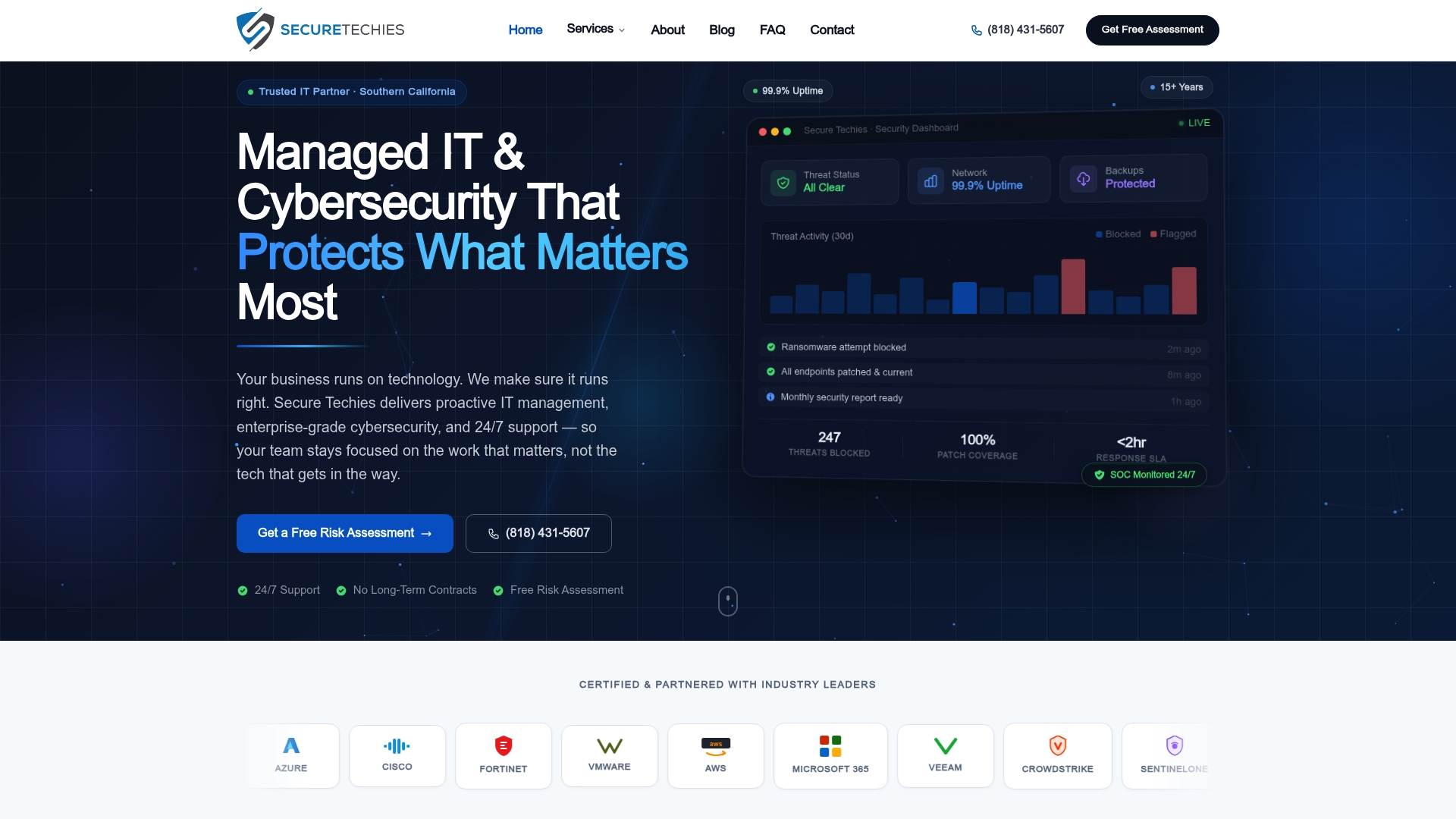
Securetechie's managed infrastructure services cover the full stack: 24/7 monitoring, EDR, managed backup with defined RTO/RPO, patch management, and on-site support across Southern California. For businesses in regulated industries, the compliance and security audit practice handles HIPAA, CMMC, and SOC 2 readiness directly. The managed help desk operates with a 99.9% uptime commitment and documented response SLAs. Contact Securetechie to request a scoped proposal that maps directly to the checklist in this guide.
Sources
The following sources informed the pricing ranges, model definitions, and security framework references in this guide.
- Nist
- Cisa
- Channel Dive — 6 popular managed services pricing models
- Guide To Managed IT Service Pricing Models and Cost