
Every law firm needs five controls in place before anything else: enterprise-wide multi-factor authentication (MFA), hardened email defenses (SPF, DKIM, and DMARC with sandboxing), immutable backups that are actually tested, endpoint detection and response (EDR) tied to 24/7 monitoring, and an incident response plan built around your state bar's notification rules. CyberReplay reports that MFA alone blocks more than 99% of automated account takeover attempts, which makes it the single highest-leverage fix a firm can deploy this week.
- Enterprise MFA on email, VPN, and practice management systems
- Email authentication (SPF/DKIM/DMARC) plus attachment sandboxing
- Immutable, tested backups following the 3-2-1 model
- EDR connected to managed detection and response (MDR)
- An incident response plan mapped to ABA and state bar guidance
The rest of this guide breaks these down into a 30/60/90-day roadmap you or your IT partner can execute in order.
Key Takeaways
Law firm cybersecurity works when identity, email, and backups get hardened first, then endpoint detection and an ethics-driven incident response plan close the remaining gaps.
| Point | Details |
|---|---|
| MFA is the top lever | Enterprise MFA blocks the vast majority of automated account takeover attempts and should be deployed within 30 days. |
| Inventory before you protect | Map every endpoint, SaaS tool, and vendor connection so controls target real exposure, not guesswork. |
| Backups need testing, not just existence | Follow the 3-2-1 model with immutable copies and run scheduled restore drills tied to defined RTOs. |
| Notification duties are not optional | State bar ethics opinions like NYC's Formal Opinion 2024-3 require prompt client notification after a confidentiality breach. |
| Managed services close execution gaps | Securetechie offers MDR, tested backups, compliance audits, and an incident response retainer for firms that need a faster path to full coverage. |
This article is general information, not a substitute for advice from a qualified lawyer. Consult a qualified legal professional about your own circumstances before acting on anything here.
Table of Contents
- Identify Your Cyber Assets and Map Sensitive Data Flows
- Access Controls: Passwords, Password Managers, and MFA
- Email Hardening and Anti-Phishing Controls
- Network and Endpoint Protections
- Data Encryption and Ransomware-Ready Backups
- Third-Party and Vendor Risk Management
- Incident Response and Your Ethical Notification Duties
- Policies, Training, and Governance That Make Controls Stick
- Your 30/60/90-Day Cybersecurity Roadmap
- How Secure Techies Helps Law Firms Secure Client Data
- Sources
Identify Your Cyber Assets and Map Sensitive Data Flows
You cannot protect what you have not counted. Most law firm data breaches trace back to a device, account, or vendor connection nobody remembered existed. Building a real asset inventory is the unglamorous first step that makes every other control on this list actually work.
Your inventory needs to cover more ground than most firms assume:
- Every endpoint: laptops, desktops, tablets, and personal devices used for firm email
- SaaS applications, including practice management, e-discovery, and billing platforms
- Servers, whether on-premises or cloud-hosted
- Printers and scanners, which retain document caches longer than most partners realize
- Third-party integrations with read or write access to client files
Once the inventory exists, assign a data owner to each category and tier documents by sensitivity, matter type, privilege status, and regulatory exposure work best as tiers. A vendor access register belongs in this same exercise, since unmanaged third-party connections are frequently a law firm's largest blind spot.
Pro Tip: Test your inventory, don't just trust it. Ask your IT team to produce an access log showing everyone who touched a specific sensitive document in the last 30 days. If they cannot generate that report in under an hour, your data map has gaps.
Access Controls: Passwords, Password Managers, and MFA
Credential theft remains the fastest route into a firm's systems, and it is also the cheapest problem to fix. MFA should apply to every account with access to email, client files, or financial systems, no exceptions for partners who find it inconvenient. Choose app-based or hardware-key methods over SMS, since text-message codes are the weakest form of MFA and increasingly targeted by SIM-swap attacks.
- Require a password manager firm-wide, with a shared, access-controlled vault for privileged credentials like domain admin accounts
- Set minimum passphrase length at 14 characters rather than relying on complexity rules alone
- Build a documented emergency access process for MFA lockouts that does not bypass verification entirely
- Apply least-privilege access by default, with just-in-time elevation for anyone who needs temporary admin rights
Audit access permissions quarterly, not annually. CyberReplay's data shows MFA alone blocks over 99% of automated account takeover attempts, which means the access-control layer often delivers more protection per dollar spent than any other single investment on this list.
Email Hardening and Anti-Phishing Controls

Email remains the entry point for the majority of successful attacks against law firms, largely because attorneys receive constant unsolicited attachments and links as a normal part of practice. Layered defenses matter more here than any single tool.
Start with authentication records: SPF, DKIM, and DMARC configured in enforcement mode, not just monitoring mode. Add attachment sandboxing and URL reputation scanning so malicious files get detonated in an isolated environment before they reach an inbox.
- Run phishing simulations quarterly, with immediate one-on-one remediation for staff who click repeatedly
- Track phish-click rate, time-to-remediate, and gateway block rate as ongoing KPIs
- Flag external senders automatically so attorneys can spot spoofed internal addresses at a glance
- Require callback verification for any wire transfer or trust account request received by email
Pro Tip: Business email compromise attacks targeting law firms often impersonate a client asking to redirect a wire transfer. Train your billing staff to verbally confirm any change in payment instructions using a phone number already on file, never one included in the email.
Network and Endpoint Protections
Firewalls and antivirus software alone no longer stop determined attackers. Firms need endpoint detection and response deployed with tamper protection, feeding into a security information and event management (SIEM) platform monitored around the clock. Microsoft's telemetry on cybercrime trends underscores why layered, active detection outperforms static defenses against modern attack techniques.
Segmentation limits how far an attacker can move once inside. A reasonable structure separates administrative systems, billing and finance, and client document repositories into distinct network zones, so a compromised paralegal workstation cannot directly reach trust accounting servers.
- Deploy EDR with tamper protection connected to a 24/7 MDR service
- Segment networks into at least admin, billing, and client-data zones
- Require WPA3 encryption and a separate guest network for firm Wi-Fi
- Enforce automatic patching schedules for operating systems and third-party software
- Enable remote wipe capability on every device that accesses firm email
Pro Tip: Ask your IT provider how long it takes them to detect and contain a simulated intrusion. If the answer is measured in days rather than hours, your endpoint protection isn't earning its cost.
Data Encryption and Ransomware-Ready Backups

Client data needs encryption both at rest and in transit, and privileged communications deserve encrypted email specifically, a baseline ABA and state bar guidance treats as standard practice rather than optional hardening.
Backups are what determine whether a ransomware attack becomes a bad afternoon or a firm-ending event. Follow the 3-2-1 model, three copies, two different media types, one stored offline or in an immutable format that ransomware cannot encrypt or delete.
- Encrypt all client data at rest and in transit using current industry standards
- Maintain immutable, offline backup copies alongside your primary backup
- Define recovery point objective (RPO) and recovery time objective (RTO) for each system
- Run restore tests on a schedule, not just after an incident forces the question
- Coordinate backup testing with legal hold procedures so preserved evidence isn't accidentally overwritten
CyberReplay's checklist notes that a prioritized sprint through identity, email, and backup controls produces measurable risk reduction within a few weeks to a few months, which is precisely why backups sit near the top of this list rather than buried at the bottom.
Third-Party and Vendor Risk Management
Vendors with access to your systems are an extension of your attack surface, whether that vendor is a court reporting service, an e-discovery platform, or a cloud-based document management system. Treat vendor vetting with the same rigor you apply to internal controls.
- Require SOC 2 (or equivalent) certification before granting any vendor system access
- Request penetration-test summaries and insist on breach notification timelines in the contract itself
- Negotiate indemnification clauses that reflect the sensitivity of data the vendor can reach
- Maintain a vendor access register and revalidate high-risk vendors annually
- Revoke credentials immediately when a vendor relationship ends, not weeks later
Guidance from legal management organizations identifies vendor management as a baseline professional responsibility, not an optional add-on for firms with extra budget.
Incident Response and Your Ethical Notification Duties
Cybersecurity controls exist to prevent an incident. An incident response (IR) plan exists for the day prevention fails, and for law firms, that plan carries ethical weight most other industries don't face. Under New York City Bar Formal Opinion 2024-3, attorneys have a duty under rules like Rule 1.4 to promptly notify current clients when a cybersecurity incident compromises confidentiality or system availability.
Formal Opinion 2024-3 also clarifies a point many firms get wrong under pressure: there is no ethical prohibition on paying a ransom, and attorneys may be candid in ransom negotiations when doing so is aimed at protecting client data.
Build your IR plan around these steps:
- Assemble a response team in advance: IT lead, managing partner, breach counsel, and cyber insurer contact
- Contain the incident first, isolate affected systems before investigating root cause
- Preserve forensic evidence carefully to protect attorney-client privilege during any later litigation
- Notify affected clients per your state bar's specific timeline and disclosure requirements
- Run tabletop exercises at least annually so the plan isn't being read for the first time during a real breach
Pre-selecting breach counsel and confirming your cyber insurance carrier's preferred forensics vendor before an incident happens saves critical hours when it matters.
Policies, Training, and Governance That Make Controls Stick
Technical controls fail without policy and habit behind them. Every firm needs a written information security program (WISP), a bring-your-own-device (BYOD) policy, a vendor management policy, and increasingly, an AI acceptable-use policy covering how staff may use generative tools with client information.
- Review all core security policies annually and update them after any incident or major system change
- Run annual baseline security training for every employee, attorneys included
- Layer in quarterly phishing simulations with role-based modules for high-risk staff like billing and IT
- Enforce policies with real consequences; a WISP nobody follows offers no protection
- Assign one named owner for the firm's security program and set measurable KPIs they report against
- Schedule external audits and penetration tests on a recurring basis, not just before a compliance deadline
Your 30/60/90-Day Cybersecurity Roadmap
Sequencing matters more than trying to do everything at once. Here's a realistic order of operations:
- Days 1 to 30: Deploy MFA across all systems, enforce email authentication records, and confirm backups are both immutable and restorable. Acceptance test: restore a sample file set within your defined RTO.
- Days 31 to 60: Deploy EDR with 24/7 monitoring, complete your asset and vendor inventory, and run your first phishing simulation. Acceptance test: produce a full vendor access register with named owners.
- Days 61 to 90: Finalize your IR plan, run a tabletop exercise, and complete network segmentation. Acceptance test: simulate an incident and time your team's containment response.
Firms with in-house IT can execute the first 30 days internally. Beyond that, most benefit from managed detection and response services or an incident response retainer, since 24/7 monitoring and forensic-grade IR planning require specialized staffing that few firms maintain on their own.
Pro Tip: Don't wait for a completed asset inventory before enabling MFA. Sequence the highest-impact, fastest-to-deploy controls first, then layer in the more time-intensive work like network segmentation.
Lessons Learned From Securing Law Firms
The root cause of most law firm breaches is rarely a sophisticated attacker. It's shadow SaaS nobody inventoried, a departed vendor's credentials still active a year later, or backups nobody bothered to restore-test until the day they needed them. Tools matter less than leadership deciding who owns security and funding it accordingly. Firms that hand detection and recovery to a managed partner consistently cut incident timelines from days to hours.
— Alex
How Secure Techies Helps Law Firms Secure Client Data
Building every control on this list in-house takes months most firms don't have, and getting it wrong carries ethical exposure most managed service providers don't understand. Securetechie approaches law firm cybersecurity the way this guide is structured: identity and email hardening first, then backups, then 24/7 detection, all mapped to the professional responsibility rules your firm actually answers to.
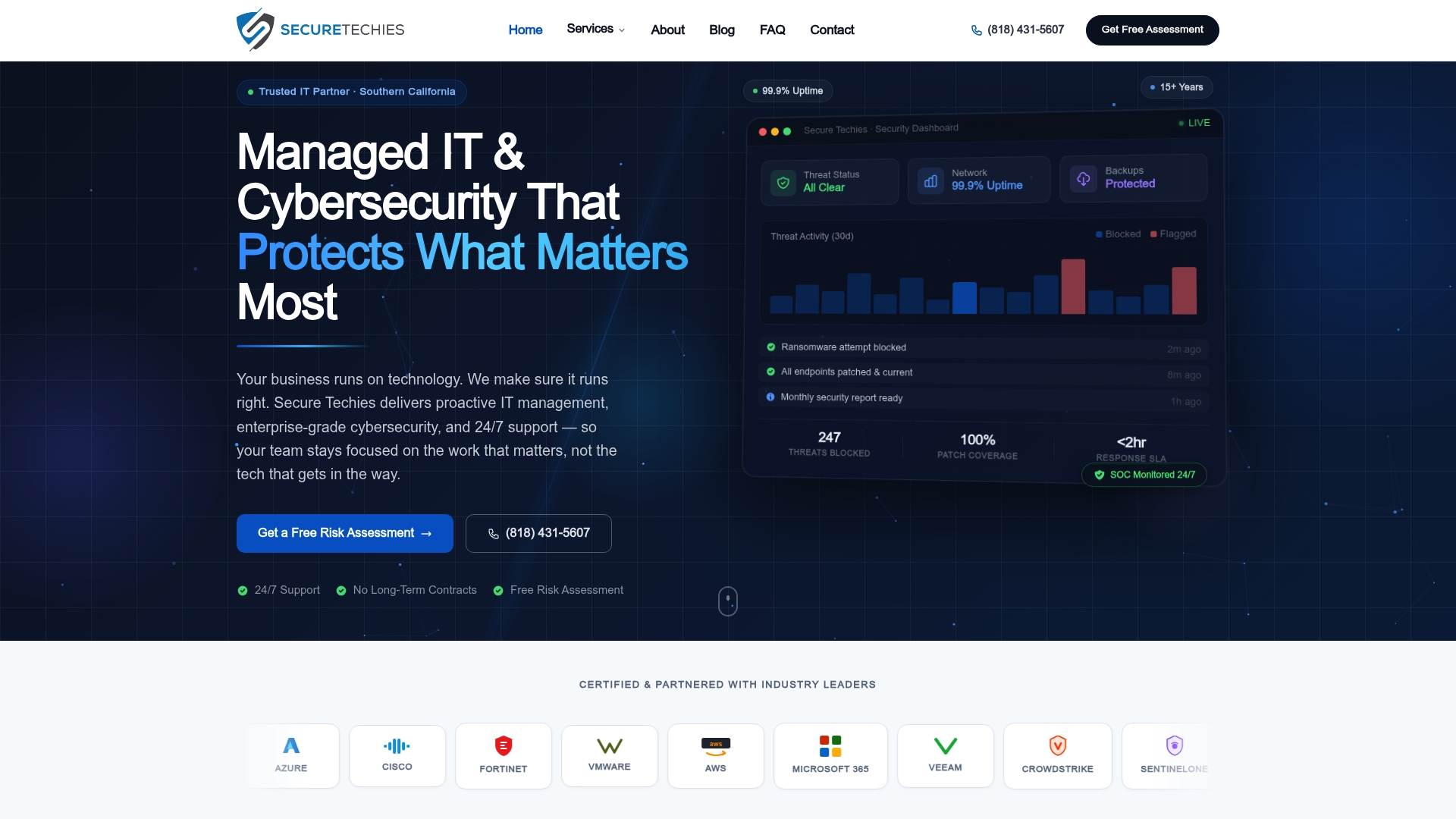
Securetechie's managed cybersecurity services include EDR and MDR monitoring, tested backup and disaster recovery architecture, HIPAA, GDPR, SOC 2, and CMMC compliance audits, and an incident response retainer with a dedicated Southern California team available around the clock. If your firm is ready to move past a static checklist, request a cybersecurity risk assessment and get a prioritized 30-day sprint plan built around your actual environment.
Sources
- Formal Opinion 2024-3: Ethical Obligations Relating to a Cybersecurity Incident
- Best Practices for Law Firms to Meet Cybersecurity Obligations
- Microsoft digital defense report 2022 — state of cybercrime