
IT budget planning works only when every dollar maps to an outcome, whether that outcome is protecting the business, growing it, or transforming it. The recommended approach for 2026 is continuous IT financial management: a Run/Grow/Transform portfolio structure with built-in scenario bands, reviewed and reallocated quarterly instead of locked into a single annual number. The sections below walk through the components, the process, and the governance model that make this defensible to finance and the board.
TL;DR:
- Most IT budgets should allocate a majority of spend to Run costs, 15-20% to Grow initiatives, and 5-15% to Transform projects, adjusted for industry needs.
- A contingency reserve of 5-10% (scaled based on past unplanned expenses) is essential for handling unexpected events like security incidents or hardware failures.
- Continuous IT financial management with quarterly scenario planning, explicit reallocation thresholds, and outcome mapping builds a more adaptable and defendable budget.
- Tools like dedicated ITFM platforms and cloud billing consolidators improve forecast accuracy and early anomaly detection, reducing manual reconciliation errors.
- Rigid annual budgets are ineffective; prioritize flexible planning, governance, and a living process with regular reviews over perfect but static financial models.
Table of Contents
- What Is IT Budget Planning and Why ITFM Matters?
- Core Components Every IT Budget Must Include
- Allocation Models, Benchmarks, and Setting Your Percentages
- Step-by-Step Process to Build an IT Budget Leaders Can Defend
- Scenario Planning, Rolling Forecasts, and Governance for Volatile Markets
- Common Mistakes, Optimization Levers, and Practical Cost-Savings Tactics
- Secure Techies' Perspective: Evidence, Proof Points, and Predictable Costs
- Integrating IT Budget Planning With Corporate Budgeting
- How Emerging Technology Is Reshaping IT Budgets
- Budgeting for Compliance and Data Privacy Costs
- Software and Tools for Tracking Your IT Budget
- Why Most IT Budgets Fail Before the Year Even Starts
- Sources
What Is IT Budget Planning and Why ITFM Matters?
IT budget planning is the process of forecasting, allocating, and tracking technology spend against business priorities for a given period. IT financial management, usually shortened to ITFM, is the broader discipline that treats budgeting as one part of a continuous cycle: cost accounting, allocation, forecasting, optimization, and governance, all running year-round rather than once a year. Gartner's IT governance glossary frames this as the structure that keeps IT decisions accountable to business outcomes, not just to a spreadsheet approved in November.
The distinction matters because most budget failures aren't math errors. They're process errors. A budget built once a year and left alone for twelve months cannot respond to a vendor price hike, a new compliance mandate, or an AI tooling opportunity that shows up in March. ITFM fixes this by giving the CIO and CFO a shared, ongoing view of cost and value instead of two separate conversations that only intersect during budget season.
EY's framework for IT financial management describes this shift plainly: it moves the conversation from "what does this project cost" to "how does this portfolio perform under different conditions." That's a genuinely different question, and it's the one boards are starting to ask.
Continuous planning tends to outperform annual-only budgeting in a few specific conditions:
- When cloud or SaaS costs are a large and variable share of spend
- When the business itself is growing, contracting, or pivoting mid-year
- When security exposure or regulatory requirements shift faster than the fiscal calendar
- When leadership wants showback or chargeback visibility into which departments actually drive cost
If none of those apply to your organization, an annual budget with a light quarterly check might still suffice. For most mid-size and growing businesses, at least one of them does.
Core Components Every IT Budget Must Include
A defensible IT budget breaks spend into categories that map cleanly to business risk and opportunity, not just to vendor invoices. Here's how to structure the core line items.
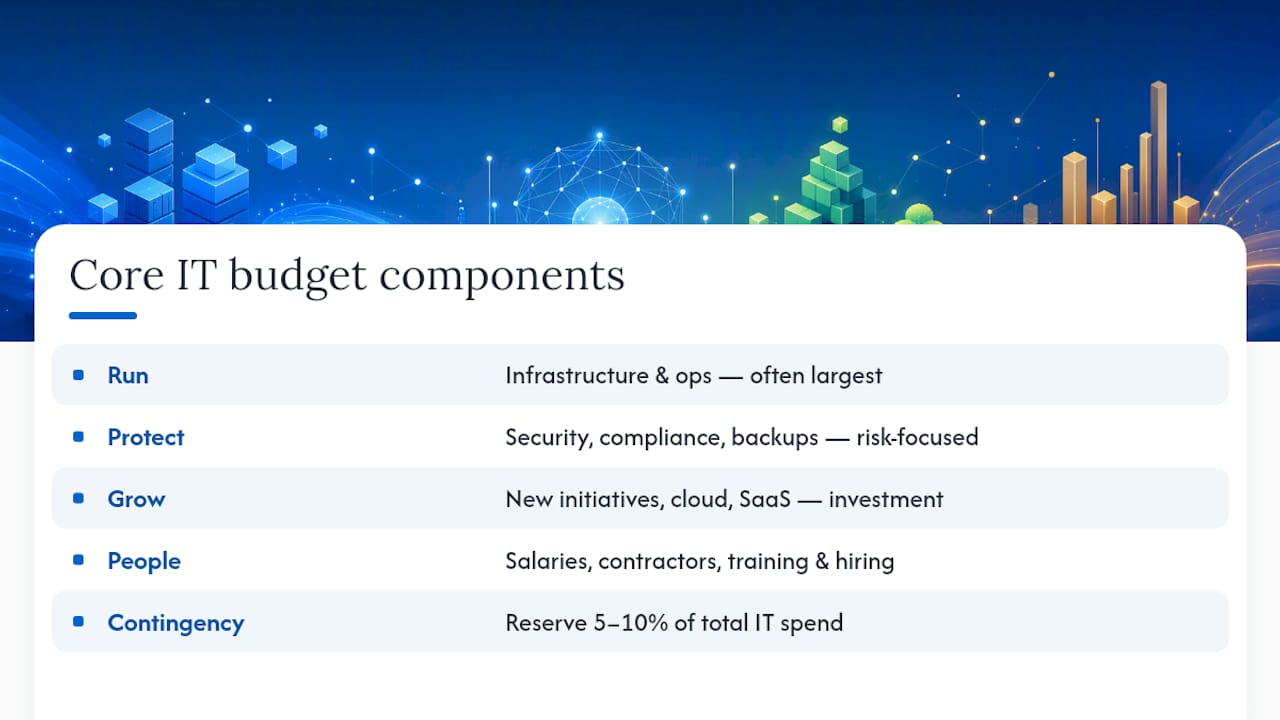
Run costs cover the infrastructure that keeps operations functioning: servers, networking equipment, end-user devices, maintenance contracts, and day-to-day technical support. This category is usually your largest, and it's also the one most likely to be underfunded because it's invisible when it's working correctly.

Protect costs include security tooling, endpoint detection, compliance audits, backup and disaster recovery, and third-party risk assessments. Skipping detail here is one of the most common ways budgets fall apart under scrutiny, because a single missed line item, such as third-party vendor risk review, can become a six-figure incident later.
Grow costs fund new initiatives: cloud migrations, SaaS expansion, new project work, and pilot programs for AI and automation tools. This is the category finance usually wants to see grow year over year, since it signals investment rather than upkeep.
People costs cover salaries, contractor fees, training budgets, and recruitment for both IT staff and the broader digital skills the organization needs. Training is the line item most often cut first and regretted most, since undertrained staff generate more support tickets and slower incident response.
Contingency reserve is the unknowns bucket, and it deserves its own line rather than being buried inside Run. Ardura Consulting's 2026 budgeting checklist recommends sizing this reserve at 5% to 10% of total IT spend, scaled up for organizations with higher regulatory exposure or aggressive growth plans.
Pro Tip: Size your contingency reserve based on your last two years of unplanned spend, not a generic percentage. If you've had a ransomware incident, a surprise license audit, or an unplanned hardware failure in the last 24 months, your reserve should reflect that real history, not a textbook default.
The mistake most leaders make with these categories is treating them as static. A well-run ITFM process revisits each bucket quarterly, checking whether Protect spend still matches the current threat picture and whether Grow investments are actually shipping value. For a deeper look at how cloud costs specifically fit into this structure, see Secure Techies' guide to cloud services, migration, and cost drivers.
Allocation Models, Benchmarks, and Setting Your Percentages
The Run/Grow/Transform model gives you a starting framework, and the percentages you assign should reflect your industry, regulatory load, and growth stage rather than a one-size-fits-all rule.
Run typically dominates the budget, and Ardura Consulting's benchmarking puts a common range at a majority share of total IT spend for most mid-size organizations.
| Allocation category | Typical range | What it covers |
|---|---|---|
| Run | majority share | Infrastructure, devices, network, maintenance, support contracts |
| Grow | 15% to 20% | Projects, cloud expansion, SaaS, automation pilots |
| Transform | 5% to 15% | Platform overhauls, AI adoption, major strategic shifts |
| Contingency reserve | typically a moderate portion of total IT spend | Unplanned spend, incident response, price volatility |
These bands shift based on real conditions. A healthcare practice managing HIPAA obligations should expect Protect costs to eat into what would otherwise be Grow or Transform budget, since compliance audits and risk assessments aren't optional.
When presenting these numbers to finance or the board, don't just show the percentages. Show the comparators: what similar-size organizations in your industry allocate, what changed since last year's request, and why.
Deviate from standard bands when you have a specific, named reason: a known technical debt backlog, an upcoming acquisition, or a regulatory deadline. Deviating without a reason is what makes finance start asking harder questions in every future cycle.
Step-by-Step Process to Build an IT Budget Leaders Can Defend
Building a budget that survives finance scrutiny isn't about better spreadsheets. It's about sequence. Skip a step here and the whole thing falls apart in the boardroom.
-
Run a 90-minute baseline audit. Pull every active vendor contract, cloud bill, and license renewal into one list. Most organizations discover forgotten subscriptions, duplicate tools, or auto-renewed contracts nobody remembers signing during this single exercise. This is the fastest way to find real savings before you ask for a bigger budget.
-
Map every line item to a business outcome and an owner. A budget line without an owner is the first thing finance will cut when pressed. Assign each category, Run, Protect, Grow, Transform, to a named accountable person, and tie each major expense to a specific business goal: revenue growth, risk reduction, or operational uptime.
-
Build your forecast with explicit inputs. Include expected inflation on vendor contracts, projected cloud cost curves (which tend to rise faster than general inflation as AI workloads scale), and headcount changes. Don't forecast in a vacuum; use last year's actuals as your floor and adjust from there.
-
Package the request for finance as a decision, not a list. Finance leaders respond better to decision packets that show tradeoffs than to itemized wish lists. For each major request, show the ROI case, the risk of not funding it, and how it fits the contingency rules you've already established. RealVNC's 2026 CIO planning framework makes the point directly: boards increasingly expect traceability from every dollar back to a specific business outcome, not just a category label.
-
Set approval thresholds and quarterly reallocation authority up front. Decide now, not during a crisis, who can approve a $10,000 emergency spend versus a $100,000 one, and build in a standing quarterly review where unspent Grow budget can shift to cover an unexpected Protect need.
One data point worth building into your forecast conversation: NetSuite's research on IT services budgeting finds that new systems commonly require ongoing maintenance equal to 15% to 20% of the initial build cost, every year, for the life of the system. Leaders who forget to carry that forward into year two and three end up quietly underfunding maintenance until something breaks.
The sequence matters because each step builds credibility for the next. An audit without outcome mapping just produces a longer list. Outcome mapping without a forecast produces guesses. And a forecast without a clear approval structure produces a document that gets debated line by line instead of approved as a portfolio.
Scenario Planning, Rolling Forecasts, and Governance for Volatile Markets
Static budgets break the first time reality diverges from the plan, and in 2026, reality diverges often. The fix is building explicit scenario bands into the budget from the start, not scrambling to explain variance after the fact.
Most organizations benefit from three defined scenarios:
- Base case: your standard forecast assuming stable vendor pricing, expected headcount, and no major disruptions.
- Constrained case: revenue comes in lower than expected, triggering predefined cuts to Grow and Transform first, never to Protect.
- High-inflation case: vendor price increases or cloud cost spikes exceed forecast, triggering pre-approved reserve draws rather than emergency finance meetings.
RealVNC's 2026 planning framework argues this scenario structure matters more now than in prior years because AI adoption curves, cloud pricing volatility, and expanding security exposure all move faster than a traditional annual cycle can track. Rolling forecasts, updated monthly or quarterly rather than once a year, let you catch a variance in month three instead of discovering it in month eleven.
Governance needs explicit triggers, not vague "we'll revisit if needed" language. Define in advance: what variance percentage triggers a reforecast conversation, who has authority to approve a mid-year reallocation, and what dollar threshold requires board notification versus CFO sign-off alone.
Track a small set of KPIs at each quarterly review:
- Variance to plan: how far actual spend deviates from forecast, by category
- Surprise spend percentage: the share of total spend that wasn't in the original budget
- Prevention yield: cost avoided through proactive maintenance or security investment, compared to the cost of a reactive incident
These three numbers tell you more about the health of your ITFM process than any single line-item review, because they measure whether your forecasting is actually improving over time.
Common Mistakes, Optimization Levers, and Practical Cost-Savings Tactics
The same errors show up in budget reviews across industries, and most are avoidable with better structure rather than more spending discipline.
The biggest mistake is under-budgeting maintenance while over-funding new builds. It's easier to get approval for a shiny new platform than for the unglamorous cost of keeping it running, and that imbalance compounds every year a system ages. A close second is ignoring technical debt entirely; unaddressed debt doesn't disappear, it just gets more expensive and more risky to fix later. The third recurring mistake is treating the budget as an annual event instead of a living document, which is exactly the failure mode continuous ITFM is designed to correct.
On the optimization side, a few levers consistently free up real budget without cutting delivery capability:
- Cloud rightsizing: matching compute and storage provisioning to actual usage, rather than peak-estimate guesses made at initial deployment.
- Reserved capacity commitments: locking in discounted rates for predictable, steady-state cloud workloads.
- License rationalization: auditing SaaS and software licenses for unused seats or overlapping tools, a step that frequently surfaces meaningful savings in the baseline audit alone.
- Staff augmentation: using contractors or a managed provider for variable workload instead of carrying full-time headcount year-round.
Pro Tip: When evaluating any cost-cutting move, calculate total cost of ownership over three years, not the sticker price. A cheaper tool that requires more internal support hours often costs more in year two than the "expensive" alternative did in year one.
Fast wins, like license audits and cloud rightsizing, can free up budget within a single quarter. Longer-term programs, like technical debt reduction or a full platform migration, take longer to pay off but protect the budget from much larger emergency costs down the road.
Secure Techies' Perspective: Evidence, Proof Points, and Predictable Costs
Secure Techies works with small to mid-size businesses across Southern California precisely because unpredictable IT spend is one of the most common budget complaints leadership teams raise. A managed services model converts a large share of unpredictable Run costs, emergency repairs, after-hours support calls, unplanned downtime, into a fixed, predictable monthly line item that's far easier to forecast and defend.
A few concrete markers of what that shift looks like in practice:
- A 99.9% uptime guarantee backed by 24/7 monitoring, which reduces the "surprise spend" category almost entirely for infrastructure failures.
- Quick response times that shrink the cost of incidents before they escalate into larger recovery projects.
- Compliance support across HIPAA, GDPR, SOC 2, and CMMC, which turns audit prep from a scramble into a scheduled, budgeted activity.
Real examples of this in action are documented across Secure Techies' client case studies, where predictable monthly contracts replaced the reactive break-fix cycle that had been driving unplanned spend.
Integrating IT Budget Planning With Corporate Budgeting
IT budgets can't live in a silo separate from the rest of the organization's financial planning, and treating them that way is one of the fastest ways to lose credibility with the CFO. The IT budget should feed into the same corporate planning calendar, use the same fiscal year boundaries, and follow the same approval hierarchy as sales, operations, and marketing budgets.
In practice, this means IT leadership needs a seat at the same planning table where revenue targets, headcount plans, and capital expenditure decisions get made, not a separate meeting that happens afterward. When a company plans to expand into a new market or add a product line, IT costs, from new licenses to added infrastructure capacity, should be baked into that plan from the start rather than requested as an afterthought once the expansion is already underway.
The Run/Grow/Transform categories translate directly into corporate finance language: Run maps to operating expense, Grow and Transform often split between operating and capital expense depending on how the projects are structured. Framing IT spend this way, rather than as a separate technical budget, makes it far easier for a CFO to slot IT numbers into the broader corporate model without a separate translation step every quarter.
How Emerging Technology Is Reshaping IT Budgets
AI adoption is the single biggest new variable in IT budgeting for 2026, and it doesn't fit neatly into existing categories. A generative AI pilot might touch Grow (new capability), Protect (data governance and access controls), and People (training staff to use it effectively) all at once, which means budgets built around rigid category walls will misclassify this spend constantly.
The practical fix is building a small, explicit line item for AI and automation pilots within the Grow category, sized conservatively in year one and reforecast aggressively as adoption proves out. Cloud cost curves are rising faster than general inflation partly because AI workloads consume far more compute than traditional applications, and that trend shows no sign of reversing.
Digital transformation more broadly, whether that's platform modernization, workflow automation, or customer-facing digital tools, tends to blur the same lines between Grow and Transform. The organizations handling this well aren't the ones with the most detailed category definitions. They're the ones running quarterly reviews frequent enough to reclassify spend as its purpose becomes clearer, rather than locking a rigid taxonomy in place for twelve months and forcing every new technology into a box that doesn't fit.
Budgeting for Compliance and Data Privacy Costs
Regulatory compliance costs belong in the Protect category, and they deserve more granularity than most budgets give them. HIPAA, GDPR, SOC 2, and CMMC each carry distinct audit cycles, documentation requirements, and remediation costs, and lumping them into a single "compliance" line item makes it nearly impossible to forecast accurately year over year.

The organizations that handle this best budget for compliance as a recurring operational cost, not a one-time project. Annual audit fees, ongoing risk assessment work, staff training on data handling, and the technical controls required to maintain certification all recur, and skipping a year to save money usually costs more later in remediation and potential penalties.
Data privacy costs specifically, encryption, access controls, data mapping, and breach notification readiness, tend to grow as regulations expand and as more states and countries adopt their own privacy frameworks. Building a dedicated compliance and audit subcategory within Protect, reviewed at least twice a year, keeps these costs visible instead of buried inside a general security line where they're easy to underfund. Secure Techies' compliance and security audit services are built around exactly this recurring structure for regulated businesses across law, healthcare, and financial services.
Software and Tools for Tracking Your IT Budget
Spreadsheets work for a first attempt at IT budget planning, but they break down fast once you're managing rolling forecasts, multiple scenarios, and quarterly reallocation. Purpose-built planning platforms solve this by automating data ingestion from cloud bills and vendor invoices directly into a forecasting model.
Platforms like IBM Apptio Planning are built specifically for this kind of continuous IT financial management, offering multi-model forecasting and variance analysis that update automatically as actual spend comes in, rather than requiring a manual reconciliation every month. For organizations managing heavy cloud and SaaS spend specifically, technology spend management platforms like StackSpend consolidate billing across providers and flag anomalies daily, which catches overruns weeks before a traditional monthly review would.
Beyond dedicated ITFM software, project and task management tools also play a quieter role in budget accuracy. Platforms like Seven help track project timelines and resource allocation, which feeds directly into more accurate Grow and Transform forecasting since project delays are one of the most common causes of budget variance. Whatever tool you choose, the goal is the same: replace manual reconciliation with a system that surfaces variance before your next scheduled review, not after.
If you'd rather have a team manage this infrastructure and reporting layer directly, Secure Techies' managed infrastructure services build predictable, tracked IT environments that make budget forecasting significantly more reliable from the start. For a broader look at how outsourced management compares to handling this internally, see Secure Techies' breakdown of managed IT versus break-fix economics. If your organization is based in Orange County, Secure Techies also supports managed IT services in Irvine with the same predictable-cost model.
Why Most IT Budgets Fail Before the Year Even Starts
The research behind this article points to one uncomfortable conclusion: most IT budgets fail not because the numbers are wrong, but because the structure treats budgeting as an event instead of a process. An annual spreadsheet approved in Q4 and left untouched is obsolete by Q2, and no amount of careful line-item math fixes that.
Conventional budgeting advice spends too much time on precision, getting each category to the exact right percentage, and not enough time on flexibility, building in the scenario bands and reallocation authority that let a budget survive contact with reality. A budget accurate to the dollar in January that can't adapt by June isn't actually more disciplined. It's just wrong later instead of wrong now.
If you take one thing from this framework, prioritize the contingency reserve and the quarterly review cadence before you obsess over perfecting your Run/Grow/Transform percentages. A rough allocation with real governance behind it will outperform a precise allocation with none, every time.
— Alex
Sources
- IT budget planning 2026: a strategic framework for CIOs — RealVNC
- IT budget planning checklist for 2026 — Ardura Consulting