
Healthcare IT security in 2026 comes down to five priorities: phishing-resistant identity controls, complete asset visibility, fast vulnerability patching, immutable backups with tested recovery, and a rehearsed incident response plan, all wrapped in a zero-trust, defense-in-depth architecture. These aren't opinions. They come straight from the HIPAA Security Rule, HICP/CISA mitigation guidance, and FDA device cybersecurity expectations, the three bodies of guidance every healthcare organization should treat as its baseline.
TL;DR:
- Asset inventory, multi-factor authentication, and verified backups should be in place within the first 30 days to establish a strong security foundation.
- Segmenting networks and applying conditional access policies are critical after 60 days to limit lateral movement and protect medical devices and remote users.
- Regular risk assessments must be ongoing, documented, and revisited quarterly to adapt to changing environments and prevent drift.
- Role-based phishing training, frequent micro-simulations, and easy reporting mechanisms help improve staff awareness and reduce the risk of successful attacks.
- In case of ransomware, immediate network isolation, evidence preservation, and verified backups are crucial to effective recovery and minimizing patient care disruption.
Table of Contents
- Why Healthcare Organizations Face Elevated Cyber Threats
- Building Defense-in-Depth and Zero Trust for Healthcare
- What Does HIPAA Actually Require for IT Security?
- How Do You Secure Network-Connected Medical Devices?
- Your staged Healthcare IT Security Checklist
- What Happens in the First Hours of a Ransomware Attack?
- Choosing a Risk Assessment Framework That Fits Your Organization
- Security Awareness Training That Actually Changes Behavior
- Encryption Standards for ePHI at Rest and in Transit
- Managing Vendor and Third-Party Risk in Healthcare IT
- What Should Healthcare IT Security Audits and Monitoring Cover?
- Telehealth and IoMT: The Threats Most Organizations Underestimate
- The Practical Reality Behind Healthcare Cybersecurity Advice
- How Secure Techies Supports Healthcare IT Security Programs
- Authoritative Resources to Consult Next
- Sources
Why Healthcare Organizations Face Elevated Cyber Threats
Healthcare data commands a premium on criminal markets because a medical record combines insurance details, Social Security numbers, and clinical history in one package. That makes hospitals, clinics, and health systems a persistent target rather than an occasional one.
HICP identifies five threats that account for most incidents in the sector: social engineering, ransomware, loss or theft of equipment and data, insider or accidental data loss, and attacks against network-connected medical devices. Each hits differently:
- Ransomware locks electronic health records and forces diversion of ambulances to other facilities.
- Phishing and business email compromise trick staff into wiring payments or surrendering credentials.
- Insider and accidental exposures happen when staff misconfigure a shared drive or lose an unencrypted laptop.
- Medical device attacks target infusion pumps, imaging systems, and monitors running outdated firmware.
- Supply-chain compromises enter through a vendor's software update rather than the hospital's own perimeter.
The common thread is availability. When a system goes down in a factory, production stops. When it goes down in an ICU, care stops.
Building Defense-in-Depth and Zero Trust for Healthcare
Layered security means no single control is expected to stop everything. A typical stack for a mid-size provider includes:
- Identity and access management, with multi-factor authentication and privileged access management on every administrative account.
- Endpoint detection and response (EDR/XDR) on workstations, servers, and wherever agents can be deployed on clinical devices.
- Network segmentation and microsegmentation, isolating medical devices, guest Wi-Fi, and administrative systems into separate zones.
- Encryption for data at rest and in transit, paired with centralized logging and a security operations function watching for anomalies.
- Application and web protections that filter traffic before it reaches patient-facing portals.
Zero trust translates these layers into daily practice: every device gets a posture check before connecting, every user gets only the access their role requires, and conditional access policies block logins from unexpected locations or unmanaged devices. For medical device zones specifically, microsegmentation limits lateral movement so a compromised infusion pump can't reach the billing system. A closer look at how device-based authentication verifies trusted hardware shows why device posture, not just user credentials, has become part of the access decision.
Pro Tip: Start phishing-resistant MFA (security keys or platform authenticators, not SMS codes) with your domain admins and EHR super-users first. CISA's mitigation guide flags privileged accounts as the highest-value targets, and they're usually the smallest group to convert.
Readers building this out from scratch should review how zero-trust architecture applies to smaller organizations before committing budget to any single vendor.

What Does HIPAA Actually Require for IT Security?
The HIPAA Security Rule organizes requirements into three safeguard categories: administrative (risk analysis, workforce training, contingency planning), physical (facility access, device controls), and technical (access controls, audit logs, transmission security). The rule doesn't specify exact technologies. It requires a documented risk analysis and an ongoing risk management process, which means the compliance work never really finishes.
HICP and CISA fill the gap between the regulation's language and actual implementation:
- HICP maps ten cybersecurity practices, covering email protection, endpoint protection, access management, data protection, asset management, network management, vulnerability management, incident response, device security, and governance.
- CISA's HPH mitigation guide narrows that further, prioritizing asset inventory, patching known exploited vulnerabilities, and MFA as the highest-leverage moves.
- NIST SP 800-66 Rev. 2 walks through how to map specific technical controls to each safeguard category, which is useful when an auditor asks how a firewall rule satisfies a regulatory requirement.
A structured HIPAA compliance checklist helps keep these three frameworks aligned instead of treated as separate projects.
How Do You Secure Network-Connected Medical Devices?
The FDA expects manufacturers to build security into devices before they reach the market, not patch it in afterward. Its premarket cybersecurity guidance centers on five objectives: authenticity, authorization, availability, confidentiality, and secure, timely updatability.
That guidance shapes what buyers should demand during procurement:
- A documented patch and update policy, including how long the manufacturer will support the device.
- A software bill of materials (SBOM) listing every third-party component, so you know your exposure when a library vulnerability surfaces.
- A vulnerability disclosure process, with a named contact and expected response time.
Plenty of devices already on hospital floors will never receive another security update. For those, compensating controls carry the weight: put legacy devices on isolated network segments, restrict which protocols can reach them, and monitor their traffic for anything outside their normal baseline. Missing or incomplete device inventories are a root cause behind many healthcare breaches, because you cannot segment or monitor a device you don't know exists.
Your staged Healthcare IT Security Checklist
Turning policy into practice works best in stages. Here's a realistic sequence for a small or mid-size provider:
- Days 1 to 30: Build or verify a complete asset inventory, covering every server, workstation, and network-connected device. Enable MFA on all administrative and remote-access accounts. Confirm backups are running and that at least one immutable, offline copy exists.
- Days 31 to 60: Deploy EDR on critical endpoints. Establish a patch cadence prioritized around known exploited vulnerabilities rather than patching everything on the same schedule. Segment the network and apply conditional access policies for remote users and medical devices.
- Days 61 to 90: Run a tabletop exercise simulating a ransomware event. Review business associate agreements with major vendors. Deploy centralized logging or managed monitoring, and write down the incident response runbook so it doesn't live only in someone's head.
Pro Tip: Track three numbers monthly: percentage of admin accounts with phishing-resistant MFA, mean time to patch known exploited vulnerabilities, and days since your last successful backup restoration test. Those three tell you more than a dozen vanity metrics.
What Happens in the First Hours of a Ransomware Attack?
The first moves matter more than the eventual fix. Isolate affected network segments immediately to stop lateral spread, preserve evidence for forensic review before wiping anything, and notify leadership and legal counsel in parallel rather than sequentially.
If the electronic health record is unavailable, switch to paper-based contingency workflows so patient care doesn't stall while systems recover. Recovery follows a prioritized order: validate that backups are clean before restoring, bring back life-safety and clinical systems first, and communicate clearly with clinicians and patients about what's affected and when service resumes.
Ransomware-specific groundwork pays off here. Immutable backups and an offline recovery copy mean the attacker's leverage disappears the moment you can restore independently. Organizations should also have a predetermined policy on vendor negotiation, since improvising that decision during an active incident invites bad outcomes. Breach notification obligations under HIPAA still apply regardless of whether a ransom gets paid, and a post-incident review should feed directly back into the risk management process.
Choosing a Risk Assessment Framework That Fits Your Organization
A risk assessment isn't a one-time compliance exercise. It's the mechanism that tells you where to spend limited security budget next, and HIPAA requires it explicitly as an ongoing obligation, not a checkbox completed once at go-live.
Most healthcare organizations build their process around NIST's risk management approach, since NIST SP 800-66 already maps directly to HIPAA's safeguard categories. The basic cycle looks the same regardless of organization size: identify assets and data flows, assess threats and vulnerabilities against those assets, determine likelihood and impact, and document remediation with owners and deadlines.
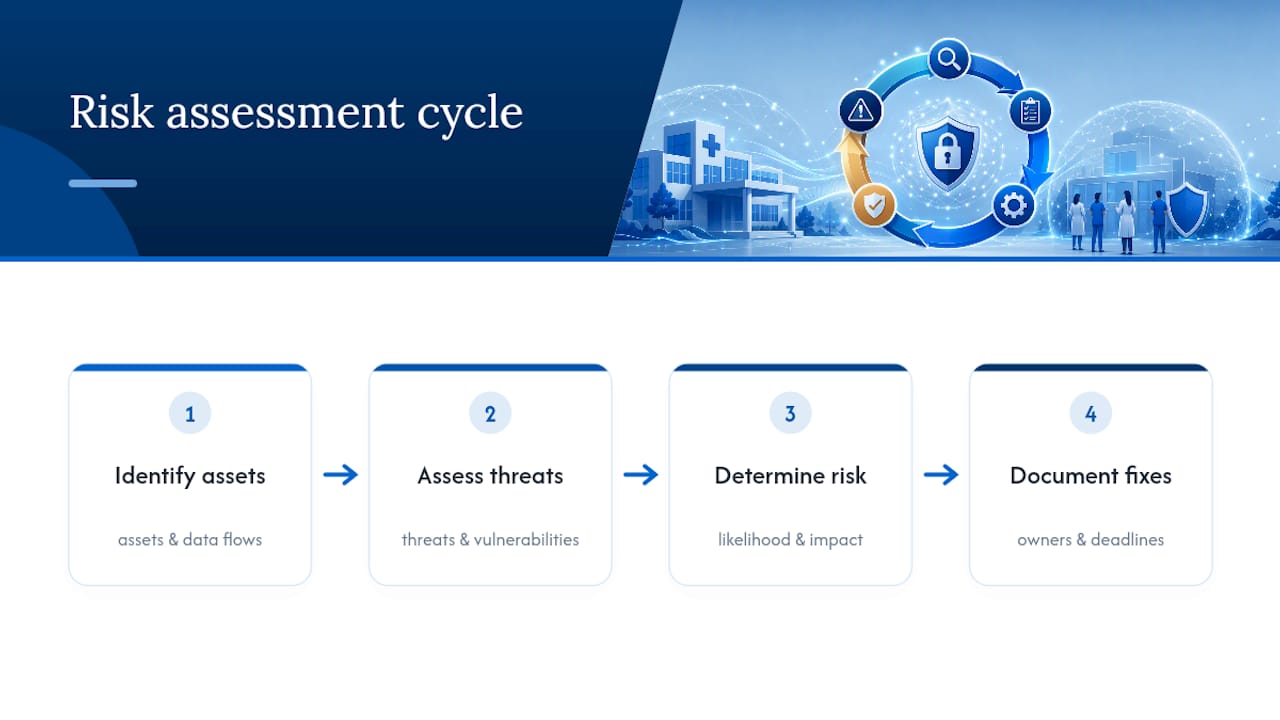
Smaller organizations often skip the documentation step, treating risk assessment as something the IT team just "knows." That's a mistake auditors catch quickly, and it's also a mistake that costs you internally, because undocumented risk decisions can't be revisited when circumstances change. A radiology practice that added a new PACS vendor last year has a different risk profile than it did before that integration, and the assessment should reflect it.
The output of a good risk assessment isn't a report that sits in a drawer. It's a prioritized action list, tied to the same asset inventory and vulnerability data driving your patch management program. Organizations that treat the risk register as a living document, revisited quarterly rather than annually, tend to catch drift before it becomes a breach. Reassessment triggers should include new vendor integrations, EHR upgrades, mergers, and any incident, near miss or actual, that reveals a gap the last assessment missed.
Security Awareness Training That Actually Changes Behavior
Generic annual training modules rarely stop the phishing email that actually gets clicked. Clinical staff, billing staff, and IT administrators face different threats, and training that treats them identically wastes everyone's time.
Front-desk and billing staff face the highest volume of business email compromise attempts, since invoice fraud and payment redirection scams target exactly the workflows they handle daily. Clinical staff, by contrast, are more likely to encounter credential phishing disguised as EHR notifications or lab result alerts. IT and privileged users are the smallest group but the highest-value target, since one compromised administrator account can expose far more than one compromised nurse's login.
Role-based training informed by actual phishing telemetry, meaning who in your organization is being targeted and how, outperforms one-size-fits-all modules because it matches the lesson to the real threat each group faces. If your email security platform shows billing staff receiving three times the phishing volume of any other department, that's where the next training cycle should focus, not on a generic slide deck covering every threat type equally.
Frequency matters as much as content. Quarterly micro-trainings with simulated phishing tests tend to keep awareness higher than a single dense annual session. And training shouldn't stop at the classroom: pairing it with a fast, visible reporting mechanism (a single button to flag suspicious email) turns staff into an early warning system instead of a liability waiting to be exploited.
Encryption Standards for ePHI at Rest and in Transit
Encryption is one of HIPAA's "addressable" technical safeguards, meaning covered entities must assess whether it's reasonable to implement and document the decision either way. In practice, nearly every organization implements it, because the alternative is documenting why you chose not to protect patient data.
For data at rest, AES-256 has become the effective standard across databases, file servers, and backup storage. Full-disk encryption on laptops and mobile devices prevents a lost or stolen device from becoming a reportable breach, since encrypted data on a lost laptop generally falls outside HIPAA's breach notification requirements.
For data in transit, TLS 1.2 or higher should protect every connection carrying ePHI, including the connections between your EHR and any integrated lab, pharmacy, or billing system. Email carrying patient information needs its own layer, since standard email isn't encrypted by default; secure email gateways or forced TLS between known partners close that gap.
Key management deserves as much attention as the encryption algorithm itself. An encrypted database with keys stored on the same server defeats much of the purpose. Separate key management, whether through a dedicated hardware security module or a cloud provider's key management service, keeps the encryption meaningful if an attacker compromises the storage layer but not the key vault.
Managing Vendor and Third-Party Risk in Healthcare IT
Every vendor with access to your systems or your patients' data extends your attack surface, whether that's a billing service, a cloud EHR host, or the company that maintains your imaging equipment. The AMA's health data privacy framework points out that HIPAA's permissive data-sharing rules for treatment, payment, and operations put the burden on covered entities to strengthen internal governance, since the regulation itself doesn't force every downstream partner to meet the same bar.
A workable vendor risk program includes signed business associate agreements with every partner handling ePHI, a standing review cycle rather than a one-time signature, and specific security questions before onboarding: How is data encrypted? What's their incident notification timeline? Do they carry their own compliance certifications?
Software vendors, particularly those supplying clinical or IoT devices, deserve extra scrutiny around update practices and how quickly they disclose vulnerabilities. A compliance and security audit that includes vendor review, not just internal controls, catches gaps that internal teams often miss because they trust the vendor relationship more than the vendor's actual security posture.
What Should Healthcare IT Security Audits and Monitoring Cover?
Audit logs are only useful if someone reviews them, and healthcare organizations generate an enormous volume of log data across EHR access, network traffic, and endpoint activity. The practical goal is monitoring that flags anomalies fast, not logging everything and hoping to review it later.
At minimum, audit trails should capture every access to ePHI, including who viewed a record, when, and whether that access matched their role. Unusual access patterns, a nurse pulling records for patients outside her unit, or an administrator account logging in at 3 a.m. from an unfamiliar location, are the kind of signals a properly tuned SIEM or managed detection service surfaces automatically.
Regular internal audits should also verify that access controls match current staffing. Terminated employees retaining active credentials is a common and entirely preventable finding, and it shows up in nearly every compliance review that actually checks. Quarterly access reviews, paired with automated deprovisioning tied to HR systems, close that gap before it becomes an incident.
Telehealth and IoMT: The Threats Most Organizations Underestimate
Telehealth platforms expanded fast, and security controls didn't always keep pace. A video visit that routes through a consumer-grade conferencing tool, rather than a platform built for protected health information, creates exposure that's easy to overlook because the clinical workflow feels routine.
The Internet of Medical Things (IoMT) compounds the problem. Infusion pumps, remote patient monitors, and connected wearables often run on embedded operating systems that were never designed with regular patching in mind, and many will outlive the vendor's own support window. That's exactly the scenario FDA's device guidance anticipates, and it's why compensating network controls matter more for IoMT than almost any other category of connected asset.
Two practical steps reduce exposure quickly: require telehealth platforms to document their encryption and BAA status before rollout, and treat every IoMT device as untrusted by default, placed on its own segment with traffic limited to only what its function requires.
The Practical Reality Behind Healthcare Cybersecurity Advice
Most healthcare IT security guidance assumes a security team with dedicated headcount and a discretionary budget. Most small and mid-size providers have neither. That gap, not any single threat, is what actually determines whether an organization ends up in a breach notification letter.
The staged approach works because it forces sequencing: identity and backups first, monitoring and segmentation second, tabletop exercises and vendor review third. Skipping ahead to advanced tooling before basic asset visibility exists is the most common failure mode Alex sees discussed across the industry. Managed monitoring and preventative controls tend to be the more realistic path for smaller providers, not because internal teams lack the knowledge, but because sustained 24/7 coverage requires staffing that few clinics or mid-size practices can justify keeping in-house. The organizations that hold up best treat their managed provider as a partner in the risk conversation, not a vendor executing a fixed list.
— Alex
How Secure Techies Supports Healthcare IT Security Programs
Building every layer described above with an internal team stretched across help desk tickets and EHR support is a real constraint, not a hypothetical one. Secure Techies works specifically with healthcare organizations across Southern California to close that gap: managed cybersecurity with 24/7 monitoring and endpoint detection, incident response readiness so a ransomware event has a rehearsed playbook instead of a scramble, and HIPAA compliance audits that map directly to the safeguard categories covered above.
Rather than treating compliance and monitoring as separate projects, the goal is one coordinated program covering managed IT services, infrastructure, and security together.
If your organization is still working through the 30/60/90-day checklist above and wants a second set of eyes on where the gaps are, reach out to Secure Techies for a compliance and security assessment tailored to your current environment.
Authoritative Resources to Consult Next
- HHS Summary of the HIPAA Security Rule: the regulatory baseline for administrative, physical, and technical safeguards.
- HICP main document (HHS): threat definitions and ten cybersecurity practices for healthcare organizations.
- FDA medical device cybersecurity guidance: premarket security expectations for connected devices.
- CISA HPH Sector Mitigation Guide: prioritized technical mitigations, including KEV patching and MFA.
- NIST SP 800-66 Rev. 2: practical mapping from HIPAA safeguards to technical controls.
- CISA's healthcare cybersecurity hub: toolkits and voluntary information-sharing programs for the sector.
Sources
- Hhs
- Cybersecurity Practices: HICP main document (HHS)
- HPH Sector Mitigation Guide | CISA
- Cybersecurity in Medical Devices: Quality Management System Considerations and Content of Premarket Submissions | FDA
- SP 800-66 Rev. 2: Implementing the HIPAA Security Rule | NIST