
The FINRA Small Firm Cybersecurity Checklist is a risk-based, optional tool that organizes a small firm's cybersecurity program around five pillars: identify, protect, detect, respond, and recover. It is not a safe harbor, and completing it alone does not guarantee compliance with SEC or FINRA rules. The fastest path to audit-ready compliance is a prioritized, evidence-driven gap assessment tied to the checklist's 12 sections and mapped to NIST CSF controls. Here are three actions your team can take in the next 72 hours:
- Download and assign ownership. Pull the official checklist (XLSX) and assign each of the 12 sections to a named owner: compliance officer, IT lead, or CISO. Unowned sections stay incomplete indefinitely.
- Run a rapid system and data inventory. List every system that stores or transmits customer data, map remote access points, and flag any system without multi-factor authentication (MFA). This inventory becomes the foundation of your gap assessment.
- Schedule a 30-day gap assessment. Block time on the calendar now. Use the gap template in Section 4 of this guide to score each checklist item against your current controls, assign risk scores, and set target remediation dates.
Key Takeaways
Implementing the FINRA cybersecurity checklist requires a risk-based, evidence-driven approach: identity controls first, documentation as an ongoing practice, and a tested incident response plan before the next exam cycle.
| Point | Details |
|---|---|
| Identity controls come first | Enable MFA on all privileged and remote-access accounts before completing any other technical remediation. |
| Evidence must be current | Collect policy excerpts, configuration screenshots, and log exports at the time of implementation, not retroactively before an exam. |
| Vendor oversight is documented | Maintain a vendor register with SOC 2 reports, completed questionnaires, and contracts with incident notification clauses. |
| Testing proves the program is active | Run quarterly tabletop exercises and monthly vulnerability scans; file the after-action reports in the evidence bundle. |
| Securetechie delivers the full package | Securetechie provides gap assessments, MFA/EDR deployment, WSP drafting, and evidence bundles for small FINRA-registered firms. |
Table of Contents
- What does the FINRA cybersecurity checklist cover, and who should use it?
- How is the checklist structured? A section-by-section breakdown
- How do you run a gap assessment and build a remediation plan?
- What technical controls does FINRA expect small firms to have?
- How do you build an incident response plan and run tabletop exercises?
- How do you manage third-party and vendor risk under the checklist?
- What monitoring metrics and testing cadence demonstrate ongoing compliance?
- What mistakes do small firms most often make with the checklist?
- How a managed IT provider operationalizes the FINRA checklist for small firms
- Why identity controls should come before everything else
- Securetechie helps small FINRA firms go from checklist to audit-ready
- Authoritative sources to download and reference
- Sources
What does the FINRA cybersecurity checklist cover, and who should use it?
The checklist is built around the same five-function structure as the NIST Cybersecurity Framework: Identify, Protect, Detect, Respond, and Recover. FINRA designed it specifically for small broker-dealers and registered investment advisers with FINRA obligations, where dedicated security teams are rare and budgets are constrained. The goal is a cybersecurity program that is appropriately scaled to the firm's business model and the sensitivity of the data it handles, not a one-size-fits-all enterprise standard.
Which FINRA and SEC rules intersect with the checklist?
Implementing the checklist touches several regulatory obligations simultaneously. Knowing which rules apply helps you build evidence that satisfies multiple examiners at once:
- FINRA Rule 3110 (Supervision): requires written supervisory procedures (WSPs) covering cybersecurity controls and role-based oversight.
- FINRA Rule 3120 (Supervisory Control System): requires testing and verification of supervisory procedures, including cybersecurity-related controls.
- FINRA Rule 4370 (Business Continuity Plans): requires a documented BCP that addresses technology failures, data loss, and recovery procedures.
- SEC Regulation S-P: requires safeguards for the protection of customer records and information.
- SEC Regulation S-ID (Identity Theft Red Flags): requires a written identity theft prevention program for firms that offer or maintain covered accounts.
Which firms should prioritize this checklist?
The checklist is most directly applicable to small broker-dealers with fewer than 150 registered representatives, boutique fintech broker-dealers with limited IT staff, and dually registered investment advisers subject to FINRA oversight. Firms that process high volumes of wire transfers, hold customer assets directly, or operate with significant remote workforces face elevated risk and should weight the protect and detect sections more heavily. Firms with minimal customer-facing systems may reasonably deprioritize certain technical controls, but they must document that risk-based decision.
One important caveat: FINRA expects a risk-based approach rather than a checkbox exercise. The checklist is an optional, non-exhaustive tool that requires tailoring to your firm's specific risk profile. Treating it as a compliance finish line rather than a starting point is one of the most common mistakes examiners find.
How is the checklist structured? A section-by-section breakdown
The 12 sections of the checklist fall into four logical clusters. Each cluster maps to one or more NIST CSF functions and carries distinct examiner expectations. The table below maps each section to its highest-priority action, the role that typically owns it, and the concrete evidence artifact an examiner will expect to see. This mapping draws on FINRA's Core Cybersecurity Threats and Effective Controls for Small Firms, which provides governance questions and control examples specifically designed for small-firm exam preparation.
Cluster 1: Governance and risk (sections 1–3)
These sections establish the foundation. Without documented governance, every technical control you implement becomes harder to defend during an exam because there is no policy framework tying it to a risk decision.
| Checklist Section | Highest-Priority Action | Owner Role | Evidence Artifact |
|---|---|---|---|
| 1. Risk Assessment | Complete a written cyber risk assessment covering all systems, data types, and threat vectors | Compliance Officer | Signed risk assessment document with date, scope, and findings |
| 2. Cybersecurity Policies | Draft or update WSPs to include cybersecurity roles, responsibilities, and acceptable use | Compliance Officer / Legal | WSP excerpt with effective date and supervisory sign-off |
| 3. Asset Inventory | Maintain a current inventory of hardware, software, and data assets | IT Lead | Asset register with last-updated date and owner field |
Cluster 2: Protect and detect controls (sections 4–8)
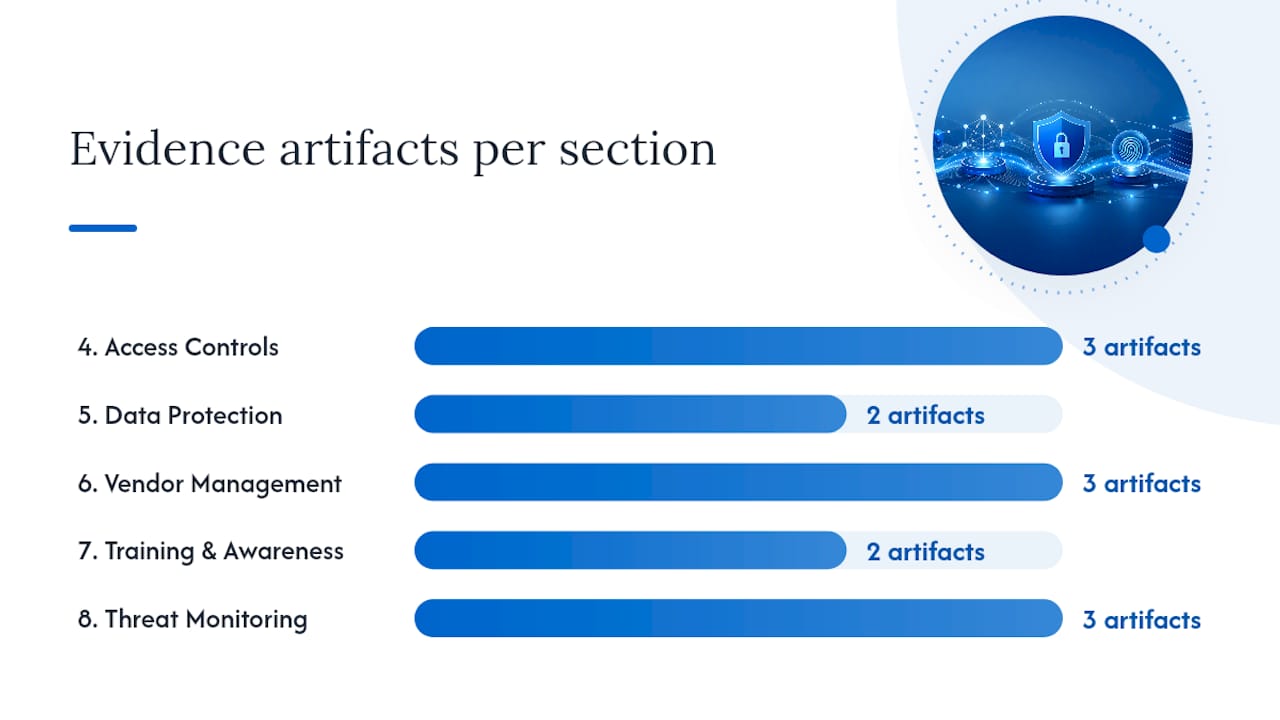
This cluster is where most small firms have the largest gaps. FINRA's annual regulatory oversight guidance consistently flags MFA gaps, weak endpoint controls, and insufficient logging as top findings. A small broker-dealer rolling out MFA for remote brokers, for example, should capture configuration screenshots from the identity provider (Microsoft Entra ID, Okta, or Duo), export the enabled-user report, and attach both to the policy excerpt as a three-part evidence bundle.
| Checklist Section | Highest-Priority Action | Owner Role | Evidence Artifact |
|---|---|---|---|
| 4. Access Controls | Enforce MFA on all remote access and privileged accounts | IT Lead | MFA enablement logs, configuration screenshot, policy excerpt |
| 5. Data Protection | Encrypt data at rest and in transit; enforce classification policy | IT Lead | Encryption configuration report, data classification policy |
| 6. Vendor Management | Conduct due diligence on all critical vendors; obtain SOC 2 reports | Compliance Officer | Vendor assessment records, SOC 2 summaries, contract clauses |
| 7. Training and Awareness | Deliver role-based phishing simulation and cybersecurity training annually | Compliance Officer / HR | Training completion logs, phishing simulation results |
| 8. Threat Monitoring | Deploy endpoint detection and response (EDR) with centralized alerting | IT Lead / CISO | EDR console screenshot, alert configuration, monitoring policy |
Cluster 3: Incident response and recovery (sections 9–10)
A written incident response plan (IRP) that has never been tested carries little weight with examiners. The evidence they want is an after-action report (AAR) from a tabletop exercise, not just the plan document itself.
| Checklist Section | Highest-Priority Action | Owner Role | Evidence Artifact |
|---|---|---|---|
| 9. Incident Response | Draft IRP with escalation matrix, reporting contacts, and playbooks for top threat scenarios | Compliance Officer / CISO | Signed IRP, tabletop exercise AAR, escalation contact list |
| 10. Business Continuity / Recovery | Test backup restoration; document RTO/RPO targets in the BCP | IT Lead | Backup restore test log with date, RTO/RPO statement, BCP excerpt |
Cluster 4: Third-party oversight and documentation (sections 11–12)
These sections close the loop between your internal controls and the vendors and documentation that support them. Examiners frequently request vendor contracts and policy change logs during cybersecurity reviews.
| Checklist Section | Highest-Priority Action | Owner Role | Evidence Artifact |
|---|---|---|---|
| 11. Third-Party Risk | Maintain a vendor register with risk tier, last review date, and contract status | Compliance Officer | Vendor register, due-diligence questionnaire responses, contract excerpts |
| 12. Policies and Procedures | Establish a review cycle for all cybersecurity policies; document each update | Compliance Officer | Policy version log, annual review sign-off, change record |
How do you run a gap assessment and build a remediation plan?
A gap assessment converts the checklist from a list of questions into a prioritized work plan. The process has four steps: score each item, prioritize by risk, assign owners and dates, and package the output as an evidence bundle.
Step 1: Score each checklist item
Use the template structure below. Score risk on a 1–5 scale where 1 is low likelihood and low impact, and 5 is high likelihood and high impact. A score of 4 or 5 on any item triggers immediate remediation.
| Checklist Item | Section | Baseline Control | Risk Score (1–5) | Owner | Target Date | Evidence File Name |
|---|---|---|---|---|---|---|
| MFA on remote access | 4. Access Controls | None currently | 5 | IT Lead | 30 days | mfa_config_screenshot_2026.png |
| Encrypted backups offsite | 10. Recovery | Local backup only | 4 | IT Lead | 30 days | backup_restore_test_log.pdf |
| Vendor SOC 2 on file | 6. Vendor Management | Not collected | 3 | Compliance | 60 days | vendor_soc2_register.xlsx |
| Annual phishing simulation | 7. Training | Ad hoc only | 3 | Compliance | 60 days | phishing_sim_results_q1.pdf |
| Written IRP with playbooks | 9. Incident Response | Draft exists | 2 | CISO | 90 days | irp_v2_signed.pdf |
Step 2: Prioritize using impact × likelihood
Group items into three workstreams based on their risk scores and regulatory dependencies:
- 30-day sprint (scores 4–5): MFA deployment, backup encryption and offsite copy, EDR installation on all endpoints. These are the controls examiners check first and the ones most likely to help prevent or contain a breach.
- 60-day workstream (scores 3): Vendor SOC 2 collection, phishing simulation launch, data classification policy draft, log retention policy.
- 90-day workstream (scores 1–2): IRP finalization and tabletop exercise, BCP update, policy version log establishment, annual training calendar.
Medium-term items (90–180 days) include penetration testing, SIEM deployment or managed log service onboarding, and a full WSP review cycle. Long-term items include annual third-party risk reassessments and ongoing metric dashboards.
Step 3: Convert remediated items into evidence bundles
Each completed checklist item should produce a named evidence file. A bundle for MFA deployment, for example, contains three files: the policy excerpt from the WSP, the configuration screenshot from the identity provider, and the MFA enablement log exported from the admin console. Name files consistently (control_name_date.extension) and store them in a folder structure that mirrors the checklist's 12 sections. When an examiner requests documentation, you hand over the folder, not a scrambled collection of screenshots.
Pro Tip: Set a calendar reminder to refresh each evidence file every 12 months. Stale screenshots from a prior year raise questions about whether controls are still active.
What technical controls does FINRA expect small firms to have?
FINRA's cybersecurity guidance identifies several baseline technical controls that small firms should implement regardless of size. The list below includes the minimum configuration standard and the audit-ready evidence to collect for each.
Core technical controls
- Multi-factor authentication (MFA): Required on all remote access, privileged accounts, and email. Use phishing-resistant MFA (FIDO2/hardware keys or authenticator apps) rather than SMS where possible. Evidence: admin console export showing MFA status per user, configuration screenshot, policy excerpt. For deployment guidance, see MFA best practices for business.
- Endpoint detection and response (EDR): Deploy EDR agents on all endpoints, including remote worker laptops. Configure automatic quarantine for high-severity alerts. Evidence: EDR console showing agent coverage percentage, alert configuration, and a sample alert/response log.
- Encryption: Full-disk encryption on all laptops and workstations (BitLocker or FileVault); database encryption for systems holding customer data; TLS 1.2 or higher for all data in transit. Evidence: encryption policy, configuration report from device management platform (Intune, Jamf).
- Backups: Daily encrypted backups with an offsite or cloud copy; tested restore at least quarterly. For small firms, a 4-hour RTO and 24-hour RPO is a reasonable starting target for critical systems. Evidence: backup configuration screenshot, restore test log with date and result, BCP excerpt stating RTO/RPO.
- Centralized logging: Retain authentication logs, firewall logs, and endpoint event logs for a minimum of 12 months, with 24 months preferred for firms subject to SEC examination. Use a managed SIEM or a managed log service if internal resources are limited. Evidence: log retention policy, SIEM or log service configuration screenshot, sample log export.
Deployment patterns for small firms
A staged MFA rollout works well for firms with limited IT bandwidth. Start with privileged accounts and remote access in week one, then roll out to all staff email in week two, and complete the remaining systems by week four. This approach limits help-desk volume and gives the IT lead time to resolve authentication issues before they affect the full firm.
For EDR, prioritize endpoints that access customer data or connect to the firm's core systems first. A managed detection and response (MDR) service compresses the skill gap significantly: the MDR provider monitors alerts 24/7 and escalates to your IT lead only when human judgment is needed, which is a practical model for firms without a dedicated security operations center.
Pro Tip: Identity controls (MFA, role-based access, privileged account management) prevent more breaches than any other single control category. If your budget is constrained, fund identity first and defer lower-priority controls to the 60-day workstream.
Reducing identity fraud exposure is directly tied to how well your MFA and account-takeover controls are configured, particularly for firms that process wires or account changes on customer request.
How do you build an incident response plan and run tabletop exercises?
A tested incident response plan is one of the clearest signals of program maturity that examiners look for. FINRA's cybersecurity advisory notes that effective incident response includes intelligence sharing and that voluntary reporting to regulators and law enforcement can materially support investigations and broader industry defense. The plan itself is only as good as the last time you tested it.
Incident response checklist
Work through these phases in order during any confirmed or suspected incident:
- Identification: Confirm the incident is real. Collect initial indicators (alert source, affected systems, user accounts involved). Assign an incident commander.
- Containment: Isolate affected systems from the network. Disable compromised accounts. Preserve forensic evidence before wiping or reimaging.
- Eradication: Remove malware, close the attack vector, patch the exploited vulnerability or misconfiguration.
- Recovery: Restore systems from clean backups. Verify integrity before reconnecting to the network. Monitor for re-infection for at least 72 hours.
- Post-incident review: Complete an after-action report within 14 days. Document what happened, what worked, what failed, and what changes are required.
Reporting obligations and escalation matrix
Incident response planning must include clear criteria for mandatory versus voluntary reporting. Mandatory reporting thresholds vary by rule and incident type:
- FINRA: Voluntary reporting is encouraged for significant cyber incidents; FINRA may also request information during an exam or investigation.
- SEC Regulation S-P: Requires notification to affected customers when a breach involves their nonpublic personal information.
- FinCEN: Suspicious activity reports (SARs) are required when a cyber incident involves potential money laundering, fraud, or unauthorized transactions above applicable thresholds.
- FBI IC3: File a complaint at ic3.gov for any cybercrime, including business email compromise (BEC) and ransomware. Early reporting can support asset recovery.
- State regulators: Many states have independent breach notification requirements with their own timelines (often 30–72 hours).
Your escalation matrix should list a named contact (not just a title) for each of these reporting channels, along with the firm's legal counsel and cyber insurance carrier. Keep a printed copy offsite in case your systems are unavailable during an incident.
Tabletop exercise agenda and after-action template
A tabletop exercise (TTX) does not require a full-day commitment. A 90-minute session with the right participants produces meaningful findings. Here is a practical agenda:
- 0:00–0:10: Objectives and ground rules. Remind participants this is a learning exercise, not a performance review.
- 0:10–0:30: Scenario inject. Example: a broker reports that a client called to complain about an unauthorized wire transfer. The broker's email account shows login activity from an unfamiliar IP address at 2:00 AM.
- 0:30–0:60: Guided discussion. Walk through identification, containment, and reporting decisions. Who calls whom? What systems get isolated? When does legal get involved?
- 0:60–0:80: Gaps and findings discussion. What did the team not know? What contacts were missing? What decisions were unclear?
- 0:80–0:90: Wrap-up and AAR assignments.
The after-action report should capture: the scenario used, participants, key findings, each finding's remediation owner, target completion date, and the evidence file that will confirm remediation. For a detailed IRP build-out, see Securetechie's incident response plan guide.
The business email compromise scenario above is worth running at least once per year. BEC attacks targeting wire instructions and account changes are among the most common financial sector incidents, and the response window is narrow. Firms that have rehearsed the scenario recover faster and report more accurately.
How do you manage third-party and vendor risk under the checklist?
Vendor risk is one of the areas where small firms most frequently receive exam findings. The checklist requires documented due diligence, not just a signed contract. The distinction matters: an examiner asking for vendor oversight evidence expects a completed questionnaire, a SOC 2 report, and a contract with incident notification language, not just a master services agreement.
Vendor due-diligence questionnaire
Send this questionnaire to every critical vendor before onboarding and at each annual reassessment:
- What security certifications does the vendor hold (SOC 2 Type II, ISO 27001, FedRAMP)?
- Has the vendor experienced a data breach or significant security incident in the past 24 months? If so, provide a summary.
- Does the vendor use subprocessors that access firm or customer data? If so, list them and describe the oversight mechanism.
- What is the vendor's vulnerability management cadence (scan frequency, patch SLA)?
- What is the vendor's incident notification timeline and process for notifying affected clients?
Required evidence from the vendor: SOC 2 Type II report (or equivalent), most recent penetration test executive summary, and a completed questionnaire signed by the vendor's security officer.
Contract clauses to require
Every contract with a critical vendor should include language covering:
- Incident notification: Vendor must notify the firm within 72 hours (or sooner) of any confirmed or suspected breach involving firm or customer data.
- Right to audit: Firm retains the right to request security documentation or conduct a security review with reasonable notice.
- Data handling limits: Vendor may use firm data only for the contracted purpose; no sale, sharing, or secondary use without written consent.
- Subcontractor vetting: Vendor must apply equivalent security requirements to any subcontractor with access to firm data and notify the firm of any subcontractor changes.
- Data return and deletion: Upon contract termination, vendor must return or certify destruction of all firm data within 30 days.
Vendor monitoring cadence
- Initial onboarding: Full due-diligence questionnaire, SOC 2 review, contract clause verification.
- Quarterly checks (critical vendors): Confirm no material security incidents; verify SOC 2 or equivalent is current; review any subcontractor changes.
- Annual reassessment (all vendors): Repeat full questionnaire; update risk tier if the vendor's scope or your firm's reliance has changed.
Cloud-native vendors (SaaS platforms, cloud storage) typically provide SOC 2 reports and shared-responsibility matrices as standard documentation. Managed-service vendors (MDR, managed SIEM) should also provide evidence of their own internal controls, since a breach at your MDR provider could expose your firm's data and logs. Treat managed-service vendors as critical regardless of contract size.
What monitoring metrics and testing cadence demonstrate ongoing compliance?
A cybersecurity program that produces no metrics is difficult to defend during an exam. Examiners want to see that controls are active, not just configured. The monitoring KPIs below give you a dashboard that demonstrates program maturity and flags degradation before it becomes an exam finding.
Monitoring KPIs
- Time to detect (TTD): Average time from incident start to detection. Target under 24 hours for endpoint alerts.
- Time to contain (TTC): Average time from detection to containment. Target under 4 hours for high-severity incidents.
- MFA coverage: Percentage of user accounts with MFA enabled. Target 100% for privileged and remote-access accounts; 95%+ for all staff.
- EDR agent coverage: Percentage of endpoints with an active, current EDR agent. Target 98%+.
- Patch compliance rate: Percentage of systems patched within the firm's defined SLA (typically 30 days for critical patches, 90 days for others).
Log retention policy
Retain the following log types for the periods shown:
Hash verification (SHA-256 of each log file at time of creation) proves log integrity during an exam or legal proceeding. Most SIEM platforms and managed log services generate these hashes automatically; confirm the feature is enabled.
Testing cadence
- Monthly: Automated vulnerability scans on all internet-facing systems and internal network segments.
- Quarterly: Tabletop exercises (rotate scenarios: ransomware, BEC, insider threat, third-party breach).
- Annually: Full penetration test or scoped pentest focused on the firm's highest-risk systems (remote access, customer-facing portals, core trading systems).
Presenting metrics to an examiner works best as a one-page dashboard export from your SIEM or MDR platform, supplemented by a log retention policy document and the most recent pentest executive summary. Screenshots of the dashboard taken at a consistent date each month also serve as a timeline of program activity. FINRA's 2024 regulatory oversight report identifies logging, monitoring, and governance as recurring focus areas in cybersecurity examinations.
What mistakes do small firms most often make with the checklist?
The most costly mistakes are not technical failures. They are documentation gaps and process failures that leave firms unable to demonstrate controls they may actually have in place.
Common mistakes and quick fixes
- Treating the checklist as a one-time checkbox exercise. Fix: assign a quarterly review owner and add the checklist review to the firm's supervisory calendar.
- Collecting insufficient evidence. Fix: adopt the three-part bundle standard (policy excerpt + configuration screenshot + log export) for every control before marking it complete.
- Weak or absent BYOD controls. Fix: draft a BYOD policy that requires device enrollment in mobile device management (MDM), enforces encryption, and prohibits storing customer data on personal devices. FINRA's guidance specifically flags BYOD as a recurring exam finding.
- Incomplete vendor oversight. Fix: build the vendor register described in Section 7 and schedule the first quarterly check within 30 days of completing the initial assessment.
- Undocumented or untested IRP. Fix: schedule a tabletop exercise within 60 days and file the AAR in the evidence bundle.
- Focusing only on technology controls. Exam findings frequently center on the human element: WSP documentation, supervisory controls, role-based training, and BYOD supervision. A firm with excellent technical controls but no training records or supervisory sign-offs is still exposed.
Red-flag triggers requiring immediate remediation
- Active ransomware or confirmed data exfiltration: invoke the IRP immediately; do not delay to complete documentation.
- Failed backup restore test: suspend reliance on that backup set and restore from an alternate source while investigating.
- Any privileged or remote-access account without MFA: treat as a critical gap and remediate within 24 hours.
Low-effort, high-impact fixes
- Enable MFA on all admin accounts today (30 minutes, no budget required if Microsoft 365 or Google Workspace is already in use).
- Export and save the current MFA coverage report as the first entry in your evidence bundle.
- Add a phishing simulation to the next all-staff meeting using a free or low-cost platform (KnowBe4, Proofpoint Security Awareness, or Microsoft Attack Simulator). Pair it with phishing and email security training resources your team can reference afterward.
- Set a 90-day calendar reminder to review and update the vendor register.
How a managed IT provider operationalizes the FINRA checklist for small firms
A 90/180-day engagement with a managed IT provider gives small firms a structured path from gap assessment to audit-ready program without requiring a full-time internal security team. The plan below reflects the kind of phased approach that translates the checklist's 12 sections into concrete deliverables.
90-day plan: discovery and priority remediation
- Days 1–14 (Discovery): Conduct a full gap assessment against the checklist's 12 sections. Inventory all systems, data flows, and remote access points. Score each item using the risk matrix in Section 4. Deliver a written gap report with prioritized findings.
- Days 15–30 (Identity and access): Deploy MFA across all privileged and remote-access accounts. Configure role-based access controls. Document and deliver the MFA evidence bundle (policy, configuration screenshot, enablement log).
- Days 31–60 (Endpoint and backup): Install and configure EDR agents on all endpoints. Validate backup encryption and offsite copy. Run a backup restore test and document the result. Deliver EDR coverage report and backup restore log.
- Days 61–90 (Policy and training): Draft or update WSPs to reflect implemented controls. Deliver role-based cybersecurity training and a phishing simulation. Facilitate a tabletop exercise and produce the AAR. Deliver the complete evidence bundle for all 30-day and 60-day items.
180-day plan: program maturity and ongoing compliance
- Days 91–120: Onboard managed SIEM or log service. Configure log retention per the policy in Section 8. Deliver log retention policy document and SIEM configuration screenshot.
- Days 121–150: Complete vendor due-diligence questionnaires for all critical vendors. Collect SOC 2 reports. Update contracts with required clauses. Deliver vendor register and contract review summary.
- Days 151–180: Conduct scoped penetration test. Deliver pentest executive summary. Run a second tabletop exercise with a different scenario. Deliver updated AAR and remediation tracking log. Produce a monthly compliance dashboard template the firm can maintain independently.
Deliverables at engagement close
- Written gap assessment report with risk scores and remediation status
- Prioritized remediation plan with owners and target dates
- Complete evidence bundle organized by checklist section
- Updated WSP excerpts covering all implemented controls
- Tabletop exercise AAR with open findings and owners
- Monthly compliance dashboard template
Firms that want to start with a scoped gap assessment before committing to a full engagement can request one as a standalone project. The gap report alone gives compliance officers a clear picture of where the firm stands and what the remediation workload looks like before any budget decisions are made.
Why identity controls should come before everything else
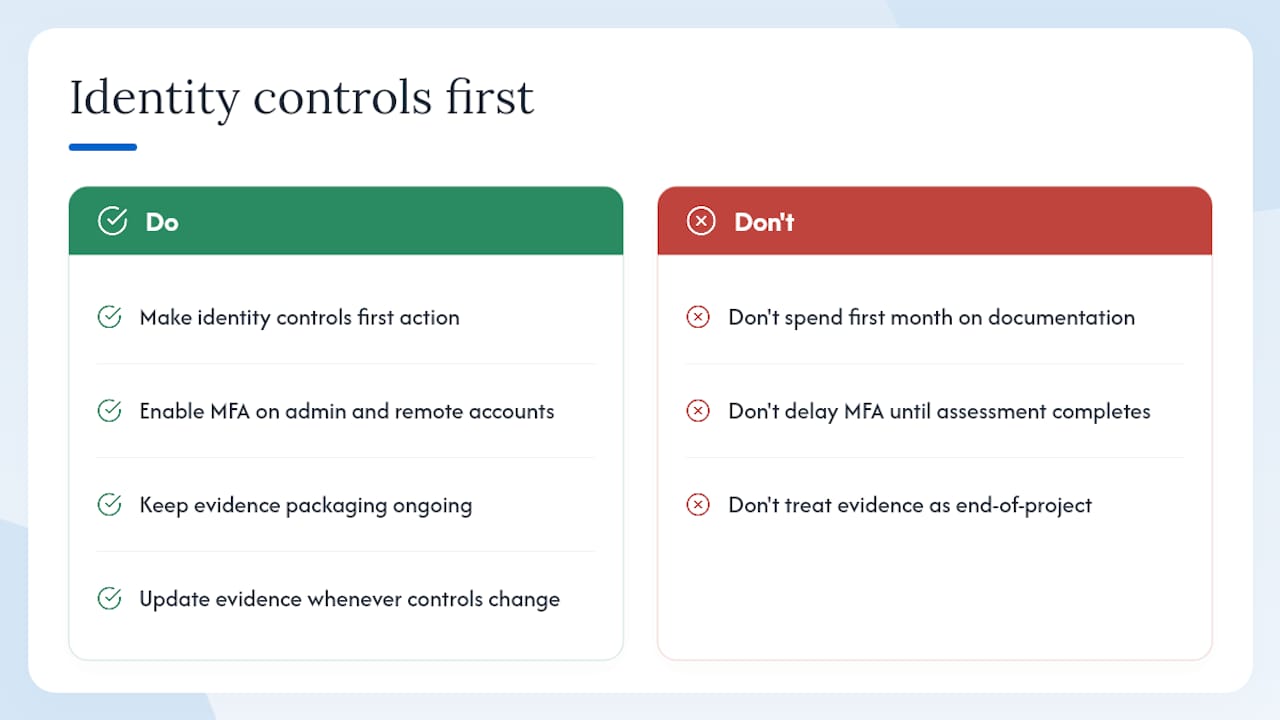
The conventional wisdom in small-firm cybersecurity is to start with the risk assessment and work through the checklist in order. That is a reasonable framework, but it can lead firms to spend the first 30 days on documentation while leaving the highest-probability attack vectors open.
The evidence from FINRA exam findings and incident data consistently points to the same root causes: compromised credentials, missing MFA on remote access, and undetected account takeovers. These are identity failures, not technology failures. A firm can have a beautifully written WSP and a fully documented risk assessment while a broker's email account is being used to redirect wire transfers.
The practical implication is that identity controls should be the first technical action, not the third or fourth. Enable MFA on every admin and remote-access account before the gap assessment is even complete. The documentation can follow. The risk of waiting for a perfect process is real: the average time between credential compromise and detection is measured in days, not hours, and the financial sector is a high-value target precisely because the payoff from a successful BEC or account-takeover attack is immediate.
The second underappreciated point is evidence packaging. Most firms treat evidence collection as an end-of-project task, something to assemble before an exam. That approach produces gaps, because screenshots taken months after a control was implemented often cannot prove the control was active at the relevant time. Treating evidence packaging as an ongoing deliverable, updated every time a control is configured or changed, produces a far more defensible record and reduces the scramble before an exam.
Securetechie helps small FINRA firms go from checklist to audit-ready
Small FINRA-registered firms that need to implement the cybersecurity checklist without a dedicated internal security team have a concrete alternative: outsource the implementation to a managed IT and cybersecurity provider that already knows the checklist, the evidence standards, and the exam expectations.
Securetechie delivers managed cybersecurity services purpose-built for small to mid-size businesses, including FINRA-registered broker-dealers. The engagement covers every major checklist requirement: MFA deployment and identity management, EDR/MDR monitoring with 24/7 alerting, encrypted backup and restore testing, WSP drafting and policy updates, tabletop exercise facilitation, and compliance audit services that produce the gap reports and evidence bundles examiners expect.
Clients receive a structured deliverable set at each phase: a written gap assessment report, a prioritized remediation plan with owners and dates, a complete evidence bundle organized by checklist section, and a monthly compliance dashboard. The result is a program that is both functional and documentable, which is the combination that holds up during a FINRA exam.
To request a gap assessment for your firm, contact Securetechie directly at Securetechie. The assessment scopes your current controls against the checklist's 12 sections and delivers a written report within two weeks.
Authoritative sources to download and reference
These are the primary and complementary resources your firm should download, cite in your WSPs, and save in your evidence bundle. Primary sources carry direct regulatory weight; complementary sources support risk-based prioritization and control selection.
Primary sources (FINRA and SEC)
- FINRA Small Firm Cybersecurity Checklist (web page): The official checklist landing page with context, scope, and download links. Bookmark this page and check it periodically for updates.
- FINRA Small Firm Cybersecurity Checklist (XLSX download): The working file for gap assessments. Save the downloaded file with a date stamp in your evidence bundle.
- FINRA Cybersecurity Topic Page: Aggregates FINRA's rules, guidance, reports, and advisories on cybersecurity. Use this page to track regulatory developments between exam cycles.
- Core Cybersecurity Threats and Effective Controls for Small Firms (PDF): FINRA's most detailed small-firm control guidance. Examiners reference this document; your WSPs should reflect its recommendations.
- FINRA Cybersecurity Advisory: Effective Practices for Responding to a Cyber Incident: Covers incident response, voluntary reporting, and intelligence sharing. Attach a copy to your IRP as a reference document.
- FINRA Rule 4370 (Business Continuity Plans): The rule text governing BCP requirements. Your BCP should cite this rule directly.
- SEC Regulation S-P: Available at sec.gov; governs safeguarding of customer records and information. Your data protection policy should reference the applicable provisions.
- SEC Regulation S-ID (Identity Theft Red Flags): Available at sec.gov; governs identity theft prevention programs for covered accounts. Relevant for firms that open or maintain customer accounts.
Sources
- Finra
- Nist
- Small Firm Cybersecurity Checklist
- Cybersecurity Advisory – FINRA highlights effective practices for responding to a cyber incident
Save the exact downloaded files (with date stamps) referenced in your gap assessment into the firm's evidence bundle. An examiner who asks for the source of a control decision should be able to trace it directly to one of these documents.
This article is general information, not a substitute for advice from a qualified financial advisor. Consult a qualified financial professional about your own circumstances before acting on anything here.