
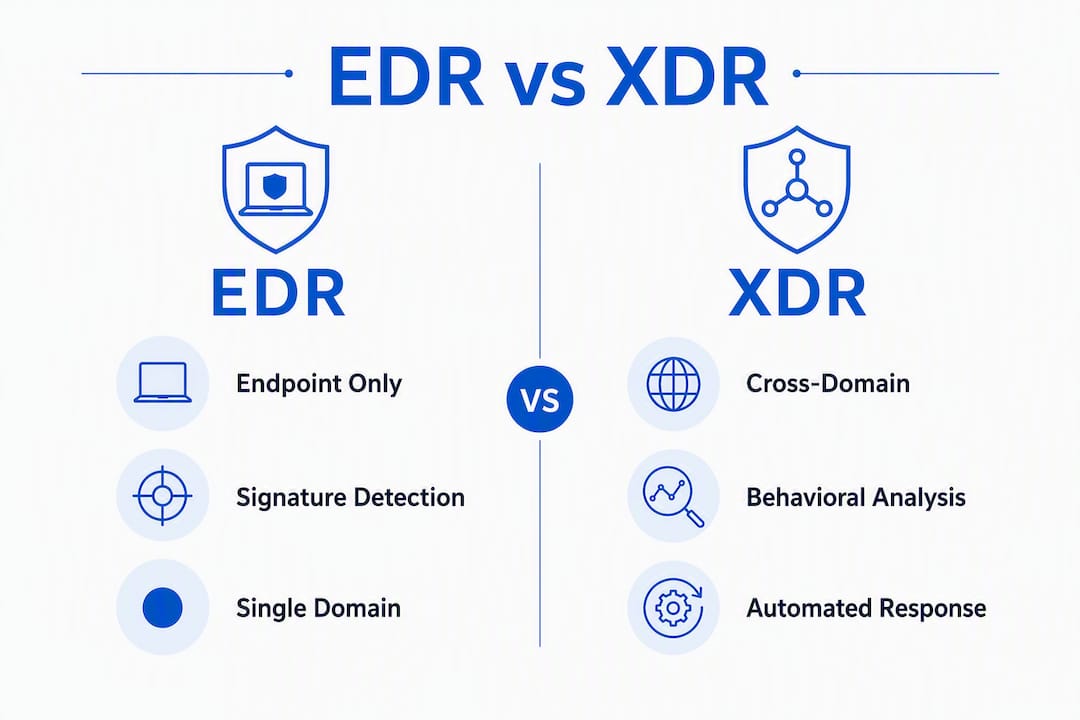
EDR gives deep, endpoint-level detection and forensic capability; XDR extends that detection across endpoints, identity, email, network, and cloud to correlate multi-vector attacks into unified incidents. According to Microsoft Security, neither approach is inherently superior — the right choice depends on your environment's complexity, security maturity, and threat exposure.
Start with EDR if:
- Your estate is primarily endpoint-centric with limited cloud or SaaS footprint
- Your security team is small or still building detection and response workflows
- Budget is constrained and you need focused, high-value coverage first
- Compliance requirements center on endpoint logging and device control
Move to XDR when:
- Telemetry spans identity providers, email gateways, firewalls, and cloud workloads
- Your analysts spend too much time pivoting across disconnected alert consoles
- You need cross-domain automated response (account suspend, email quarantine, network isolation)
- Compliance pressure from HIPAA, CMMC, or SOC 2 demands broader visibility
If you are still undecided, run the decision checklist in the "How to decide" section below before committing to a platform.
Table of Contents
- What does EDR actually do at the endpoint level?
- What is XDR and how does cross-domain correlation work?
- How do EDR and XDR compare across the dimensions that matter?
- What are the real pros, cons, and misconceptions for each?
- How do you decide between EDR and XDR for your organization?
- How do EDR and XDR fit alongside MDR, NDR, and SIEM?
- What does a successful EDR or XDR deployment actually require?
- How Securetechie approaches managed EDR and XDR
- Key Takeaways
- The gap between what XDR promises and what actually gets deployed
- Securetechie's managed cybersecurity services for EDR and XDR
- Useful sources and further reading
What does EDR actually do at the endpoint level?
Endpoint Detection and Response (EDR) is a security platform that continuously monitors endpoint devices — workstations, servers, laptops, and mobile endpoints — collecting telemetry to detect, investigate, and contain threats that traditional antivirus misses. The term was coined by Gartner analyst Anton Chuvakin in 2013, and the category has matured significantly since.
Core telemetry sources
EDR agents collect four primary data streams from each endpoint:
- Process execution: every process spawned, its parent, command-line arguments, and hash
- File system activity: file creation, modification, deletion, and execution events
- Endpoint network traffic: DNS queries, outbound connections, and lateral movement indicators
- System logs: registry changes, service installations, scheduled tasks, and authentication events
Detection methods
EDR platforms combine signature-based detection for known malware with behavioral baselines and machine learning to catch novel threats. When a process behaves abnormally — spawning unexpected child processes, accessing LSASS memory, or making unusual outbound connections — the EDR flags it regardless of whether a signature exists. Forensic capabilities like process trees and attack timelines let analysts reconstruct exactly what happened on a compromised host, which is where EDR genuinely outperforms anything else in the stack.
How the agent architecture works
Most EDR deployments run a lightweight agent on each endpoint that streams telemetry to a cloud console or on-premises management server. The agent handles real-time containment actions locally: isolating the host from the network, killing a malicious process, or rolling back file changes. The cloud console handles correlation, threat intelligence enrichment, and case management. This split keeps response latency low even when network connectivity is degraded.
Pro Tip: On mixed estates with legacy Windows systems, older macOS versions, or Linux servers, verify agent compatibility before deployment. Running a traditional AV solution alongside EDR for commodity malware filtering is a practical way to reduce EDR alert volume — antivirus handles high-volume, known threats cheaply while EDR focuses on behavioral detection and investigation. Learn more about how these two layers fit together in Securetechie's EDR vs antivirus breakdown.
What is XDR and how does cross-domain correlation work?
XDR, or Extended Detection and Response, broadens detection by ingesting telemetry from multiple security domains simultaneously. Where EDR watches endpoints, XDR aggregates data across endpoints, cloud workloads, identity and access management, email security, and network infrastructure to detect attacks that span more than one layer.

What "extended" means in practice
A phishing email that delivers a credential-harvesting payload touches at least three domains: email (delivery), identity (credential use), and endpoint (payload execution). An EDR sees only the endpoint portion. XDR sees all three, correlates the timeline, and surfaces a single incident rather than three separate alerts in three separate consoles.
Typical XDR telemetry sources include:
- Endpoints: process, file, and network events (same as EDR)
- Identity: Azure AD / Entra ID sign-in logs, MFA challenges, privilege escalation events
- Email: message headers, attachment analysis, URL detonation results
- Network: firewall logs, DNS, proxy, and east-west traffic metadata
- Cloud/SaaS: API activity logs from AWS, Azure, Microsoft 365, and Google Workspace
Native XDR vs open XDR
Native XDR platforms (typically from a single vendor) offer tight integration and pre-built detections but lock you into that vendor's ecosystem. Open XDR platforms use vendor-neutral connectors and APIs to normalize telemetry from existing tools, letting organizations keep their current EDR, firewall, and email security investments while gaining centralized detection and response. The trade-off: open XDR requires more integration work upfront.
Pre-correlation: the core operational benefit
XDR's defining value is pre-correlation — it stitches related signals from different domains into a single incident so analysts spend their time on validated, contextualized threats instead of chasing dozens of disconnected alerts across separate consoles.
SentinelOne describes this as XDR collecting and correlating data from multiple security layers and surfacing unified incidents rather than isolated alerts. The practical result is a measurable reduction in mean time to detect (MTTD) and mean time to respond (MTTR) when telemetry is comprehensive and well-configured.
Automated cross-domain response
XDR platforms can execute orchestrated responses across domains simultaneously: suspend a compromised account in the identity provider, quarantine the phishing email for all recipients, and isolate the affected endpoint — all from a single playbook trigger. The limits of this automation matter: playbooks require tuning, and poorly configured responses can disrupt legitimate users. Automation is a force multiplier, not a replacement for analyst judgment.
Architecture note: a useful diagram for this section would show telemetry sources (endpoint, identity, email, network, cloud) flowing into a normalization layer, then into a correlation engine, then into an incident console, with automated playbooks branching off the console.
How do EDR and XDR compare across the dimensions that matter?
The practical differences between EDR and XDR show up most clearly when you map them to the operational dimensions IT buyers actually evaluate during procurement.

| Dimension | EDR | XDR |
|---|---|---|
| Coverage | Endpoints only (workstations, servers, mobile) | Endpoints, identity, email, network, cloud/SaaS |
| Detection correlation | Per-endpoint alert correlation | Cross-domain pre-correlation into unified incidents |
| Response automation | Endpoint containment (isolate, kill process, rollback) | Cross-domain orchestration (account suspend, email quarantine, network isolation) |
| Operational load | Moderate; focused alert triage on endpoint events | Lower analyst pivots; higher integration setup cost |
| Deployment model | Agent-based; cloud console or on-prem management | Cloud-native or hybrid; requires telemetry integrations |
| Compliance and retention | Endpoint log retention; limited cross-domain audit trail | Broader telemetry retention; still typically requires SIEM for long-term compliance |
| Cost / TCO | Lower entry cost; scales with endpoint count | Higher licensing and integration cost; ROI depends on telemetry maturity |
What this looks like during a real incident
Consider a phishing-to-lateral-movement attack:
Under EDR: The platform detects the malicious payload executing on the initial endpoint, raises an alert, and can isolate that host. The analyst must then manually check the email gateway logs, query the identity provider for suspicious sign-ins, and search firewall logs for lateral movement — all in separate tools. The investigation takes hours.
Under XDR: The platform correlates the email delivery event, the credential use from an unusual location, and the endpoint execution into a single incident with a full attack timeline. The analyst sees the complete picture immediately. An automated playbook suspends the compromised account and quarantines the email across the organization before the analyst even opens the case.
The difference is not just speed. It is the analyst's ability to see the full attack chain without manually stitching together data from four different consoles.
What are the real pros, cons, and misconceptions for each?
EDR strengths
- Deep endpoint forensics: process trees, memory analysis, and attack timelines that no other platform matches
- Lower integration complexity; faster time to value on endpoint-centric estates
- Strong fit for organizations with limited cloud footprint or early-stage security programs
- Granular containment actions at the device level
EDR limitations
- Blind to attacks that never touch an endpoint (identity-only compromise, email-only phishing campaigns)
- No native correlation across identity, email, or network telemetry
- Alert volume can be high without proper tuning or an AV layer handling commodity threats
XDR strengths
- Unified incident view across multiple attack surfaces reduces analyst fatigue
- Pre-built detection models for cross-domain attack patterns (phishing chains, credential stuffing, cloud misconfigurations)
- Automated cross-domain response compresses MTTR significantly when playbooks are tuned
- Lower analyst pivot overhead once integrations are stable
XDR limitations
- Requires well-configured telemetry from firewalls, email gateways, and identity systems — without it, the correlation engine lacks context and underdelivers
- Higher upfront integration cost and ongoing maintenance burden
- Many SMBs fail to get value from XDR when integrations are immature or telemetry is incomplete
Common misconceptions
XDR is not a replacement for SIEM, and EDR is not made obsolete by XDR. These are complementary layers, not substitutes. Treating them as interchangeable is the most common procurement mistake in mid-market security programs.
Myth 1: XDR replaces SIEM. SIEM specializes in long-term log management and rule-based correlation; XDR optimizes real-time detection and response but typically lacks SIEM-grade retention and audit tooling. Regulated organizations in the US almost always need both.
Myth 2: EDR makes antivirus obsolete. AV handles commodity malware at high volume and low cost. Running both layers is standard practice for reducing EDR noise.
Myth 3: XDR is plug-and-play. Real-world ROI from XDR requires playbook tuning, threat-hunting, and supervised ML model refinement in most deployments. Out-of-the-box detection models are a starting point, not a finished product.
Myth 4: XDR is only for large enterprises. XDR can benefit mid-market organizations, but only when the underlying telemetry sources are mature. A 200-person company with a well-configured Microsoft 365 environment, a next-gen firewall, and an identity provider can get genuine value from XDR.
How do you decide between EDR and XDR for your organization?
The decision comes down to where your threats live and whether your team can operationalize cross-domain data. Start with EDR for endpoint-centric, less-distributed environments. Adopt XDR when cloud, email, and identity signals are critical and your team can act on cross-domain incidents.
Decision checklist
Work through these six questions before committing to a platform:
- Security maturity: Does your team have documented detection and response workflows, or are you still building them? EDR is the right foundation.
- Cloud and SaaS footprint: Are your users primarily in Microsoft 365, Google Workspace, or AWS? XDR's identity and email telemetry becomes high-value.
- Endpoint count: Under 500 endpoints with no cloud workloads? EDR covers the estate cleanly. Over 500 with hybrid infrastructure? XDR's correlation pays off.
- Compliance requirements: HIPAA, CMMC, or SEC rules? You likely need SIEM alongside whichever detection platform you choose.
- SOC staffing: No dedicated SOC? Consider a managed detection and response (MDR) service layered on top of EDR or XDR rather than running either platform in-house.
- Budget and TCO tolerance: EDR has a lower entry cost. XDR's TCO includes integration labor, telemetry storage, and ongoing playbook maintenance.
Questions to ask vendors
- What telemetry sources are required for the correlation engine to function at baseline?
- What are the default retention limits, and what does extended retention cost?
- Which identity providers, email gateways, and firewalls have native integrations vs API connectors?
- What automated response playbooks ship out of the box, and how are they customized?
Quick-decision flow
- Assess maturity: map your current detection and response capability against the checklist above.
- Map telemetry sources: list every data source you can realistically connect within 90 days.
- Run a proof of concept: deploy EDR first if you have no existing coverage; add XDR integrations incrementally.
- Choose managed or in-house: if SOC staffing is limited, a managed service accelerates time-to-value significantly.
Pro Tip: Before signing any XDR contract, ask the vendor for a telemetry readiness assessment. Many organizations discover mid-deployment that their firewall or email gateway does not produce the log format the XDR platform expects. Catching this in a POC saves months of remediation work.
How do EDR and XDR fit alongside MDR, NDR, and SIEM?
These four platform types are frequently confused because they overlap in function, but each has a distinct operational job.
| Platform | Primary job | Data focus | Retention strength | Compliance fit |
|---|---|---|---|---|
| EDR | Endpoint detection and response | Endpoint telemetry | Short to medium term | Device-level audit trails |
| XDR | Cross-domain detection and response | Multi-layer telemetry | Medium term | Broader but not audit-grade |
| NDR | Network traffic analysis and detection | Network metadata and flows | Medium term | Network forensics |
| SIEM | Log aggregation, long-term retention, compliance reporting | All log sources | Long-term (years) | Primary compliance system of record |
| MDR | Managed detection and response service | Depends on underlying platform | Depends on provider | Varies by contract |
Common operational pairings
- XDR + SIEM: the standard pattern for regulated US organizations. XDR handles frontline detection and fast response; SIEM handles long-term retention, audit reporting, and exhaustive log search. HIPAA, SEC, and CMMC requirements typically mandate log retention periods that XDR alone does not cover.
- EDR + MDR: the right fit for organizations without dedicated SOC staffing. An MDR provider monitors EDR alerts 24/7, handles triage, and escalates confirmed incidents. This combination delivers enterprise-grade response capability without the headcount.
- XDR + MDR: for organizations that want cross-domain detection but lack the internal expertise to tune integrations and playbooks. Operational ROI from XDR usually requires managed services or SOC support to realize faster time-to-value.
Do you need EDR if you already have XDR?
Most XDR platforms include EDR as a foundational component — the endpoint agent is the most critical telemetry source in any XDR deployment. If your XDR vendor provides a native EDR agent, you do not need a separate EDR product. If you are using open XDR with an existing third-party EDR, keep it: the endpoint telemetry quality from a mature EDR agent typically exceeds what a generic XDR connector produces.
For a deeper look at how network security telemetry feeds into XDR correlation, Securetechie's network security service page covers the firewall and wireless infrastructure that generates the network layer data XDR depends on.
What does a successful EDR or XDR deployment actually require?
Getting a platform deployed is straightforward. Getting it to produce reliable detections is the harder problem, and it starts with telemetry quality.
Deployment prerequisites
- Agent coverage: 100% of managed endpoints must have the EDR agent installed and reporting. Gaps in coverage create blind spots that attackers reliably exploit.
- Identity provider integration: for XDR, connecting Azure AD / Entra ID or Okta is typically the highest-value integration after endpoints.
- Email gateway logs: Microsoft 365 Defender or a third-party secure email gateway must be configured to export message trace and threat detection logs.
- Firewall telemetry: next-gen firewall logs in a normalized format (CEF or syslog with consistent field mapping) are required for network-layer correlation.
Telemetry hygiene
Clock synchronization across all log sources is non-negotiable. A five-minute clock drift between an endpoint event and an identity log breaks correlation and produces false negatives. Log completeness matters equally: if your email gateway only exports summary events rather than full message headers, the XDR correlation engine cannot reconstruct the delivery chain. Common integration pitfalls include inconsistent field naming across vendors, missing source IP fields in cloud logs, and firewall rules that block the telemetry export traffic itself.
Measuring success: key operational metrics
Track these KPIs from day one to establish a baseline and demonstrate improvement:
- MTTD (mean time to detect): how long from initial compromise to first alert
- MTTR (mean time to respond): how long from alert to containment
- False-positive rate: percentage of alerts that require no action after triage
- Analyst time per incident: hours spent per confirmed incident from detection to closure
- Incident volume trend: total alerts per week, tracked over time to measure tuning effectiveness
Reducing false-positive rate is often more impactful than reducing MTTD. An analyst team drowning in low-quality alerts will miss real incidents regardless of how fast the platform detects them.
Compliance considerations
Most regulated US organizations keep SIEM for long-term retention and audit evidence even after deploying XDR. HIPAA requires audit log retention for a minimum of six years. CMMC Level 2 and above mandates specific log categories and retention windows that XDR platforms do not natively provide. SEC cybersecurity disclosure rules add another layer of evidence requirements for public companies. The operational pattern that works: feed XDR for detection and automated response, feed SIEM for archival, compliance reporting, and legal hold. Securetechie's compliance and security audit services cover HIPAA, SOC 2, CMMC, and SEC requirements for organizations navigating this dual-platform model.
| Compliance framework | EDR sufficient? | XDR adds value? | SIEM required? |
|---|---|---|---|
| HIPAA | Partial (endpoint logs only) | Yes (broader audit trail) | Yes (6-year retention) |
| CMMC Level 2+ | Partial | Yes | Yes (specific log categories) |
| SOC 2 Type II | Partial | Yes | Recommended |
| SEC cybersecurity rules | No | Yes | Yes (disclosure evidence) |
How Securetechie approaches managed EDR and XDR
Securetechie's recommended approach for most small to mid-size businesses in Southern California is to establish a solid EDR baseline first, then layer XDR correlation where telemetry maturity and organizational complexity justify it. For clients under HIPAA, CMMC, or SOC 2 obligations, SIEM is added as the compliance system of record.
What the managed service covers
Securetechie handles the full deployment and ongoing management lifecycle:
- Agent onboarding and endpoint coverage verification across the entire managed estate
- Telemetry integration configuration for identity providers, email gateways, and firewalls
- Detection playbook tuning and false-positive reduction over the first 90 days
- 24/7 monitoring with escalation to the client's IT team for confirmed incidents
- Quarterly detection review and threat-hunting sessions to surface gaps in coverage
Compliance and trust signals
Securetechie's managed cybersecurity practice covers HIPAA, SOC 2, CMMC, and GDPR compliance requirements. For regulated clients, the team configures the telemetry pipeline to feed both the XDR platform and a SIEM for long-term retention, ensuring audit evidence is available when regulators or auditors ask for it.
Choosing between EDR and XDR is rarely a one-time decision. As your environment grows — more cloud workloads, more SaaS applications, more remote users — the telemetry picture changes. The organizations that get the most value from these platforms are the ones that treat detection and response as an ongoing program, not a one-time deployment.
Pro Tip: If you are evaluating managed EDR or XDR for the first time, ask your provider to show you a sample incident timeline from a real (anonymized) case. The quality of that timeline tells you more about the platform and the team's operational maturity than any feature comparison sheet.
Key Takeaways
EDR is the right foundation for endpoint-centric environments; XDR adds cross-domain correlation and automated response when your telemetry spans identity, email, network, and cloud.
| Point | Details |
|---|---|
| EDR vs XDR scope | EDR covers endpoints only; XDR correlates across endpoints, identity, email, network, and cloud. |
| When to choose XDR | Adopt XDR when your telemetry spans multiple domains and your team can operationalize cross-domain incidents. |
| SIEM remains necessary | Regulated US organizations (HIPAA, CMMC, SOC 2) still need SIEM for long-term log retention and audit evidence alongside XDR. |
| Telemetry quality determines ROI | XDR underdelivers when integrations are immature; verify telemetry readiness before deployment. |
| Securetechie managed approach | Securetechie deploys EDR as the baseline, layers XDR where telemetry supports it, and adds SIEM for compliance-driven clients. |
The gap between what XDR promises and what actually gets deployed
The XDR category has a marketing problem. Vendors present it as a unified platform that automatically correlates every threat across every layer — and technically, that is accurate. What the marketing rarely emphasizes is that the correlation engine is only as good as the telemetry feeding it. A poorly configured email gateway, an identity provider with incomplete log exports, or a firewall that drops half its syslog traffic produces an XDR deployment that looks impressive in a demo and underperforms in production.
The organizations that get genuine value from XDR share one characteristic: they treated telemetry readiness as a prerequisite, not an afterthought. They audited their log sources before signing the contract, fixed normalization gaps during the POC, and built playbook tuning into the first 90 days of operation.
The other pattern worth noting: many mid-market IT teams adopt XDR expecting it to reduce analyst workload immediately, then find that the first few months actually increase it — because the platform surfaces incidents that were previously invisible. That is not a failure. It is the platform working correctly. The workload normalizes as playbooks mature and false-positive rates drop. Teams that understand this going in stay the course; teams that do not often abandon the platform before it delivers.
For organizations without the internal capacity to manage that ramp-up period, a managed service is not a compromise. It is the faster path to operational value.
Securetechie's managed cybersecurity services for EDR and XDR
For small to mid-size businesses in Southern California, Securetechie delivers the managed detection and response capability that most organizations cannot build in-house at a comparable cost. Rather than handing you a platform license and a deployment guide, Securetechie configures, monitors, and tunes the entire detection stack on your behalf — from initial agent rollout through ongoing playbook refinement and 24/7 alert monitoring.
A typical engagement starts with a security posture assessment that maps your current telemetry sources, identifies coverage gaps, and produces a prioritized deployment plan. From there, Securetechie handles agent onboarding, integration configuration, and the first 90-day tuning cycle. Clients under HIPAA, CMMC, or SOC 2 obligations get the dual-platform configuration (XDR for detection, SIEM for compliance) from day one.
If your organization is evaluating EDR, XDR, or a managed detection and response program, the right next step is a direct conversation with the Securetechie team. Visit the managed cybersecurity services page to request a security assessment or schedule a consultation.
Useful sources and further reading
The following sources informed this article and provide authoritative technical detail for teams conducting deeper research:
- Anton Chuvakin's original "Endpoint Threat Detection & Response" post, Gartner Blog — the original naming and framing of the EDR category
- EDR vs XDR: What Is the Difference? — Microsoft Security — vendor technical definitions and maturity-based guidance
- SIEM vs. XDR: Exploring the transition — Elastic — open XDR architecture and vendor-neutral integration patterns
- Cybersecurity Solutions — Securetechie — Securetechie's managed detection and response services for Southern California businesses