
The right move is to hire a managed IT provider whose service level agreements, security stack, and compliance experience match your industry, not the one with the flashiest sales deck. Vetted candidates like Secure Techies fit this model for small and mid-size businesses that need documented SLAs and compliance support. Your next step: write down your environment details and invite three qualified providers to respond to the same brief.
TL;DR:
- Vendors must be able to demonstrate security capabilities like endpoint detection, multi-factor authentication, and tested backup restores before signing a contract.
- A clear, detailed scoping brief covering user counts, locations, critical applications, compliance, and budget is essential for fair proposal comparison.
- SLAs should specify priorities, targets, reporting, and penalties, with flexible pricing and short contract terms to avoid long-term commitments.
- Proposal comparison requires standardized questions and scoring across dimensions like security, onboarding, references, and pricing transparency.
- A thorough onboarding process should include asset inventories, test restores, credential transfers, and a written offboarding plan to ensure a smooth transition.
Table of Contents
- Scope Your Environment Before You Talk to Any Vendor
- What Security and Compliance Standards Should a Provider Meet?
- What SLA and Contract Terms Actually Protect Your Business?
- How Do You Compare Proposals Without Getting Fooled by Price?
- What Should Onboarding Look Like When You Switch Providers?
- Spotting a Strategic Partner Instead of an Order-Taker
- How Secure Techies Supports Your Provider Search
- Sources
- FAQ
Scope Your Environment Before You Talk to Any Vendor
You cannot compare two proposals fairly if the vendors quoted two different jobs. That happens more often than it should, because most businesses call providers before they have written down what they actually need. Fix that first, and the entire selection process for choosing an IT provider gets faster and more honest.
Build a scoping brief that covers the following before you send a single email:
- User and device counts. The number of employees and the devices needing support, including laptops, desktops, phones, and servers.
- Office locations. Every physical site, plus any remote or hybrid workers who need coverage.
- Business-critical applications. The software your revenue depends on, whether that's a practice management system, a loan origination platform, or a custom database.
- SaaS vendors in use. Microsoft 365 or Google Workspace, plus any industry-specific cloud tools.
- Backup targets and current recovery process. What gets backed up, where, and how often it's tested.
- Compliance obligations. HIPAA, SOC 2, CMMC, GDPR, or SEC requirements tied to your industry.
- Required support hours. Business hours only, or 24/7 monitoring for critical systems.
- Budget range. Even a rough monthly figure keeps proposals grounded in reality.
Send that exact same document to every provider on your list. Identical inputs are the only way to get comparable outputs, and a proposal built on guesswork is a proposal you can't trust.
A rigorous selection process typically works best with 3 to 5 qualified providers in the running. Fewer than three leaves you no real baseline for comparison. More than five turns the process into a part-time job, and the quality of your evaluation drops as the pile of proposals grows.
What Security and Compliance Standards Should a Provider Meet?
Any provider can promise "enterprise-grade security" in a sales call. Far fewer can prove it with documentation, and that gap is where a lot of businesses get burned six months into a contract.
Require these capabilities in writing, not just verbally, before you sign anything:
- Endpoint detection and response (EDR) or managed detection and response (MDR), not legacy antivirus alone.
- Enforced multi-factor authentication across email, VPN, and administrative accounts, with no exceptions for convenience.
- Email security and anti-phishing filtering, since inbox compromise remains the most common entry point for attackers.
- Automated patching for operating systems and third-party applications, with a documented schedule.
- Backup with regularly tested restores, not just backup software that runs and gets ignored.
Pro Tip: Ask every candidate one question directly: "When did you last run a full test restore for a client, and what did it prove?" A provider that hesitates or gives a vague answer probably hasn't tested a restore recently, and that's the moment disaster recovery plans fail in real life.
Compliance experience needs the same scrutiny. A provider claiming HIPAA or SOC 2 familiarity should hand you a SOC 2 report summary, a case example from a similar client, or a NIST framework mapping, not a paragraph of reassurance. Filtering vendors by their security stack and documented compliance evidence separates providers who can operate in regulated industries from those who are learning on your dime.
Ask for architecture diagrams and penetration-test executive summaries as part of the proposal. Also ask who handles incident response and what that process looks like on paper, step by step, with named roles. If a provider can't name who does what during a breach, that's your answer about how prepared they actually are.
What SLA and Contract Terms Actually Protect Your Business?
A service level agreement is only useful if it defines terms precisely enough to enforce. Vague language like "prompt response" protects the provider, not you. Documented responsibilities and explicit SLA definitions are the foundation of any contract worth signing.
Require the SLA to spell out:
- Priority definitions. What counts as a critical outage versus a minor ticket, in specific terms both sides agree to.
- Response and resolution targets. Not just when they'll acknowledge the ticket, but when the issue gets fixed.
- Measurement and reporting cadence. Monthly or quarterly reports showing actual performance against the promised targets.
- Penalties or exit triggers. What happens, contractually, if they miss SLA targets repeatedly.
Pricing models vary by provider, and each has trade-offs. Per-user pricing scales predictably as you hire. Per-device pricing can punish businesses with a lot of shared or specialty hardware. Tiered pricing bundles services but can hide gaps in what's actually included. Ask directly what's excluded, because third-party software licenses, major infrastructure projects, and emergency onsite labor outside business hours are common carve outs that show up as surprise invoices later.
On contract terms, push back on anything longer than a one or two year initial term with automatic long renewals baked in. Insist on data portability language, a defined exit and knowledge-transfer process, and clear liability allocation if something goes wrong on their watch. A provider confident in their work won't flinch at reasonable exit terms.
How Do You Compare Proposals Without Getting Fooled by Price?
Every proposal will look reasonable on its own. Side by side, they rarely use the same assumptions, which is why price alone is a poor first filter. A structured interview and scoring approach fixes that.
Send the same written questions to every provider so answers are directly comparable:
- What is your client-to-technician ratio, and how does that change during a major incident?
- Which EDR or MDR platform do you run, and what does your monitoring approach look like day to day?
- How often do you test backup restores, and can you show a recent example?
- What does a typical onboarding timeline look like from signed contract to full cutover?
- Can you share a case study or reference from a client in our industry and size range?
- What is your escalation process when a ticket isn't resolved on time?
- Can you walk through a real pricing example based on our scoping brief?
Score each provider from 1 to 5 across six to eight dimensions: SLA terms, security stack, reference quality and industry fit, onboarding plan, pricing transparency, and communication style. Scoring providers on these specific dimensions turns a subjective gut call into something you can defend to a board or a business partner.
Before comparing totals, normalize every proposal into a simple matrix: what's included in the base price, and what's extra cost. Normalizing proposals this way before comparing dollar figures is the step most buyers skip, and it's exactly why two "similar" quotes can differ by thousands of dollars once the fine print gets translated into the same units. Treat price as the tiebreaker after fit, not the first filter.
What Should Onboarding Look Like When You Switch Providers?
Switching providers is where deals fall apart in practice, even when the contract looked great on paper. Onboarding is the highest-risk phase of any provider change, and a vague transition plan is a warning sign you should not ignore.
Demand these deliverables before cutover day:
- A complete asset inventory covering every device, license, and credential in your environment.
- Documented runbooks describing how systems are configured and maintained.
- A formal credentials transfer process, not informal password sharing over email.
- A test restore of your backups, proving data integrity before the old provider walks away.
- A named account manager you can reach directly, not a generic support queue.
- A written 30 and 60 day checklist showing what gets done and when.
Your contract with any new provider should also lock in offboarding rights for the future: data export timelines, full documentation handover, and a clear credential decommissioning procedure. A zero-downtime transition process is exactly the kind of promise worth asking any provider to put in writing, and it's a reasonable bar to hold every candidate to.
Spotting a Strategic Partner Instead of an Order-Taker
Most MSP pitches sound identical, but small businesses can scale operations efficiently with AI for Small Business, enabling strategic vendor advice and improved efficiency. The difference between an order-taker and a real partner shows up after the contract is signed, in how they handle the ordinary Tuesday afternoon requests.
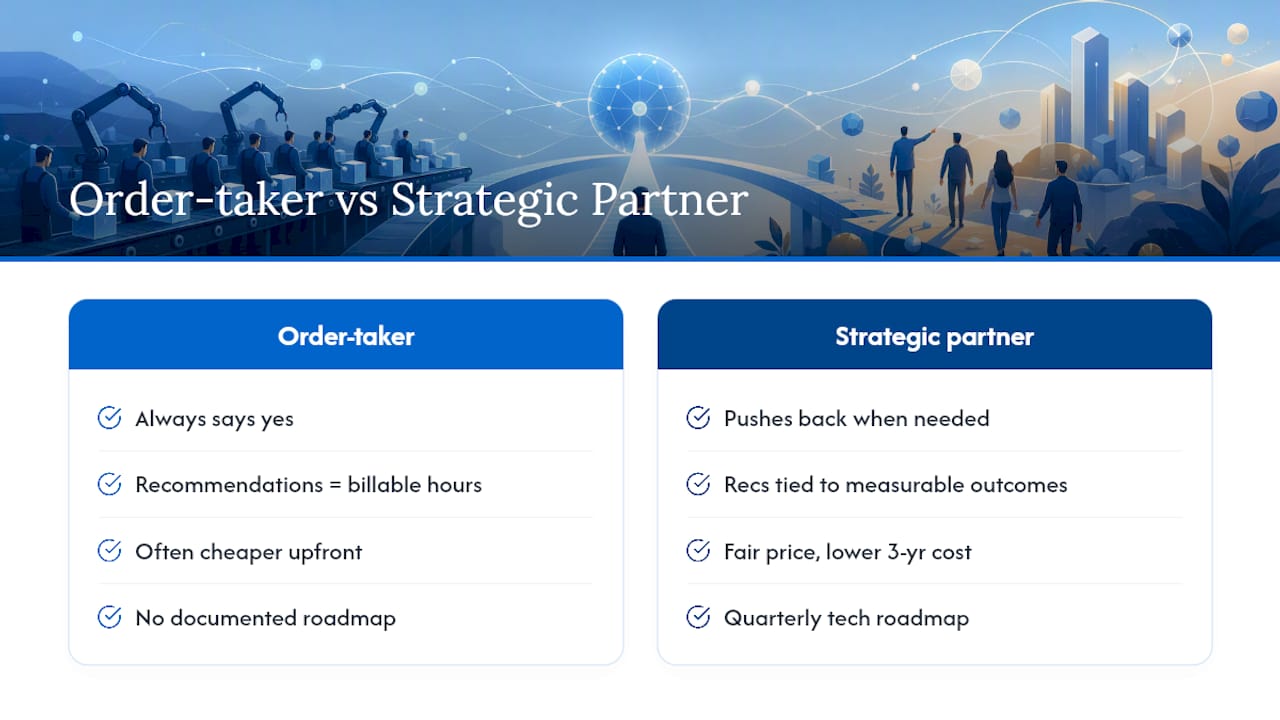
An order-taker says yes to everything you ask for. A strategic partner pushes back when a request doesn't serve your actual business goals, and ties their recommendations to measurable outcomes rather than billable hours. That distinction matters more than almost anything else in this process, because the cheapest quote from an order-taker often costs more over three years than a fairly priced partner who prevents problems before they start.
A provider that agrees to every request without offering alternatives is usually optimizing for renewal, not for your growth. Two signs separate the two types quickly: does the provider produce documented strategy work, like a quarterly technology roadmap tied to your business plans, and can they name a specific escalation path with an accountable leader, not just a ticket number?
— Alex
How Secure Techies Supports Your Provider Search
Secure Techies gives small and mid-size businesses in Southern California a managed IT partner built around the exact criteria this guide covers: documented SLAs, a real security stack, and compliance support for standards like HIPAA and SOC 2. The team backs its work with a 99.9% uptime guarantee and 24/7 monitoring, so response times aren't left to chance.
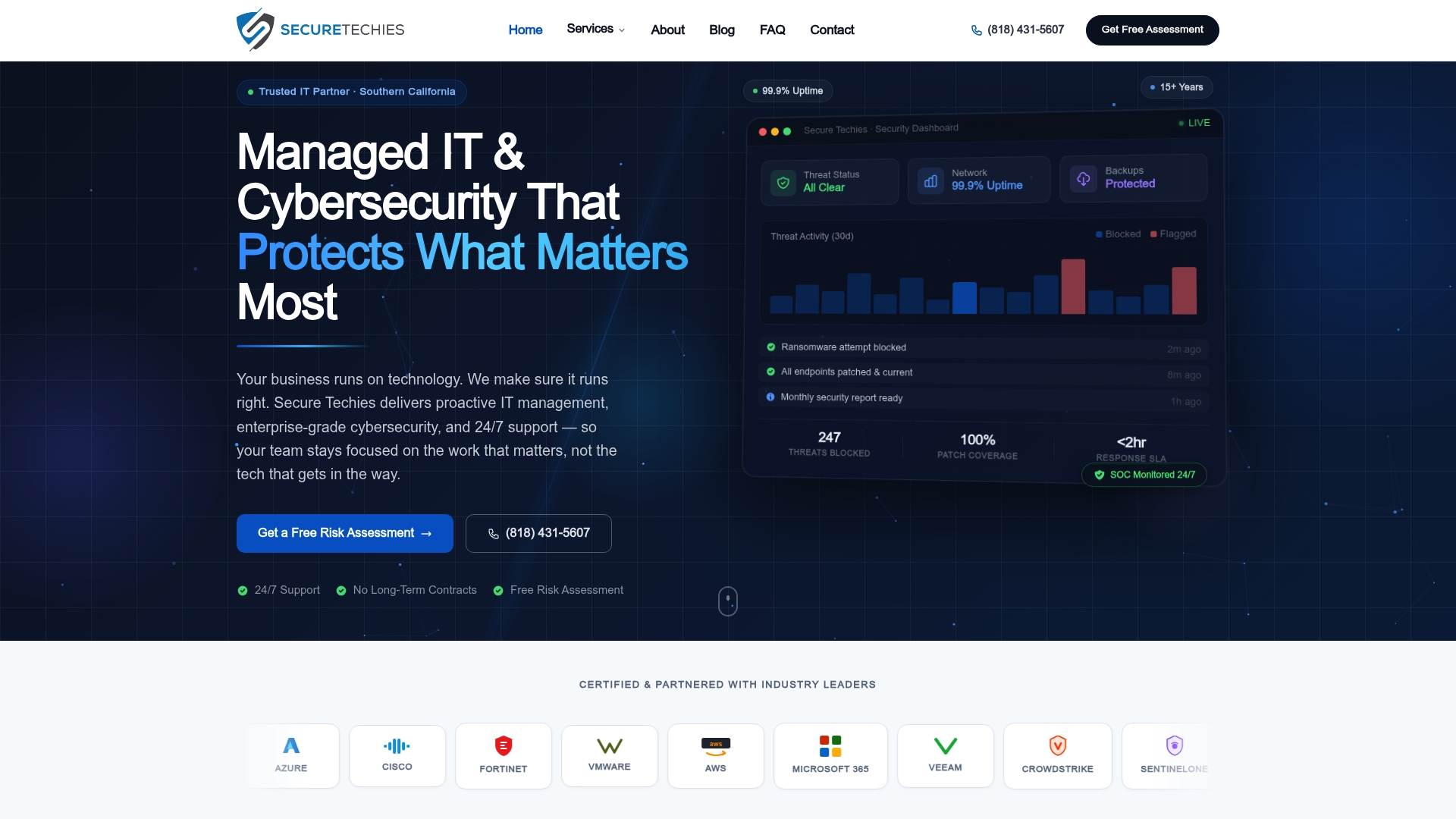
If you're comparing providers with the scorecard above, Secure Techies is worth including on that shortlist. Services span managed infrastructure, cybersecurity with endpoint detection and incident response, compliance audits, and a documented onboarding process designed to avoid the downtime that scares most businesses away from switching providers. Request a scoped consultation or have the team review your current RFP directly through the managed IT services page to see how your requirements line up.
Sources
- How to choose an MSP: A guide for SMBs | Acronis Resource Center
- My MSP Tech — provider comparison and matching service
- Choosing a managed service provider (MSP) | NCSC
- How to Evaluate an MSP in 2026: The Complete Business Owner's Guide | SerenIT
FAQ
What Is an IT Provider?
An IT provider, often called a managed service provider (MSP), is a company that manages a business's technology infrastructure, from network security and help desk support to backups and compliance, usually under a recurring service contract.
How Many IT Providers Should I Compare Before Deciding?
Evaluate three to five qualified providers using the same scoping brief. Fewer gives no real baseline, and more makes the comparison unmanageable.
What Are the Biggest Red Flags When Choosing an IT Provider?
Reluctance to share references from similarly sized clients in your industry is a major warning sign, along with vague SLA language and no documented onboarding or exit process.
How Long Should Onboarding Take With a New IT Provider?
A well-run transition typically follows a documented 30 to 60 day plan covering asset inventory, credential transfer, and a tested backup restore before full cutover, as outlined in structured MSP evaluation frameworks.
Does Secure Techies Work With Regulated Industries?
Secure Techies supports compliance needs including HIPAA and SOC 2 for healthcare organizations, financial firms, and other regulated businesses across Southern California, backed by documented security processes.